Japanese Teapot Types: Kyusu, Tokoname, Banko and the Complete Buying Guide
A kyusu (急須) is a Japanese teapot designed for small-batch brewing and multiple re-steeps — typically 100ml to 360ml, compared to the 1-liter Western teapot. The design reflects a fundamentally different approach to tea: concentrated, precise, and repeated. You brew a small amount, pour it all out immediately, and steep again. The kyusu facilitates this through its shape, its pour speed, and critically, the material of the clay itself — which isn't just a container but an active participant in what the tea tastes like.
- Tokoname (red shudei clay) and Banko (purple shidei clay) are the two premier Japanese clay traditions — each producing measurably different results in the cup due to distinct mineral compositions.
- Handle style determines pour control: yokode (side-handle) for precision green tea pours; ushirode (back-handle) for casual hojicha and genmaicha; uwade (top-handle) for boiling-water teas served to groups.
- Unglazed clay is chemically active — iron ions in the clay react with tea tannins, softening astringency and building a flavor-improving patina with every brew.
- Filter type must match your tea: use sasame or ceramesh for deep-steamed fukamushi sencha; do-ake or debeso for light-steamed whole-leaf styles.
- Never use soap on unglazed clay — the porous surface absorbs detergent compounds, which leach into every subsequent brew.
This guide covers every variable that matters: the mineral science behind Tokoname and Banko clays, how handle styles affect control and ergonomics, which filtration system to choose based on your tea type, and how to build a seasoned vessel that improves with every brew.
Last updated: April 2026
What Are the Two Regional Clay Traditions? Tokoname vs. Banko
Most high-quality Japanese clay kyusu come from one of two ceramic traditions: Tokoname-yaki (Aichi Prefecture) and Banko-yaki (Mie Prefecture). They use different clays, fire differently, and produce distinct effects on the tea.
Tokoname-yaki (常滑焼) — Aichi Prefecture
Tokoname-yaki, produced in Aichi Prefecture, is the largest of Japan's “Six Ancient Kilns” (六古窯, Rokkoryo) — a designation for the six historic ceramic-production regions active since the Heian and Kamakura periods, with a history spanning over 900 years. Its status as the premier region for teaware was cemented during the Edo period when the transition from powdered tea (matcha) to loose-leaf sencha demanded new, purpose-built tools.
The hallmark of Tokoname is shudei — red volcanic clay exceptionally rich in iron and trace minerals including zinc, copper, manganese, and chromium. The iron content is not merely aesthetic — it performs a vital chemical function. As the tea steeps, iron ions react with the tea's catechins (tannins), neutralizing excess astringency. This “softens” the water and rounds out the tea's profile, creating a mellower, smoother cup. According to Hara Y (2001, Green Tea: Health Benefits and Applications), caffeine content and chemical composition vary significantly by clay interaction and processing method — a key reason the vessel material matters as much as the leaf itself.
Tactilely, shudei is smooth and buttery. When the lid is tapped against the rim, it produces a high-pitched, metallic “clink” — a sign of high density and a well-fired body. This makes Tokoname kyusu the gold standard for daily sencha, where a precise balance between sweetness and a pleasant edge is the goal. Tokoname pots can be fired in oxidation (bright red, accentuates floral and nutty notes) or reduction (black, more neutral across all green tea types).
The history of Tokoname is inseparable from the Yamada family. Yamada Jozan III (1924–2006) was designated a Living National Treasure for his mastery of the kyusu — his work emphasized the purity of the clay and the technical perfection of the fitted lid. To understand Tokoname is to respect this lineage, where the potter serves as a kyusu-shokunin (teapot craftsman), a title that carries more weight than a general ceramicist.
Best for: Daily sencha drinkers who want a versatile, smooth-brewing teapot with a proven 900-year pedigree that actively improves with regular use.
Banko-yaki (萬古焼) — Mie Prefecture
Banko-yaki hails from Yokkaichi in Mie Prefecture. While Tokoname is known for versatility, Banko is the specialist's choice — defined by extreme durability and a unique mineral composition influenced by its proximity to the Japan Median Tectonic Line.
The signature material is shidei — a purple or violet clay with a naturally crystallized iron structure, as opposed to mass-produced pots where iron is ground and added artificially. This allows the pots to be fired at temperatures reaching 1200°C — far higher than the 600–800°C limit of artificial mixtures. The high-heat firing further activates the iron content and increases the density of the vessel.
Banko kyusu are the premier choice for high-umami, low-temperature teas like gyokuro and kabusecha. The specific mineral recipe — rich in iron and manganese — absorbs the bitter components of the tea more aggressively than porcelain, leaving only the savory, “broth-like” umami on the palate. According to Ashihara H (2015, Natural Product Communications), shade-grown teas like gyokuro contain 2–3× more theanine than unshaded sencha — making Banko's umami-enhancing mineral action especially well-matched to these varieties. The master potters of Banko-yaki work primarily through family-run kilns, with wood-fired production remaining the benchmark for high-end pieces.
Best for: Gyokuro and shade-grown tea enthusiasts seeking maximum umami extraction and a durable vessel that handles high firing temperatures.
Banko vs. Tokoname: Direct Comparison
| Feature | Tokoname Yaki | Banko Yaki |
|---|---|---|
| Origin Region | Tokoname, Aichi Prefecture | Yokkaichi, Mie Prefecture |
| Clay Type / Color | Red clay (shudei) | Purple/violet clay (shidei) |
| Primary Mineral Action | Iron neutralizes tannins → smoother, balanced cup | Iron + manganese absorbs bitterness → enhanced umami |
| Firing Temperature | 1000–1100°C | Up to 1200°C |
| Firing Type | Oxidation (red) or reduction (black) | Typically reduction firing |
| Best Tea Pairing | Versatile sencha, asamushi (light-steamed) | Gyokuro, kabusecha, shaded teas |
| Sensory Result | Smooth, balanced, bright profile | Savory umami, dense mouthfeel |
| Porosity | Low-medium (good seasoning potential) | Slightly more porous (faster seasoning) |
| Historical Master | Yamada Jozan III (Living National Treasure) | Hiroshi Suigetsu (Suigetsu Toen kiln) |
Which Kyusu Handle Style Should You Choose?
The handle orientation directly determines the ergonomics of your pour, the level of wrist control at different angles, and which teas the pot suits best — it is not a decorative choice.
Yokode (横手) — Side-Handle
The side handle, positioned at a 90-degree angle from the spout, is the most functional design for Japanese green tea — it puts the center of gravity closest to the hand and enables one-handed operation. This orientation facilitates what experienced brewers call the “twist of the wrist” pour — significantly less arm movement than back-handled designs, and critical for executing the final pour with precision. For those who prefer a modern Kyusu design, the principles of balance and control remain central, even in contemporary materials and shapes.
This orientation facilitates what experienced brewers call the “twist of the wrist” pour — significantly less arm movement than back-handled designs, and critical for executing the final “golden drop” (saigo no isshoku). This last bit of liquid contains the most concentrated flavor and oils; the yokode design lets you flick the wrist to extract every last drop with precision. Leaving water in the pot causes the leaves to stew in residual heat, creating bitterness in subsequent steeps. The yokode eliminates that problem.
Best for: Everyday sencha, asamushi, and fukamushi brewing; optimal pour control for solo or 2–3 person sessions.
Ushirode (後手) — Back-Handle
The back handle is positioned directly opposite the spout, mirroring Western teapot ergonomics — making it the most intuitive choice for anyone accustomed to European-style teaware.
These pots are often larger (300–500 ml) and are preferred for teas where precise pour control matters less — hojicha, genmaicha, or bancha. They also suit anyone transitioning from Western teaware who finds side-handle pots initially awkward.
Best for: Casual daily brewing of hojicha, genmaicha, and bancha; beginners transitioning from Western teaware.
Uwade (上手) — Top-Handle
The arched top handle, often made of rattan or bamboo, rises above the body and stays cool even when the clay body is scalding — making it the safest and most practical design for boiling-water teas.
Because heat rises away from the handle material, these are the preferred vessels for teas brewed with boiling water — hojicha, roasted bancha, and kukicha. The handle stays cool even when the body is scalding, making it practical for serving larger groups. In larger formats, these are called dobin — large-format uwade kettles traditionally used for communal brewing and tabletop service.
Best for: High-temperature teas (hojicha, bancha, kukicha) and group serving situations; the safest handle style for boiling water.
Hohin and Shiboridashi — Handleless
Handleless designs are purpose-built for high-grade, low-temperature teas — at 50–60°C, the pot body never gets hot enough to burn the palm, so the handle is unnecessary and its absence allows for a more tactile, precise brewing experience.
The wide, flat base of a shiboridashi — a shallow, handleless brewing vessel with a very short spout — allows leaves to unfurl fully and creates maximum surface area for the water to interact with the leaves, critical for the layered umami of gyokuro and kabusecha.
The hira-kyusu (flat teapot) takes this principle further: its dramatically wide, shallow profile provides a large surface for leaves to spread horizontally (their natural growth tendency) while allowing rapid temperature drop — essential for protecting the delicate amino acids in shade-grown teas that can be degraded by excess heat.
Best for: Gyokuro, kabusecha, and first-flush high-grade sencha brewed at 50–65°C; specialist tool for dedicated shade-tea drinkers.
Which Kyusu for Which Tea
| Tea Type | Recommended Style | Clay / Material | Brew Temp |
|---|---|---|---|
| Sencha (light-steamed / asamushi) | Yokode kyusu | Tokoname red clay | 70–80°C |
| Sencha (deep-steamed / fukamushi) | Yokode kyusu with fine sasame filter | Tokoname or Banko | 70–75°C |
| Gyokuro | Hohin or hira-kyusu | Banko purple clay | 50–60°C |
| Kabusecha | Hohin or yokode | Banko purple clay | 60–70°C |
| Hojicha | Ushirode or uwade | Tokoname or porcelain | 90–95°C |
| Genmaicha | Ushirode kyusu | Any clay or porcelain | 90–100°C |
| Bancha / Kukicha | Uwade (dobin) | Any clay | 85–95°C |
| Oolong (light) | Yokode kyusu | Porcelain (neutral) | 80–85°C |
Clay vs. Porcelain vs. Glass: Which Material Should You Choose?
The material of your kyusu is the single biggest determinant of how your tea will taste — choose based on whether you want the vessel to modify the tea's chemistry or leave it unchanged.
Unglazed earthenware (Tokoname, Banko) is chemically active. Iron ions in the clay react with hot water and the tannins in the leaves, rounding out the profile and building a seasoned character over time. The porous surface absorbs tea oils with each brew, creating a patina that acts similarly to a seasoned cast-iron skillet. This is the choice for the daily drinker who wants the vessel to actively improve their tea.
Best for: Committed daily drinkers who brew one primary tea type and want the vessel to improve with use.
Porcelain (Arita-yaki and others) is non-porous and chemically neutral. It does not absorb oils or interact with tannins. For this reason, porcelain is the “transparent” choice used by professionals for analytical tastings — to evaluate the true, unaltered aroma and flavor of a tea. It's easier to clean and allows quick transitions between tea types without flavor ghosting.
Best for: Tea explorers switching between tea types frequently; professionals conducting comparative tastings; beginners who want low-maintenance care.
Glass offers a purely visual experience. Ideal for mizudashi — cold-brew preparation where tea leaves steep in cold water for several hours, allowing you to watch the leaves unfurl and the liquor develop. Like porcelain, completely neutral — but no flavor-smoothing benefits.
Best for: Cold-brew (mizudashi) preparation and visual appreciation of the brewing process.
Which Filtration System Works Best for Your Tea?
The filter is the most critical component for ensuring a clear, sediment-free pour — especially when using deep-steamed (fukamushi) teas, which have more broken leaf particles. Match the filter to your primary tea type before anything else.
Do-ake (Direct Holes)
The most traditional style: holes punched directly into the clay wall behind the spout. Aesthetically pure, but these clog easily. Only suitable for asamushi (light-steamed) teas with large, intact leaves. A master potter hand-punches these holes to maximize flow while maintaining structural integrity. Not recommended for fukamushi or powdery teas.
Best for: Asamushi (light-steamed) and whole-leaf sencha only. Not suitable for fukamushi or broken-leaf teas.
Debeso (Half-Spherical Filter)
A protruding dome-shaped ceramic filter that provides large surface area with less clogging risk than flat filters. The pour may be slightly slower. These are a sign of thoughtful artisanal design — they require more skill to integrate into the body, so they're a reliable quality signal in a handmade pot.
Best for: Mid-range whole-leaf teas; also serves as a quality indicator in handmade artisan pots.
Sasame / Ceramesh — The Modern Standard
Wide, finely perforated ceramic plates, slightly convex (sasame) or flat (ceramesh). These are the best general-purpose filters: fine enough to catch fukamushi particles, wide enough not to clog mid-pour. If you brew a variety of sencha styles, this is the filter type to prioritize.
Best for: Fukamushi (deep-steamed) sencha and any broken-leaf style; the safest all-purpose choice for most buyers.
Stainless Steel Mesh
Built-in or removable stainless baskets. Convenient and easy to clean. The trade-off: cheap steel meshes can rust or introduce a metallic note over time. For beginners dealing with fukamushi, a high-quality fine-mesh steel filter is often the most practical starting point — just inspect it periodically for rust.
Best for: Beginners brewing fukamushi sencha who prioritize ease of cleaning; inspect regularly for rust.
For dedicated earthenware pots, a ceramic filter (sasame or debeso) is preferable. The tea liquor only contacts natural minerals, avoiding any metallic interference from steel. This matters most when you're trying to build a seasoned patina — you want a consistent mineral environment in every brew.
How Do You Prepare a New Clay Kyusu Before First Use?
Before the first use, soak the teapot body and lid separately in 60–80°C water for 30–60 minutes. Use only water — no tea leaves, no soap. This cleans away residual clay dust from the pores and pre-conditions the surface to resist deep staining. Boiling is unnecessary and risks thermal shock on a cold pot.
After the soak, rinse thoroughly and allow to dry completely with the lid off before any brewing.
How Do You Brew Tea in a Kyusu? The Critical Variables
Proper kyusu technique comes down to three variables: preheat the vessel, control the water temperature for your specific tea, and drain every last drop between steeps. Skipping any one of these steps creates a noticeably weaker or more bitter result.
Preheat the Pot
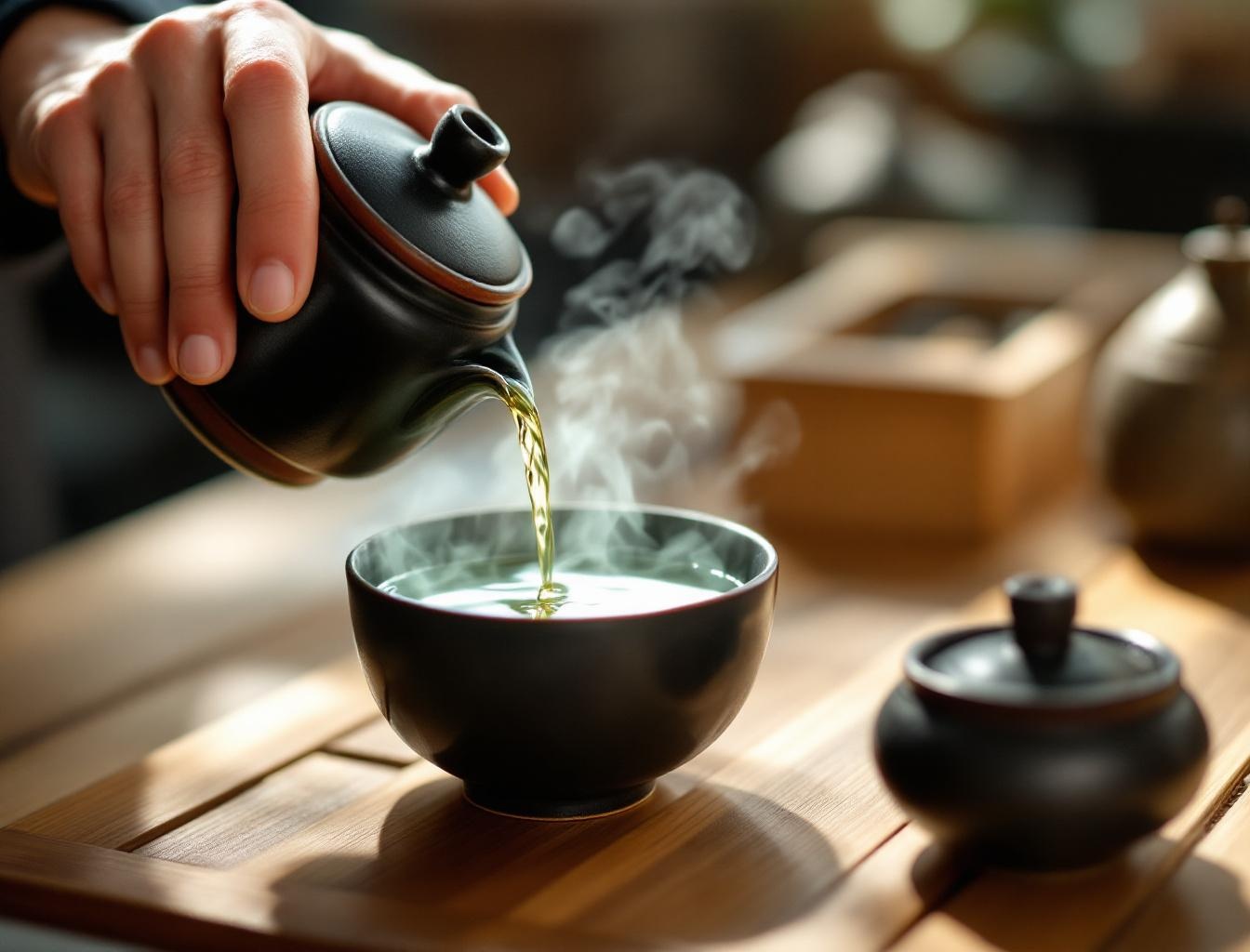
Never pour brewing water into a cold kyusu. Fill the empty pot with hot water (60–80°C) for 30 seconds to preheat the clay, then discard. If the clay is cold, it steals heat from the brewing water, dropping the temperature below the extraction threshold for umami — resulting in a weak, imbalanced cup.
The Yuzamashi
For low-temperature teas (gyokuro, kabusecha), use a yuzamashi — a small ceramic water-cooling pitcher used to step boiling water down to precise brewing temperatures before it enters the kyusu. Pour boiling water into the yuzamashi first — this drops the temperature roughly 10°C per transfer and softens the water's impact on the leaves. For gyokuro, you may transfer the water between the yuzamashi and teacups multiple times to reach the required 50–60°C without imprecision.
The Alternating Pour (Mawashi-tsugi)
When serving multiple guests, pour a small amount into the first cup, move to the second, then the third, then reverse. Continue until the very last “golden drop” is extracted. This ensures the concentration and temperature are identical in every cup — the difference between a host who understands tea and one who doesn't.
Drain Every Last Drop
Leaving water in the pot causes the leaves to continue stewing in residual heat, creating bitterness that ruins subsequent steeps. The yokode's wrist-flick design exists specifically to address this — use it.
What Temperature Should You Use for Each Tea Type?
Water temperature is the single most controllable variable in Japanese tea brewing. According to Komes et al. (2010, Food Research International), higher water temperatures increase catechin and tannin extraction, producing more astringency — which is why lower temperatures (70–80°C) are optimal for green tea flavor balance. Gyokuro requires 50–60°C, while hojicha and genmaicha tolerate boiling water.
| Tea | Temperature | First Steep Time | Typical Re-steeps |
|---|---|---|---|
| Sencha (asamushi) | 70–80°C | 60–90 sec | 3–4 |
| Sencha (fukamushi) | 70–75°C | 30–45 sec | 2–3 |
| Gyokuro | 50–60°C | 180 sec (3 min) | 3–5 |
| Kabusecha | 60–70°C | 60–90 sec | 3–4 |
| Hojicha | 90–95°C | 30–60 sec | 2–3 |
| Bancha / Kukicha | 85–95°C | 30–60 sec | 2–3 |
| Genmaicha | 90–100°C | 30 sec | 2 |
Use 4–5 grams of loose leaf per 200–300 ml of water as a starting ratio. Adjust to taste — more leaf and shorter steep time creates more complexity across multiple steeps.
How Do You Care for and Maintain a Clay Kyusu?
Proper care of an unglazed clay kyusu means three things: never use soap, dry it completely before storage, and act quickly if mold or staining develops. These rules protect both the patina you've built and the vessel's structural integrity.
The No-Soap Rule
Detergents are the absolute enemy of unglazed teaware. The porous clay absorbs scents and chemicals from soap, leaching them into every subsequent brew. To clean, rinse the pot thoroughly with hot water immediately after use. If leaves are stuck in the filter, use a soft bamboo brush.
Drying Protocol
After rinsing, place the kyusu upside down on a clean, dry surface. Do not replace the lid until the interior, spout, and filter are completely bone-dry. Storing a damp kyusu with the lid on is the most common cause of mold in earthenware teapots.
Restorative Cleaning
If your kyusu develops heavy stains or an old smell, dissolve one tablespoon of baking soda in one pot of boiling water. Crucially, pre-warm the pot with warm water first to avoid thermal shock — pouring boiling water into a cold clay pot can cause cracking. Allow the soda solution to soak for 30 minutes, then rinse at least five times with hot water until all traces of baking soda are gone.
What Should You Look for When Buying a Kyusu?
Before spending on a kyusu, evaluate these indicators of quality and fit:
- Lid fit: Artisanal pots from Tokoname or Banko are fired with the lid on the body to ensure a perfect, airtight seal. When the spout is plugged with a finger, no water should leak from the lid. This is the clearest sign of mastercraft. If the lid wobbles or rattles, it was not fired as a matched pair.
- Filter type vs. your tea: If you drink fukamushi sencha, prioritize sasame or ceramesh. If you drink primarily light-steamed or whole-leaf teas, do-ake or debeso is fine.
- Spout design: Look for a spout that produces a smooth, laminar (non-turbulent) stream. A well-designed spout keeps the liquor from agitating as it enters the cup, preserving color and aroma.
- Size: 240–300 ml is the most versatile range — large enough for 2–3 guests, small enough for high-ratio solo brewing. Under 200 ml is ideal for single-serving gyokuro (best for: dedicated gyokuro sessions). Over 400 ml suits casual daily use with low-grade teas (best for: hojicha and genmaicha in larger households).
- Clay authenticity: For Tokoname: real shudei feels smooth and buttery, sounds high-pitched when tapped. For Banko: real shidei has a distinctive purple-gray color with visible crystalline structure. Mass-produced pieces using added iron compounds often look mottled or artificial in color.
- Price tiers: Machine-made entry level runs $30–80 (best for: beginners exploring Japanese tea). Mid-range handmade $80–200 (best for: most serious home brewers — highest quality-to-value ratio). Artisan / hand-thrown $200–600+ (best for: dedicated collectors and daily practitioners). Living National Treasure lineage pieces can exceed $1,000.
The “Living” Vessel: How Unglazed Clay Improves Over Time
The unglazed interior of a Banko or Tokoname kyusu is slightly porous — and that porosity is a feature, not a flaw. Over time, the microscopic pores absorb tea oils and minerals from every brew, building a “tea patina” that actively improves the quality and smoothness of each subsequent cup.
This works similarly to seasoning a cast-iron skillet: the accumulated oils create a surface that smooths astringency and adds depth of character. For this reason, serious tea drinkers often dedicate one unglazed pot to one tea type — a Banko pot for gyokuro (best for: maximizing umami depth over time), a Tokoname for sencha (best for: building a smooth, balanced daily drinker) — to prevent flavor cross-contamination and maximize the depth of the patina. After years of use, a well-seasoned Banko pot can actually improve the quality of a mediocre tea by imparting its stored mineral character.
This is the core value proposition of traditional Japanese teaware that mass-produced alternatives cannot replicate: the vessel is not just a container. It is a participant. And it gets better every time you use it properly. See our guide on water temperature for Japanese green tea to get full value from any kyusu.
Frequently Asked Questions
What's the difference between a kyusu and a regular teapot?
A kyusu is designed specifically for small-batch brewing and multiple re-steeps — typically 100–360 ml. Western teapots (often 1 liter or more) steep once and serve. The kyusu's smaller size forces higher leaf-to-water ratios, and its shape is optimized for fully draining the pot between steeps to prevent over-extraction.
Which is better for sencha — Tokoname or Banko?
Tokoname is the standard choice for sencha. The red shudei clay's iron content neutralizes tannins and creates a smooth, balanced cup — exactly what sencha rewards. Banko's more aggressive mineral interaction pushes the flavor profile toward umami and depth, which suits shade-grown teas like gyokuro better than the fresher, more vegetal notes of sencha.
Can I use a kyusu for black tea or oolong?
Yes, but with a caveat: if your pot is unglazed clay, you must dedicate it to one tea category. Brewing a smoky Lapsang Souchong in a Banko pot will leave smoke flavor in the pores for weeks. If you want to brew multiple tea types, use a porcelain kyusu — chemically neutral, easy to clean, no flavor carryover.
How do I season a brand-new Tokoname teapot?
Soak the pot and lid separately in 60–80°C water for 30–60 minutes before first use. Use only water — no tea leaves during this initial soak. This cleans residual clay dust from the pores and pre-conditions the surface. After this, the pot is ready for brewing. Seasoning (the patina) builds naturally over months of regular use.
What is a yuzamashi and do I need one?
A yuzamashi is a water cooler — a small pitcher used to step boiling water down to brewing temperature before it enters the kyusu. For hojicha and bancha (boiling water teas), you can pour directly into the kyusu. For sencha, genmaicha, and most daily greens, a thermometer and patience work fine. For gyokuro, a yuzamashi is genuinely useful — you need 50–60°C, and multiple transfers are more precise than guessing.
Why does my new kyusu make the tea taste different (metallic or earthy)?
A new unglazed clay pot releases trace clay compounds into the first several brews. For Tokoname and Banko, the high mineral content (especially iron) can be pronounced initially. This “new pot” flavor fades after 5–10 sessions as the tea patina begins to form. If your pot has a stainless steel mesh, inspect it for rust — that's a separate issue and a sign to replace the mesh.
What's a hira-kyusu and when should I use one?
A hira-kyusu (flat teapot) has a dramatically wide, shallow profile. The wide base allows leaves to unfurl horizontally and provides large surface area for rapid temperature drop — essential for gyokuro and other shade-grown teas that require 50–60°C water. It's a specialist tool, not an everyday pot, but if gyokuro is your primary tea, the hira format genuinely improves extraction quality.
How long does a clay kyusu last?
With proper care — no soap, complete drying before storage, no thermal shock — a well-made Tokoname or Banko kyusu will outlast you. These pots don't degrade; they improve. The only risks are physical breakage and mold from improper storage. If a lid breaks, it typically cannot be replaced with a generic one, since each lid and body are fired as a matched pair. Kintsugi — the Japanese art of repairing broken ceramics with lacquer mixed with gold, silver, or platinum powder — is the traditional solution for cracks.
For further reading on the teas that pair with each kyusu style, see our guides on kabusecha, sencha, and the tetsubin cast-iron kettle — the traditional heat source for proper brewing water.
Which Japanese Tea Are You? Take the 60-second quiz
“`