The Science of Brewing: How Water Temperature Transforms Your Japanese Tea
Last updated: April 2026
Water temperature is not a minor detail in Japanese tea brewing — it is the single most important variable you control. The same leaves brewed at different temperature targets produce dramatically different results — from the intensity of flavor to the balance of sweetness and bitterness.
Understanding why this happens gives you real control over every cup you make.
Key Takeaways
- Water temperature is the single most powerful brewing variable — the same leaves at 130°F vs. 212°F can yield twice the caffeine content in your cup.
- Low temperatures favor sweetness and umami — L-theanine, the amino acid behind green tea's savory depth, extracts readily in cool water while bitter catechins do not.
- Shade-grown teas (gyokuro, kabusecha) show the most dramatic temperature swings — because they start with higher caffeine and theanine concentrations in the leaf.
- Cold brew produces a chemically distinct beverage — extracting only 30–44% of caffeine while amplifying sweet amino acids by roughly 1.5× compared to hot brew.
- No thermometer required — the traditional yuzamashi pouring method drops water approximately 10°C per pour, giving precise control with any kettle.
Why Does Water Temperature Change the Flavor of Japanese Tea?
Water temperature changes Japanese tea flavor because different compounds dissolve at different rates: sweet amino acids extract readily in cool water, while bitter catechins and caffeine require higher heat to fully release. Japanese green tea flavor is determined by the balance between these two compound groups, and temperature is the primary lever controlling that balance.
Low Temperature Extracts: Sweetness and Umami
The amino acid L-theanine (a naturally occurring compound found almost exclusively in tea, responsible for its characteristic umami depth and natural sweetness) dissolves easily and extracts readily even in cool water. At low temperatures, L-theanine dominates the cup because the bitter compounds have not yet been pulled from the leaves. According to Ashihara (2015, Natural Product Communications), shading techniques used for gyokuro and matcha increase theanine content to 2–3× that of unshaded sencha by suppressing its photosynthetic conversion to catechins.
High Temperature Extracts: Bitterness and Astringency
Catechins (polyphenol antioxidant compounds — including EGCG, ECG, EGC, and EC — that give green tea its characteristic astringency) and caffeine require higher heat and longer steeping to extract fully. When you use boiling water, these compounds flood the cup and overpower the delicate sweetness of the amino acids.
This is why the Japanese approach to tea brewing is the opposite of the Western one. In the West, you boil water and pour it directly on the tea. In Japan, you carefully control the temperature to achieve exactly the flavor balance you want.
How Much Does Temperature Affect Caffeine Extraction?
Temperature has a dramatic effect on caffeine extraction — in some teas, brewing at boiling vs. low temperature can more than double the caffeine in your cup. Laboratory analysis of 5g of various Japanese teas brewed under controlled conditions reveals this impact clearly:
| Tea Type | Low Temp Brew | Caffeine (Low) | High Temp Brew | Caffeine (High) |
|---|---|---|---|---|
| Genmaicha (Best for: caffeine-sensitive drinkers; lowest caffeine of all Japanese green teas) | 180°F / 45 sec | 9.7 mg | 212°F / 3 min | 14.3 mg |
| Kukicha (Best for: mild, low-caffeine everyday sipping) | 180°F / 1.5 min | 19.0 mg | 212°F / 3 min | 26.9 mg |
| Sencha Fukamushi (Best for: classic Japanese green tea flavor with extra body) | 175°F / 45 sec | 19.3 mg | 212°F / 3 min | 33.3 mg |
| Kabusecha (Best for: those seeking gyokuro-level sweetness at a more accessible price) | 130°F / 3.5 min | 37.9 mg | 212°F / 3 min | 77.1 mg |
| Gyokuro (Best for: maximum umami intensity and serious tea enthusiasts) | 130°F / 3.5 min | 46.0 mg | 212°F / 3 min | 82.2 mg |
Notice the pattern: shade-grown teas (kabusecha, gyokuro) show the most dramatic caffeine swings because they start with more caffeine in the leaf. Genmaicha shows the smallest change because half its volume is toasted rice, which contains no caffeine at all.
For a deeper dive into caffeine across every Japanese tea variety, see our green tea caffeine content guide.
How Does Cold Brew Compare to Hot Brew Japanese Tea?
Cold brew and hot brew produce fundamentally different beverages from the same leaves — cold water selectively amplifies sweetness while suppressing bitterness, whereas hot water delivers full catechin and caffeine extraction. Cold brewing takes the temperature principle to its extreme: the resulting tea has a chemically distinct profile, not just a cooler version of the same drink.
| Factor | Cold Brew (~4°C / 4–8 hrs) | Hot Brew (70–100°C) |
|---|---|---|
| Caffeine | 30–44% of hot brew | Full extraction |
| Bitter catechins (EGCG, ECG) | Dramatically reduced | Full extraction |
| Sweet amino acids (L-theanine) | ~1.5× increased vs. hot brew | Standard extraction |
| Non-bitter catechins (EGC, EC) | Increased concentration | Standard extraction |
| Aroma compounds | Minimal release | Full aromatic release |
| Taste profile | Sweet, smooth, no bitterness | Full body, complex, aromatic |
| Best for | Summer refreshment; caffeine-sensitive drinkers | Winter warmth; aroma enjoyment; fuller catechin extraction |
What Cold Brew Gives You
- Caffeine — Only 30–44% of what a hot brew extracts
- Bitter catechins (EGCG, ECG) — Dramatically reduced
- Sweet amino acids — Actually increased by roughly 1.5× compared to hot brew
- Non-bitter catechins (EGC, EC) — Increased concentration
The result is a remarkably sweet, smooth, and refreshing cup completely free of bitter notes. It is almost like a different beverage from the same leaves.
What Hot Brew Gives You
- Full extraction of antioxidant catechins
- Complete caffeine release
- Aromatic oils and toasty compounds (especially important for genmaicha and hojicha)
- More body and complexity
Neither method is “better” — they are genuinely different drinks from the same leaf. Cold brew is ideal for summer refreshment and caffeine-sensitive drinkers. Hot brew is ideal for winter warmth, aroma enjoyment, and fuller catechin extraction.
Practical Brewing Guide by Tea Type
Gyokuro — 45–60°C (113–140°F)
Best for: serious tea enthusiasts and umami lovers seeking the most intense, savory Japanese tea experience. Gyokuro (gyokuro: shade-grown green tea covered for 3+ weeks before harvest — producing the highest theanine concentration of any Japanese tea variety) demands the lowest temperature of any Japanese tea. Its intense umami is easily overwhelmed by catechin bitterness at higher temperatures.
- Ratio: 10g leaves to 50–100ml water (high concentration)
- Steep: 2–5 minutes
- Result: Concentrated “drop tea” — thick, brothy, intensely savory
Kabusecha — 65–70°C (150–160°F)
Best for: those who want gyokuro-level sweetness at a more approachable price and body weight. Kabusecha (kabusecha: partially shaded green tea, covered 1–2 weeks before harvest per JAS standards — producing intermediate theanine levels between sencha and gyokuro) is the semi-shaded middle ground between sencha and gyokuro. Cool enough to preserve sweetness, warm enough for a full-bodied cup.
- Ratio: 7g leaves to 300ml water
- Steep: 1–3 minutes
- Result: Sweet, umami-forward with clean astringency
Sencha — 80°C (175°F)
Best for: everyday Japanese green tea drinking and those new to the category. The classic Japanese green tea temperature. Balances the grassy sweetness with pleasant, citrusy astringency.
- Ratio: 7g leaves to 300ml water
- Steep: 2 minutes
- Tip: Drop to 70°C for sweeter, less astringent cups. Raise to 85°C for a bolder snap.
Genmaicha — 80–100°C (176–212°F)
Best for: caffeine-sensitive drinkers, beginners, and those who enjoy a nutty, toasty flavor profile. According to Heiss & Heiss (2007, Ten Speed Press), genmaicha originated as a way to stretch expensive tea leaves with roasted brown rice, and is now valued for its distinctive toasty flavor and naturally low caffeine content. Genmaicha is a tale of two ingredients — the green tea component and the toasted rice — and your temperature choice determines which one dominates.
- For rice-forward flavor: Use boiling water (100°C), steep 30 seconds. The heat unleashes the nutty, savory aroma of toasted rice.
- For tea-forward flavor: Use 80–85°C, steep 60–90 seconds. Preserves the green tea's umami and prevents bitterness. Better for premium blends with matcha or high-grade sencha.
Explore the different ways to enjoy genmaicha in our complete genmaicha guide.
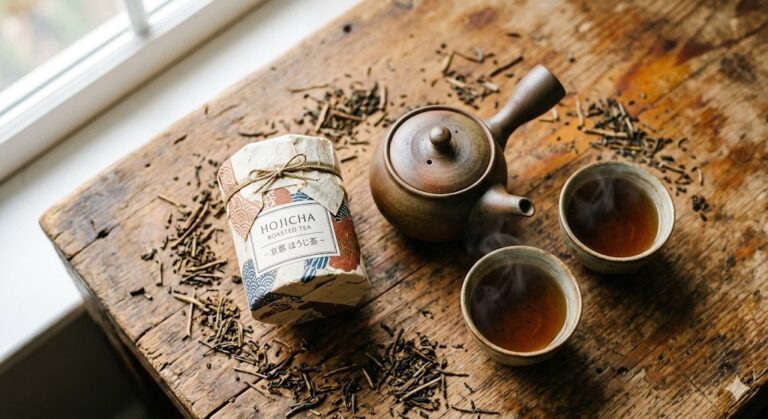
Hojicha — 93–100°C (200–212°F)
Best for: evening drinking, those sensitive to caffeine or acidity, and anyone new to Japanese tea. Hojicha (hojicha: roasted Japanese green tea, fired at 160–220°C — a process that reduces caffeine by approximately 60–70% via sublimation, leaving a distinctly smooth, low-caffeine brew) is the most forgiving Japanese tea to brew. The roasting process has already transformed most bitter catechins, so it is difficult to overbrew.
- Ratio: 4g leaves to 200–300ml water
- Steep: 30 seconds to 3 minutes
- Result: Rich, caramel, toasty — the roasted compounds extract best at high temperature
See our guide to hojicha's gentle, stomach-friendly character for why this is the ideal evening and after-meal tea.
Temperature Quick-Reference Chart
| Tea | Water Temp | Steep Time | Flavor Profile | Best For |
|---|---|---|---|---|
| Gyokuro | 45–60°C | 2–5 min | Intense umami, brothy | Umami lovers, special occasions |
| Kabusecha | 65–70°C | 1–3 min | Sweet, umami, balanced | Gyokuro alternative, everyday premium |
| Sencha | 80°C | 1–2 min | Grassy, bright, refreshing | Daily drinking, beginners |
| Genmaicha | 80–100°C | 30–90 sec | Nutty, toasty, sweet | Caffeine-sensitive drinkers, beginners |
| Hojicha | 93–100°C | 30 sec – 3 min | Roasted, caramel, warm | Evening drinking, caffeine-sensitive |
| Cold Brew (any) | Refrigerator | 4–8 hours | Sweet, smooth, no bitterness | Summer refreshment, maximum sweetness |
How to Cool Your Water Without a Thermometer
You can cool brewing water to any target temperature without a thermometer by using the traditional Japanese yuzamashi method — the practice of pouring hot water between vessels, each transfer dropping the temperature approximately 10°C. A temperature-controlled kettle is convenient, but entirely optional.
- Each pour drops ~10°C — Pour from kettle to a cup, from that cup to another cup; each transfer drops the temperature about 10 degrees
- Boiling → one pour = ~90°C (sencha range)
- Boiling → two pours = ~80°C (good sencha, genmaicha)
- Boiling → three pours = ~70°C (kabusecha range)
- Boiling → four pours = ~60°C (gyokuro range)
This pouring method is called yuzamashi and it is how Japanese tea masters have controlled temperature for centuries — no electronics required.
Frequently Asked Questions
Does colder water always make better tea?
No — colder water makes sweeter tea by favoring L-theanine extraction over bitter catechins, but it also extracts fewer catechins and less caffeine overall. If you want a fuller catechin extraction, hot brewing delivers more. Temperature is a tool for dialing in your preferred balance of sweetness, bitterness, and caffeine — not a universal quality dial.
Can I use boiling water for all Japanese teas?
Only for hojicha and standard genmaicha. Using boiling water on sencha, kabusecha, or gyokuro will produce a bitter, astringent cup that masks their natural sweetness. These teas are specifically processed and selected to be brewed at lower temperatures.
How does steeping time interact with temperature?
Temperature and time are multiplicative — higher temperature combined with longer steep time extracts the most compounds. A 3-minute steep at 212°F extracts roughly double the caffeine of a 45-second steep at 175°F. If you like a strong cup, raise either variable. For a gentle cup, lower both.
What is the best temperature for cold brew Japanese tea?
Refrigerator temperature (about 4°C / 39°F) for 4–8 hours is optimal for cold brew. The long steep time compensates for the low extraction rate. Cold brewing works with any Japanese tea but is particularly effective with sencha and gyokuro (Best for: maximizing natural sweetness and eliminating bitterness entirely), where the selective extraction amplifies the sweetness while removing nearly all astringency.
Do I need a special kettle?
No — a variable-temperature electric kettle is the most convenient solution, but the traditional yuzamashi pouring method works just as well. Each pour between vessels drops the temperature approximately 10°C, giving you reliable control with any standard kettle. Three pours from boiling reaches about 70°C — ideal kabusecha territory.