Gyokuro: Japan’s Shade-Grown Tea — Science, Cultivation + Brewing Guide
Japan produces roughly 80,000 metric tons of tea each year. Gyokuro accounts for less than 0.3% of that output. That extreme scarcity is not accidental — it is the direct consequence of a cultivation method so demanding in labor, timing, and botanical precision that most farmers have abandoned it entirely. What remains is one of the most chemically extraordinary beverages ever produced: a cup of concentrated umami, forest depth, and oceanic aroma that bears almost no resemblance to ordinary green tea.
Gyokuro (玉露), which translates literally as “jade dew,” is produced by covering tea bushes with straw or reed mats for 20 to 30 days before harvest, blocking 95–98% of sunlight. This single intervention forces the Camellia sinensis plant into a stress response that fundamentally rewires its chemistry — accumulating amino acids to nearly triple the levels found in sun-grown sencha while suppressing the bitter catechins that most tea drinkers accept as normal. The result is a liquid that veteran tasters describe as broth-like, syrupy, and oceanic. It requires specific teaware, specific water temperatures, and a willingness to brew in small, concentrated doses.
This guide covers everything: the 1835 discovery that created gyokuro, the biochemistry of shade, the three cultivation methods ranked by prestige, the three great terroirs of Japan, a six-infusion brewing protocol, and how to store a tea that costs anywhere from $30 to $300 per 100 grams.
Gyokuro at a Glance: Japan's premium shaded green tea, produced by covering bushes for 20–30 days before harvest, which triples L-theanine content to 1,500–2,500 mg/100g versus sencha's 300–600 mg. Brewed at 45°C in a small Houhin teapot, it yields 6+ infusions with an intensely savory, oceanic flavor called ooika. Accounts for less than 0.3% of Japan's annual tea production.
What Is Gyokuro Tea?
Gyokuro is a premium Japanese green tea shade-grown for 20–30 days before harvest, concentrating L-theanine amino acids to levels three times higher than sun-grown sencha, while suppressing bitter catechins through controlled light deprivation. The tea belongs to the same Camellia sinensis species as all Japanese green teas, but its cultivation method — covering bushes with traditional straw canopies or modern shade nets — triggers a metabolic stress response that radically alters the leaf's internal chemistry before a single leaf is picked. The resulting brew is distinctly savory and broth-like, carrying a signature ooika (shaded aroma) of nori seaweed and toasted grain that emerges from elevated dimethyl sulfide compounds. Unlike standard green tea brewed at 70–80°C, authentic gyokuro is extracted at 45–50°C to selectively pull umami sweetness while leaving bitterness locked in the leaf. Competition-grade gyokuro from Yame or Uji is judged on a 200-point rubric weighting flavor and aroma above leaf appearance. At its peak — particularly in the Dento Hon Gyokuro (Traditional Authentic Gyokuro) designation — it represents the highest expression of Japanese tea agriculture.
The 1835 Discovery That Created Gyokuro
Before gyokuro existed, shading was a technique reserved exclusively for tencha — the raw material for matcha. It belonged to the world of imperial courts, samurai ceremonies, and powdered luxury. The idea that shaded leaves could be steeped as whole needles, enjoyed in an ordinary teapot, had not occurred to anyone.
In 1835, Yamamoto Kahei VI — the sixth-generation head of the Yamamotoyama tea company, still operating today — traveled from Edo to Uji to study tencha production. During his stay in Kyoto's tea heartland, he observed farmers using rice straw mats to protect young tea sprouts from late-spring frost. He noticed something that had apparently gone unrecognized: the leaves sheltered beneath those frost mats had an unusual depth of color and a sweetness that went beyond anything he had tasted in sun-grown tea.
Yamamoto's insight was to replicate that sheltering effect intentionally, not as frost protection but as a flavor intervention. His initial attempts produced a hand-kneaded, bead-like tea — primitive by modern standards but chemically transformed. He had stumbled onto the relationship between light deprivation and the accumulation of sugars and amino acids in tea leaves.
Refinement followed quickly. By 1841, Eguchi Shigejuro had perfected the drying and rolling methods, establishing the needle-shaped, deeply emerald leaf form we recognize as gyokuro today. The timing was significant: Japan's samurai class was in economic decline, and tea producers needed a way to offer the prestige flavor profile of matcha — that deep umami richness — in a format accessible to anyone with a teapot. Gyokuro bridged that gap. It became, in essence, a “luxury steepable” — the complexity of the tea ceremony compressed into a small ceramic cup.
The Biochemistry of Shade: How 20 Days Changes Everything
To an agricultural biochemist, gyokuro's flavor is not mysterious — it is the predictable output of a forced metabolic shift in Camellia sinensis. Understanding that shift is what separates a drinker who tolerates gyokuro's unusual intensity from one who pursues it deliberately.
The mechanism begins with L-theanine, an amino acid synthesized in the roots of the tea plant and transported upward into the leaves. In normal growing conditions, ultraviolet radiation triggers the plant to convert L-theanine into catechins — the polyphenols responsible for astringency and bitterness. This conversion is not a defect; it is the plant's defense mechanism against UV stress.
By blocking 95–98% of sunlight for three weeks before harvest, gyokuro farmers arrest that conversion. L-theanine accumulates. Catechin production is suppressed. The resulting leaf contains approximately 5.0g of amino acids per 100g of dry leaf, compared to 2.4g in sencha — nearly double. On a serving basis, a single cup of gyokuro delivers 120–140mg of L-theanine, enough to produce a measurable effect on alpha brain-wave activity and the “calm alertness” associated with focused attention without jitteriness. According to research published in the Asia Pacific Journal of Clinical Nutrition, L-theanine's structural similarity to glutamate — the amino acid responsible for umami taste — explains why gyokuro triggers the same palate receptors as dashi broth or aged parmesan.
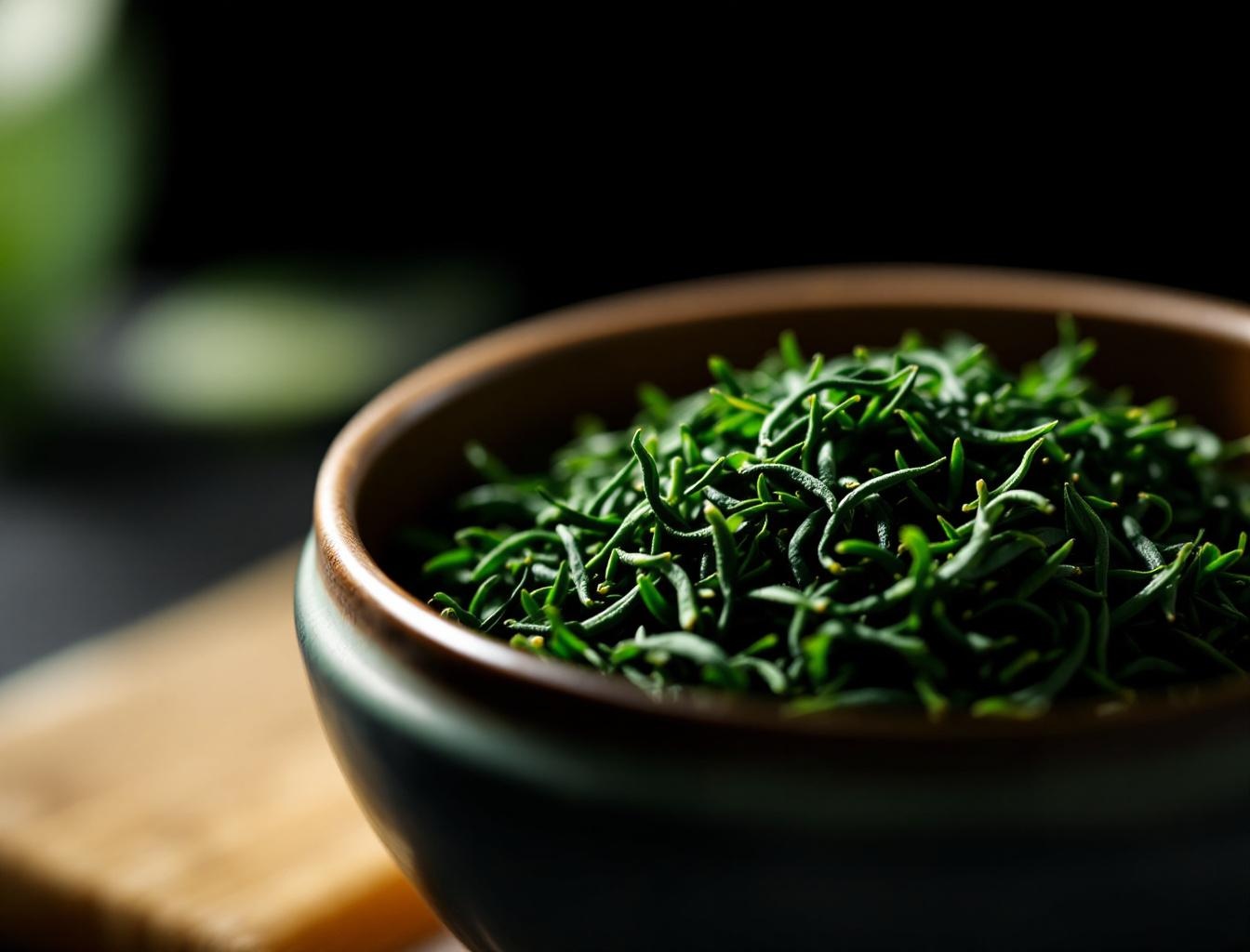
A second transformation happens with chlorophyll. Deprived of light, the plant maximizes its light-harvesting efficiency by dramatically increasing chlorophyll and carotenoid production. This gives gyokuro leaves their characteristic deep emerald, near-black hue — so dark that high-grade gyokuro can look almost ink-colored before brewing. The shading also increases volatile aromatic compounds, specifically dimethyl sulfide (DMS), which generates the ooika (覆い香, “shaded aroma”): the oceanic, nori-like, toasted-grain notes that define gyokuro's aroma profile and that no other Japanese tea replicates.
Chemical Comparison: Gyokuro vs. Sencha
| Component | Gyokuro (Shaded) | Sencha (Sun-Grown) | Sensory Contribution |
|---|---|---|---|
| Amino Acids (L-theanine) | 1,500–2,500 mg/100g | 300–600 mg/100g | Umami, sweetness, creaminess |
| Catechins (EGCG, EGC) | Lower — suppressed by shade | Higher — UV-driven synthesis | Astringency, bitterness, briskness |
| Caffeine | 3.2g / 100g | 2.3g / 100g | Stimulant; modulated by L-theanine |
| Chlorophyll | Exceptionally high | Standard | Deep emerald color, vegetal freshness |
| Dimethyl Sulfide (DMS) | High | Low / Trace | Ooika: seaweed, ocean, toasted notes |
Note that gyokuro contains more caffeine than sencha — the shading process concentrates it along with everything else. But the 120–140mg of L-theanine per serving modulates caffeine's absorption, producing stimulation without the spike-and-crash pattern of coffee. For a deeper look at how the catechin-to-amino-acid ratio determines tea quality, see our guide to catechin-to-amino-acid ratios.
How Is Gyokuro Grown? Three Cultivation Methods Ranked by Prestige
Managing the microclimate of a tea bush under shade is an architectural challenge. Farmers must provide enough darkness to trigger the biochemical shift while avoiding heat stress, restricting airflow, or inhibiting the vertical shoot growth that produces the prized tender leaves. Three methods exist, each representing a different balance of tradition, cost, and quality.
Jikagise: The Modern Shortcut
Jikagise (直掛せ, “direct covering”) uses synthetic black fiber nets — kanreisha — draped directly over the tea bushes. It is cost-effective and dominant in Shizuoka's commercial gyokuro production. The problem is thermodynamic: polyester netting traps heat against the leaves and restricts airflow, creating micro-stress that can accelerate leaf maturation unevenly. Jikagise gyokuro is widely available at accessible price points, but it rarely develops the full complexity of ooika that traditional methods achieve.
Tana: The Scaffold Method
Tana (棚, “shelf” or “canopy”) erects a free-standing scaffold structure 1.8 to 2.1 meters above the field, then stretches shading material — synthetic or natural — across it like a roof. The critical difference from jikagise is that the tea bushes grow into open, ventilated air space beneath the canopy rather than directly against the shading material. Shoots can develop vertically toward dappled light without heat stress or physical contact with the netting. Tana is the preferred structure for premium gyokuro, and most Honzu production uses this as the underlying scaffold.
Honzu: The Traditional Masterclass
Honzu (本簀, “true reed mat”) is the most labor-intensive and prestigious cultivation method, now rare enough that it carries GI protection in Yame. It uses the Tana scaffold framework but replaces synthetic netting with natural materials in a staged sequence:
- Initial shading (Days 1–7): As the spring buds break, woven reed mats are laid across the Tana scaffold, blocking 70–80% of sunlight. This gently initiates the metabolic shift without shocking the plant.
- Straw addition (Days 8–14): Dried rice straw is scattered over the reed mats, increasing shade coverage to approximately 90%. The straw breathes — it regulates temperature and humidity beneath the canopy while releasing trace minerals into the soil during rain.
- Final shading (Days 15–20+): Additional straw layers are applied until light penetration drops to 2–5%, the threshold required for maximum ooika development. The environment beneath the finished Honzu structure is described by farmers as resembling a forest floor: cool, humid, mineral-scented.
The superiority of Honzu is both chemical and sensory. Natural straw creates a “forest-like light filtration” — dappled and shifting rather than uniformly blocked — that the plant responds to differently than uniform synthetic shade. The microclimate it creates maximizes dimethyl sulfide accumulation, producing the deepest ooika of any method. For the Dento Hon Gyokuro designation in Yame, Honzu shading for a minimum of 16 days and 100% hand-picking are legally required.
The Three Great Gyokuro Terroirs
Like fine wine, gyokuro carries the imprint of where it was grown. Soil mineral composition, river humidity patterns, altitude, and diurnal temperature swings all shape the leaf's chemistry and flavor architecture. Three Japanese regions define the benchmark for gyokuro quality.
Regional Comparison
| Region | Geography and Soil | Flavor Profile | Key Cultivars |
|---|---|---|---|
| Uji (Kyoto) | Alluvial clay-loam, Uji River mist valleys | Elegant, balanced, savory richness; “kombu dashi” depth | Gokou, Asahi, Samidori |
| Yame (Fukuoka) | Volcanic Shirasu ash, mountain basin fog | Intense umami, bold sweetness, viscous, creamy body | Saemidori, Yabukita, Okumidori |
| Asahina (Shizuoka) | River-valley humidity, cool morning mist | Delicate, refreshing, soft, clear sweetness | Yabukita, Saemidori |
Uji (Kyoto): The Historic Heartland
Uji is the spiritual birthplace of Japanese shaded tea cultivation — a tradition dating to the 16th century when tencha farmers along the Uji River developed the okuizome shading technique for matcha production. The region's alluvial soil — ancient, mineral-rich deposits from the Uji and Kizu rivers — delivers exceptional drainage while providing the steady trace mineral supply that supports complex flavor development.
Uji's defining agricultural asset is its river mist. Dense morning fogs roll through the valley basin, maintaining high humidity around the tea bushes and providing natural partial shading that begins moderating the plant's photosynthesis before artificial shading even starts. The Gokou cultivar, developed exclusively in Kyoto and selected specifically for naturally high L-theanine accumulation, is the flagship of Uji gyokuro — producing a flavor profile often described as “kombu dashi in a cup”: clean, savory, and deeply umami without the bold punch of Yame.
Yame (Fukuoka): The Current Benchmark for Umami
If Uji is gyokuro's historical heartland, Yame is its competitive dominant. This inland mountain district of Fukuoka Prefecture — set between the region's two largest rivers in a basin that traps cold mountain air overnight — regularly sweeps Japan's national tea competitions. The terroir is defined by volcanic Shirasu ash soil: lightweight, highly draining, and rich in iron and manganese. These minerals are not incidental; they drive chlorophyll production more aggressively than the clay-loam soils of Uji, contributing to Yame gyokuro's characteristic near-black leaf color and the extraordinary viscosity of its brew.
The combination of cool mountain climate, dense morning fog (which provides natural pre-shading), and the strict Honzu method mandated by the Yame Traditional Hon Gyokuro GI designation creates a tea that pushes umami intensity to its maximum expression. The Saemidori cultivar — with its neon-green liquor and virtually zero astringency — produces a brew that veteran tasters describe as “silky” and “broth-weight”: a liquid with the mouthfeel of light cream rather than water.
Asahina (Shizuoka): The Gentler Expression
Along the Asahina River valley in Shizuoka, cool morning mists naturally slow the tea plant's metabolism before artificial shading begins — a double-shading effect that produces a distinctly different gyokuro character. Asahina is celebrated for delicacy rather than power: a refreshing sweetness, a soft ooika, and a clarity of flavor that makes it more accessible to first-time gyokuro drinkers. Where Yame strikes with bold umami, Asahina offers a quiet, sustained sweetness. Many tea experts recommend Asahina as the entry point for Western drinkers unfamiliar with gyokuro's intensity.
For context on how gyokuro compares to its shaded siblings, see our green tea showdown: gyokuro, kabusecha, and sencha.
How to Brew Gyokuro at Home: The Low-Temperature Method
Brewing gyokuro is an act of selective chemical extraction. Water temperature functions as a molecular filter. L-theanine and the amino acids that produce umami dissolve readily at 40–50°C. The catechins and tannins that produce bitterness require 70–80°C to release. Brewing gyokuro at the temperature you would use for sencha (80°C) is the single most common mistake beginners make — it destroys the flavor profile the farmer spent three weeks engineering into the leaf.
The Yuzamashi Technique
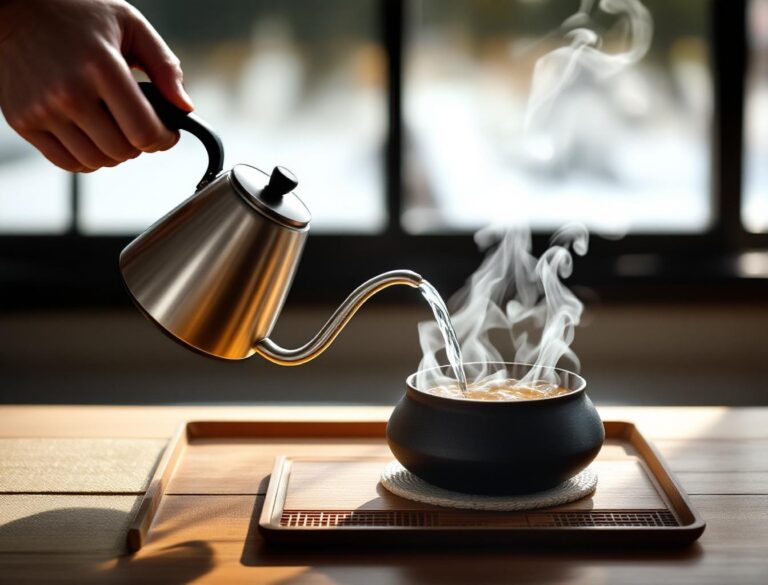
A yuzamashi (湯冷まし) is a dedicated ceramic cooling vessel used to drop boiling water to the correct temperature through sequential pours. Its logic is the thermal mass of ceramic: each pour into an unheated vessel drops water temperature by approximately 10°C. You can calibrate without a thermometer by reading steam behavior:
- 90°C: Steam rises forcefully and vertically.
- 70°C: Steam sways sideways, less dense.
- 50°C: Steam is faint, barely visible, rises with no force.
- 45°C: The vessel feels warm but not hot against the inside of your wrist.
For brewing, use 5–10g of tea leaves per 30–100ml of water — a dramatically higher leaf-to-water ratio than sencha. This concentration is intentional; gyokuro is not meant to fill a full teacup but to deliver a small, intensely flavored pour. Do not agitate the teapot during the first infusion; movement prematurely releases bitterness.
The “last golden drop” matters: tilt the Houhin completely to empty every drop. The final portion contains the highest concentration of amino acids and flavor-active compounds that settle at the bottom. Any water left in the pot will continue extracting bitterness and will ruin the second infusion. For more on how brew temperature affects extraction chemistry, see our brewing temperature science guide.
Multi-Infusion Guide: Six Infusions from a Single Measure
| Infusion | Temperature | Water Volume | Steep Time | Flavor Profile |
|---|---|---|---|---|
| 1st | 45°C | 50 ml | 150 seconds | Intense umami, syrupy, sweet, oceanic — the “umami bomb” |
| 2nd | 45°C | 70 ml | 30 seconds | Savory, lighter body, leaves unfurled, brighter sweetness |
| 3rd | 50°C | 70 ml | 45 seconds | Balanced sweetness and subtle briskness, more vegetal |
| 4th | 55°C | 70 ml | 50 seconds | Emerging vegetal freshness, lighter body |
| 5th | 65°C | 70 ml | 60 seconds | Clean, refreshing, grassy finish |
| 6th | 70°C | 70 ml | 90 seconds | Mildly astringent, palate-cleansing, distinctly green |
The progression from the first to sixth infusion is essentially a journey through the entire flavor spectrum of the tea: from concentrated liquid umami toward something closer to a delicate sencha. Each pour reveals a different facet of the same leaf. Advanced practitioners sometimes brew the first infusion at room temperature (20°C) — a technique that extracts almost pure L-theanine and produces a syrup-like “nectar” that maximizes sweetness while virtually eliminating any trace of bitterness.
Gyokuro Teaware: Why the Houhin and Shiboridashi Exist
The unusual demands of gyokuro brewing — tiny water volumes, extremely low temperatures, high leaf-to-water ratios — drove the development of two specialized teapots that are rarely used for any other tea.
The Houhin
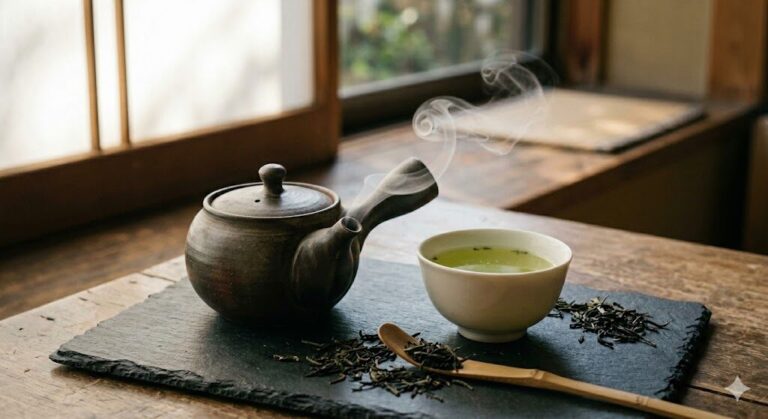
The Houhin (宝瓶) is a small, handleless teapot holding 80–150ml. Its design makes an ergonomic statement that is also a functional one: if the pot is too hot to cradle in both palms, the water inside is too hot for the tea. At 45–50°C, a ceramic Houhin should feel warm but comfortable to hold barehanded. The absence of a handle forces temperature discipline on the brewer. Traditionally made from unglazed Tokoname clay or pale Hagi ware, the Houhin's porous surface can gradually develop a patina of flavor compounds over years of use — a concept Japanese tea drinkers call yakinuki. For more on Japanese teapot traditions, see our guide to kyusu teapots.
The Shiboridashi
The Shiboridashi (絞り出し, “squeeze out”) is a flatter, wider version of the Houhin. Its shallow, disc-like shape solves a specific problem: when you load 8–10g of gyokuro needles into a small vessel, they pile up vertically and brew unevenly. The Shiboridashi's wide, flat interior allows the needles to spread horizontally, ensuring every leaf has equal contact with the small volume of water. It is the preferred vessel for ultra-high-concentration first infusions and for experienced drinkers who want maximum control over extraction. The Tokoname clay tradition produces exceptional Shiboridashi — learn more in our guide to Tokoname teapots.
Competition Standards: The 200-Point Rubric
The Zenkoku Cha Pinpyokai (全国茶品評会, National Tea Fair) is Japan's premier tea evaluation competition, and gyokuro receives its most rigorous judging there. Unlike competitions for wine or coffee that prioritize personal preference, the Zenkoku Cha Pinpyokai uses a structured 200-point rubric that reveals which qualities matter most:
- Flavor (80 points): Judges seek profound, lingering umami with an oil-like mouthfeel. Sweetness must persist well after swallowing. Any trace of bitterness is a significant deduction.
- Aroma (70 points): The complexity of the ooika is evaluated in dry leaf, wet leaf, and brewed liquor — three separate aroma moments. Both nori and toasted-grain notes must be present and layered.
- Appearance (40 points): Glossy, tightly rolled emerald needles of uniform length. Broken leaves, stems, or twigs are severe defects.
- Liquor Color (30 points): A clear, vibrant pale yellow-green — not murky, not yellow-brown.
The point weighting tells the story: flavor and aroma together account for 75% of the score. In gyokuro, beauty is secondary to biochemistry.
For the highest designation — Dento Hon Gyokuro (伝統本玉露, Traditional Authentic Gyokuro) — additional rules apply: bushes must be grown without hedge-trimming (allowing natural shape), shaded exclusively using Honzu straw for a minimum of 16 days, and harvested entirely by hand. These teas, primarily from Yame, command prices that can exceed $200 per 100 grams at auction.
Maturation: What Is Kuradashi and Why Does It Matter?
Gyokuro is rarely consumed immediately after processing. Most premium gyokuro undergoes a maturation period called kuradashi (蔵出し, “from the storehouse”), a traditional aging practice that stores the processed tea in temperature-controlled environments for several months before release.
The chemistry of kuradashi involves the gradual mellowing of sharp vegetal notes — a process where the volatile compounds responsible for the “raw” grassiness of fresh-processed tea slowly integrate with the umami amino acids. The result is a rounded, deep umami that feels more complex and less aggressive than a newly processed batch. The best kuradashi gyokuro is traditionally released in autumn, aligned with Japan's cultural appreciation for seasonal transitions. An autumn-released gyokuro from a spring harvest has had five to six months for its flavor to integrate — a gap that tea veterans can often detect in the cup.
How to Store Gyokuro: Defeating the Five Enemies
Gyokuro is among the most volatile and fragile teas produced anywhere. Its extreme concentration of chlorophyll, amino acids, and dimethyl sulfide compounds means it degrades faster than virtually any other green tea when handled carelessly. Five environmental factors accelerate that degradation:
- Oxygen: Oxidizes the vitamin C and catechins in the leaf, producing a stale, flat taste within days of an opened package. Always reseal completely after each use.
- Heat: Accelerates every chemical degradation reaction. Store away from stovetops, ovens, and direct sunlight.
- Moisture: Promotes mold and destroys the ooika aroma. The leaf is hygroscopic — it absorbs ambient humidity rapidly.
- Light: UV rays cause chlorophyll to degrade, turning leaves from deep emerald to dull yellow-green and generating off-aromas. Opaque, UV-blocking packaging is essential.
- Odors: Tea leaves are natural sponges. Gyokuro stored near coffee, spices, or pungent foods will absorb those odors within hours. Store in a dedicated, sealed container.
The refrigerator rule: If you store gyokuro in the refrigerator (which extends freshness significantly), you must allow the sealed, unopened container to come to room temperature — 6 to 12 hours — before opening. Opening a cold container in a warm room causes immediate condensation inside the package. That surface moisture will ruin a $100 batch of gyokuro in minutes. This is not optional. Let it warm up first.
Properly stored in an opaque, airtight tin in a cool, dark location, an unopened package of gyokuro retains peak quality for 6–12 months. Once opened, use within 2–3 weeks.
Frequently Asked Questions About Gyokuro
How does gyokuro differ fundamentally from matcha?
Both gyokuro and matcha are shaded teas that accumulate high L-theanine levels, but their processing diverges completely after harvest. Matcha is made from tencha — leaves that are steamed, dried without rolling, de-veined, and then stone-ground into fine powder. Gyokuro leaves are steamed, rolled into tight needles, and dried for whole-leaf steeping. You whisk matcha into water; you steep gyokuro in a small teapot. For a comprehensive comparison of shaded Japanese teas, see our complete guide to matcha.
Why is the “last golden drop” so important when brewing gyokuro?
The final drops from a gyokuro brewing session contain the highest concentration of flavor compounds — amino acids and umami-rich oils settle toward the bottom of the teapot rather than distributing evenly. Emptying the pot completely also prevents residual water from continuing to extract bitterness from the leaves, which would compromise the second and third infusions. Tilt the Houhin or Shiboridashi until the last drop falls.
What exactly is “ooika” and how is it produced?
Ooika (覆い香) means “shaded aroma” and is caused specifically by elevated dimethyl sulfide (DMS) content in the leaf — a volatile compound that increases during the light-deprivation stress response. It manifests as oceanic, nori-like notes combined with hints of toasted grain and fresh forest air. Ooika is the defining sensory marker that distinguishes gyokuro from all other Japanese green teas. Honzu-method gyokuro develops the deepest ooika due to the forest-like microclimate created by natural straw shading.
Can I brew gyokuro at room temperature?
Yes — room-temperature or even cold brewing (20°C) is an advanced technique used for competition-grade teas. At these temperatures, virtually only L-theanine and the sweetest amino acids dissolve, producing a dense, syrup-like nectar with maximum sweetness and almost zero astringency. Use 8–10g of leaves per 50ml of cool water and steep for 5–10 minutes. The resulting liquid is so concentrated it should be sipped in small quantities, like a distillate.
Why does gyokuro cost so much more than sencha?
Three cost drivers compound each other. First, the shading infrastructure: building and maintaining Tana or Honzu structures requires significant labor and materials each spring. Second, hand-picking: premium gyokuro, especially Dento Hon Gyokuro, accepts only the two or three tenderest leaves from each shoot, picked entirely by hand — a rate of roughly 1,000kg of fresh leaves to produce 180kg of finished tea. Third, kuradashi aging requires temperature-controlled storage for months before sale. The total production cost per kilogram of Honzu gyokuro is multiples of standard sencha, and the scarcity of skilled Honzu farmers — many now in their 60s and 70s with no successors — ensures that supply will continue to contract.
Is gyokuro safe to drink every day?
For most healthy adults, yes — gyokuro's elevated L-theanine content actually makes it gentler on the nervous system than the caffeine-equivalent dose of coffee. The calm alertness it produces is often described as more sustained and focused than coffee's sharp stimulation. That said, gyokuro does contain more caffeine than standard green tea (approximately 3.2g per 100g dry leaf versus 2.3g for sencha), so individuals sensitive to caffeine or those advised to limit caffeine intake should keep serving sizes small and avoid drinking it in the evening. As with any tea or supplement, wellness decisions should align with your own health circumstances.
Conclusion: A Living Record of Japanese Botanical Mastery
The history of gyokuro is a history of attention — to frost patterns, to leaf color, to the precise weight of straw on a reed mat, to the temperature of water against a palm. Each of those observations, accumulated over nearly two centuries since Yamamoto Kahei VI's frost-shade discovery in 1835, represents knowledge that cannot be automated or replicated at scale without losing what makes gyokuro remarkable.
That knowledge is disappearing. In Asahina, many of the master Honzu farmers are now past 65. The labor mathematics of hand-picking and traditional shading become harder to justify each year as Japan's rural population ages and younger generations move to cities. The less than 0.3% of Japanese tea that counts as gyokuro is likely to become even scarcer.
When you buy a quality gyokuro — particularly a Honzu-shaded, hand-picked tea from Uji or Yame — you are not just purchasing a beverage. You are participating in an economy that funds the continuation of that knowledge. The farmers who produce it, the families who have maintained these fields across generations, the agronomists who study the L-theanine biochemistry — all depend on a global market that understands what it is drinking and values it accordingly.
Brew it carefully. Drink it slowly. There is more in that small cup than most teas will offer in an entire season.
Browse our selection of premium gyokuro teas from Uji and Yame, and our full range of Japanese green tea products.