Organic Nori: What Certifications Mean for Seaweed Quality
Organic certification for seaweed is genuinely different from organic certification for terrestrial crops — and understanding those differences is key to knowing whether the organic premium on nori is worth paying. Unlike vegetables grown in farm soil, seaweed absorbs nutrients (and everything else) directly from the surrounding water. This creates a different set of questions about what organic actually guarantees for seaweed, and what it doesn't.
How Nori Is Grown
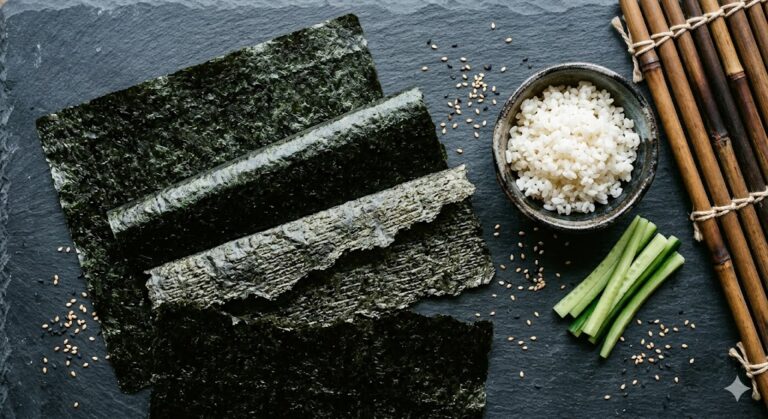
Nori (Pyropia yezoensis) is farmed on nets stretched between poles in tidal waters. The seaweed grows by absorbing dissolved minerals, nutrients, and gases directly from the seawater through its entire surface — there's no root system drawing from soil. Farmers influence the crop through:
- Net placement and depth
- Harvest timing (early vs. late season)
- Drying, toasting, and processing methods
- Disease management during growing season
What farmers generally don't do: add pesticides, herbicides, or synthetic fertilizers the way land crop farmers do. The growing medium — seawater — isn't directly manipulable in the same way.
What “Organic” Means Differently for Seaweed
Standard organic certification for land crops prohibits synthetic pesticides and fertilizers and requires documented soil management. For seaweed, the certification frameworks are still evolving, and different certifying bodies apply different standards:
JAS Organic (Japan): The Japanese Agricultural Standard for organic agriculture applies a modified framework to seaweed production. Key requirements include:
- No synthetic substances applied to the seaweed or growing area
- No synthetic additives in processing or drying
- Farm is not in waters with known industrial contamination
- Documented origin and processing traceability
JAS certification for seaweed is less about “what wasn't applied to the crop” (since very little is applied anyway) and more about water quality documentation, processing cleanliness, and supply chain traceability.
EU Organic (for Japanese nori exported to Europe): The EU's organic seaweed regulation focuses on source water quality testing, sustainable harvesting, and processing without synthetic additives. More stringent than JAS for water quality documentation.
USDA Organic: The US program has historically had less clear standards for seaweed than for land crops. USDA Organic certified nori meets the general organic principles but the seaweed-specific standards are less detailed than EU or JAS frameworks.
What Organic Nori Actually Guarantees
When you buy JAS or EU Organic certified nori, you're primarily getting:
- Water quality documentation: The farming area has been assessed for contamination (heavy metals, industrial pollutants, excess nutrients from agricultural runoff). This is the most meaningful quality assurance organic nori provides.
- Clean processing: No synthetic preservatives, dyes, or additives in drying and toasting
- Traceability: The supply chain is documented from water to package
- No synthetic substances applied during growing: Though few are applied even to conventional nori
What organic nori certification does NOT guarantee: that the surrounding ocean water is pristine. Seaweed absorbs what's in its water, and ocean water is not controllable at the farm level. Heavy metal content, microplastics, and water quality generally are better addressed by regional water quality standards than by organic certification per se.
Is Conventional Japanese Nori Safe?
Japanese nori from major growing regions — particularly the Ariake Sea, Ise Bay, and Tokyo Bay — is subject to Japan's food safety regulations, which include heavy metal testing and contamination monitoring. The major nori-growing regions of Japan are not industrial zones; they're traditional fishing and farming areas with long-standing quality management.
For the average consumer, quality conventional nori from named Japanese origins (Ariake, Ise) with documented testing is safe and high quality. The organic premium buys you additional documentation and supply chain transparency more than it dramatically changes what's in the nori.
When Organic Nori Is Worth the Premium
High-frequency consumers: If you eat nori multiple times daily — regular seaweed salads, several onigiri per day — the cumulative exposure argument applies. Water quality documentation and processing cleanliness matter more at high consumption rates.
Children eating nori regularly: Children's bodies accumulate environmental exposures differently. For households where children eat nori regularly as a snack, organic certification provides additional confidence about water quality documentation.
Personal values alignment: If you consistently choose certified organic across your food choices, extending that to nori is logically consistent.
Processing quality: Organic certification's guarantee of no synthetic processing additives is genuinely meaningful — conventional nori can include synthetic preservatives or drying aids not present in certified organic versions.
How to Read Organic Nori Labels
Look for:
- Specific certification body named (JAS, EU Organic, USDA Organic) — not just the word “organic”
- Specific growing region (Ariake Sea, Ise Bay, etc.) — water quality varies significantly by location
- Processing information — any additives in seasoning or drying
- Harvest date — freshness matters for nori regardless of organic status
A product calling itself “natural nori” or “clean nori” without a specific certification is a marketing claim without verification. Actual organic certification has specific requirements and annual auditing.
Browse our nori selection — we carry nori with full origin transparency and processing information.
Frequently Asked Questions
Is organic nori lower in iodine? No — iodine content is determined by the seaweed species and growing conditions (water nutrient levels), not farming certification. Both organic and conventional nori have naturally high iodine.
Does organic nori taste different? Not in ways most people can detect in a blind tasting. Flavor differences in nori are primarily driven by growing region (Ariake vs. Ise), harvest timing (early vs. late season), and processing quality — not organic certification per se.
Can nori be truly “organic” when it grows in the ocean? This is the philosophical tension in seaweed certification. The certifications acknowledge this — they focus on what's controllable (processing, farming practices, documented water quality) rather than claiming the ocean itself is organic. It's a reasonable pragmatic framework.
Should I choose organic nori over premium-grade conventional nori if budget forces a choice? Choose the premium-grade conventional nori from a named Japanese growing region. Grade (quality) determines flavor; organic certification primarily addresses process documentation. A gold-grade Ariake nori beats a low-grade certified organic nori on every culinary measure.
Is Korean organic nori as good as Japanese organic nori? Different products. Korean gim is typically different seaweed preparation — thinner, often pre-seasoned with sesame oil. Japanese yaki nori for sushi is distinct. Organic certification exists for both. For sushi applications, Japanese nori's specific flavor profile is what most people are seeking.