Japanese vs Western Cutting Board: Which Style Is Better for Your Kitchen?
Cutting boards look like a simple purchase until you start comparing them seriously. Japanese and Western boards differ significantly in material, construction, and the philosophy behind how they protect your knives and your food. If you're cooking Japanese dishes, working with premium knives, or simply want to upgrade from a plastic board, understanding these differences will save you money and give you a board you'll use for decades.
The Core Philosophy: Knife-First vs. Durability-First
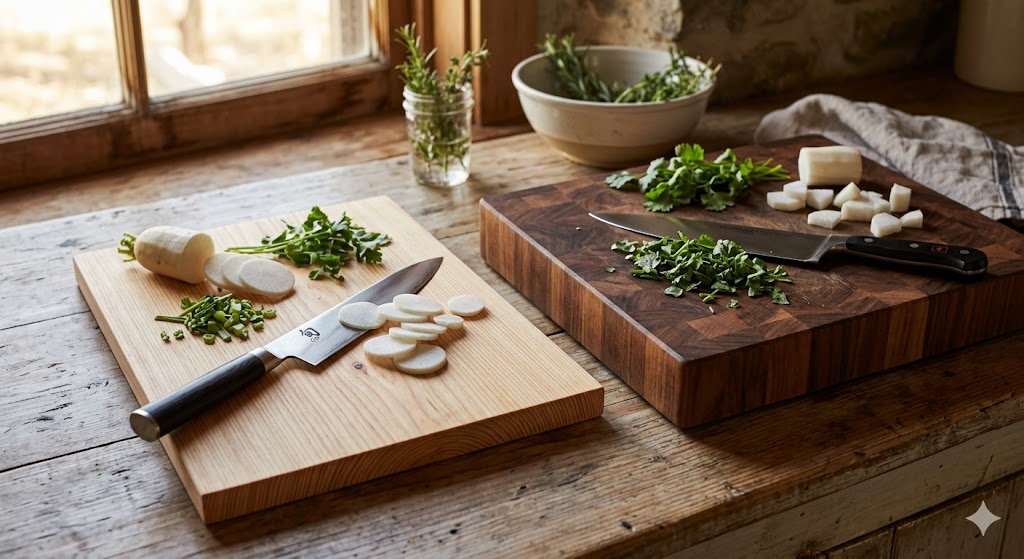
Western cutting boards — especially the thick, end-grain maple and walnut boards popular in American kitchens — are designed around durability. They're built to take abuse, handle heavy cleavers, and withstand dishwasher cycles (though you shouldn't machine-wash wood boards regardless). The wood species tend toward hard, dense hardwoods like maple, walnut, and teak.
Japanese cutting boards are designed knife-first. The traditional Japanese woods — hinoki cypress, ginkgo (icho), and paulownia (kiri) — are softer than Western hardwoods. This is intentional. Softer wood is kinder to the edge of a knife. When a blade meets a yielding surface, the edge deflects slightly rather than stopping hard, which preserves the sharpness of thin, high-hardness Japanese knives far longer than cutting on a hard surface would.
This distinction matters most if you're investing in Japanese knives. A quality Japanese cutting board is essentially a tool that protects your other tools.
Wood Species: What Each Tradition Uses
Western boards typically use:
- Hard maple: Dense, durable, takes a food-safe finish well. The American standard.
- Walnut: Slightly softer than maple, preferred by knife enthusiasts. Dark color shows stains less.
- Teak: High silica content — actually quite hard on blades. Popular but not ideal for fine knives.
- Bamboo: Very hard, fast-growing, but hard on knife edges. Not recommended for Japanese knives.
Japanese boards typically use:
- Hinoki (Japanese cypress): Aromatic, naturally antimicrobial, gentle on edges. The premium choice.
- Ginkgo (icho): Dense for a Japanese wood, has a unique self-healing quality. Highly regarded in professional Japanese kitchens.
- Paulownia (kiri): Very light, the softest of the traditional Japanese woods, excellent for edge preservation.
Shop hinoki cutting boards and ginkgo cutting boards in our full range.
Construction: End-Grain, Edge-Grain, and Single-Piece
Western boards come in two main constructions: edge-grain (wood running horizontal, the most common) and end-grain (wood running vertical, showing the cut end of the grain). End-grain boards are more expensive, more knife-friendly, and self-heal better from knife marks.
Traditional Japanese cutting boards are typically made from a single solid piece of wood or a small number of joined pieces. They're not end-grain in the Western sense. The grain runs lengthwise, and the boards are often thicker and heavier than comparable Western boards. High-end Japanese boards from specialty suppliers can be carved from a single trunk and measure several inches thick.
Thickness and Weight
Traditional Japanese professional cutting boards (known as manaita) are often extremely thick — 3 to 6 inches is not unusual in a professional kitchen. This thickness serves multiple purposes: stability during heavy cutting, thermal mass that keeps food cooler during prep, and longevity through resurfacing over decades of use.
Western end-grain boards also run thick (1.5 to 3 inches is common), but the weight can become impractical. A 3-inch thick maple end-grain board can weigh 15-20 pounds. Japanese boards in hinoki or paulownia are much lighter for their size due to lower wood density, which makes them easier to handle and clean.
Maintenance: Different Requirements
Western hardwood boards:
- Regular oiling with food-safe mineral oil (monthly or when the wood looks dry)
- Conditioning with beeswax-based board cream helps seal the surface
- Hand wash only — dishwashers warp and crack wood boards
- Dry standing upright to prevent warping
Japanese wood boards:
- Hinoki is naturally antibacterial and requires less aggressive cleaning
- Rinse thoroughly after use, dry completely before storage
- Do not oil hinoki — it can prevent the natural aromatic oils from functioning
- Lightly sand with fine-grit sandpaper if surface becomes rough or stained
See our guide on cutting board care and maintenance for full instructions.
Price Comparison
Quality Western end-grain maple boards from established makers run $80-$200 for a full-size board. Premium walnut end-grain boards can exceed $300.
Japanese hinoki boards vary widely: a good mid-size hinoki board runs $40-$100, while professional-grade thick boards from artisan makers in Japan can reach $200-$400+. Ginkgo boards tend to be slightly more expensive than hinoki due to the relative scarcity of ginkgo lumber. Paulownia boards are the most affordable option.
In both traditions, you get what you pay for. A cheap teak board from a mass retailer will outlast its welcome quickly; a quality Japanese hinoki board properly cared for will outlast you.
Which Should You Choose?
Choose a Japanese board if you:
- Own or plan to buy Japanese knives (single-bevel, high-carbon, or thin-edged double-bevel)
- Cook Japanese cuisine frequently
- Prefer lighter weight and easier handling
- Want natural antibacterial properties (hinoki)
- Value the aesthetic and the ritual of traditional Japanese kitchen tools
Choose a Western board if you:
- Primarily use Western-style knives (German chef's knives, thick-blade cleavers)
- Cook a lot of large-volume prep that requires a heavy, stable surface
- Prefer end-grain construction for self-healing properties
- Want a board that doubles as a serving presentation piece (walnut boards look beautiful)
Best of both worlds: Many serious home cooks have both. A Japanese hinoki board for fine knife work and delicate cuts, and a Western maple or walnut board for heavy prep.
Frequently Asked Questions
Are Japanese cutting boards dishwasher safe?
No. No quality wood cutting board should go in a dishwasher. The extreme heat and moisture cycling will warp and crack the wood.
Is hinoki better than bamboo?
Yes, for knife-friendly cutting. Bamboo is marketed as sustainable and hard-wearing, but its hardness is bad for blade edges. Hinoki is softer and far kinder to knives.
Can I use a Japanese cutting board for meat?
Yes. Hinoki's natural antibacterial properties come from hinokitiol and other compounds in the wood. However, standard food safety practice (washing thoroughly, allowing to dry completely) applies regardless of board material.
What size cutting board do I need?
For most home cooks, a board at least 12×18 inches gives enough working room. If you're breaking down whole fish or poultry, go larger — 15×24 inches or more.
Do Japanese boards warp?
All solid wood boards can warp if dried improperly. The key is always standing the board on edge (not laying flat) when drying, and drying both sides evenly.