Ariake Nori vs Regular Nori: Is Premium Seaweed Worth It?
If you've shopped at a quality Japanese grocer or specialty food store, you've encountered the price gap between standard nori and Ariake nori. The difference can be substantial — sometimes double or triple the cost per sheet. Is Ariake nori legitimately better, or is it primarily marketing? Having used both extensively, the answer is unequivocally: Ariake nori is better, and in most sushi applications the quality difference is immediately perceivable.
What Is Ariake Nori?
Ariake nori refers to nori harvested from the Ariake Sea (Ariake Kai) — a semi-enclosed bay on the northwestern coast of Kyushu, shared between Fukuoka, Saga, Kumamoto, and Nagasaki Prefectures. The Ariake Sea is Japan's largest nori-producing body of water and has specific characteristics that produce exceptional seaweed:
- Extreme tidal variation: The Ariake Sea has Japan's largest tidal range (up to 6 meters). This means the nori crops alternate between exposure to air and submersion in nutrient-rich water multiple times daily — a cycle that drives intensive nutrient uptake.
- Nutrient-rich shallow water: River inflows from four prefectures deliver a constant supply of agricultural runoff nutrients that feed the nori crops. Higher nutrient availability means more developed flavor compounds.
- Dedicated nori farming tradition: Generations of nori farmers have refined cultivation and processing techniques specific to Ariake's conditions, creating accumulated expertise that shows in finished product quality.
How Ariake Nori Differs: The Quality Indicators
Side by side, Ariake nori differs from generic nori in several measurable ways:
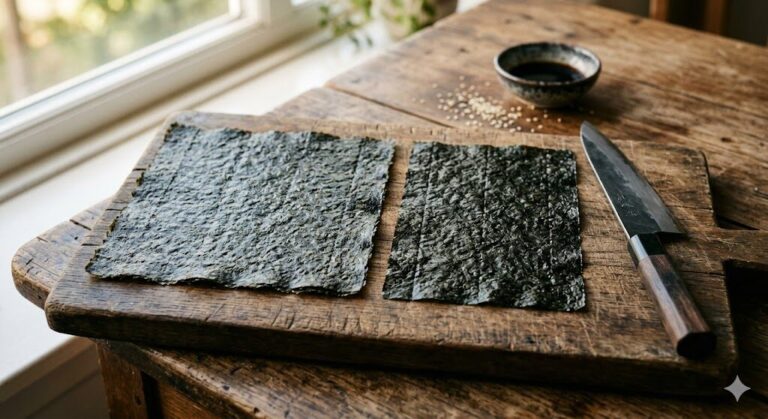
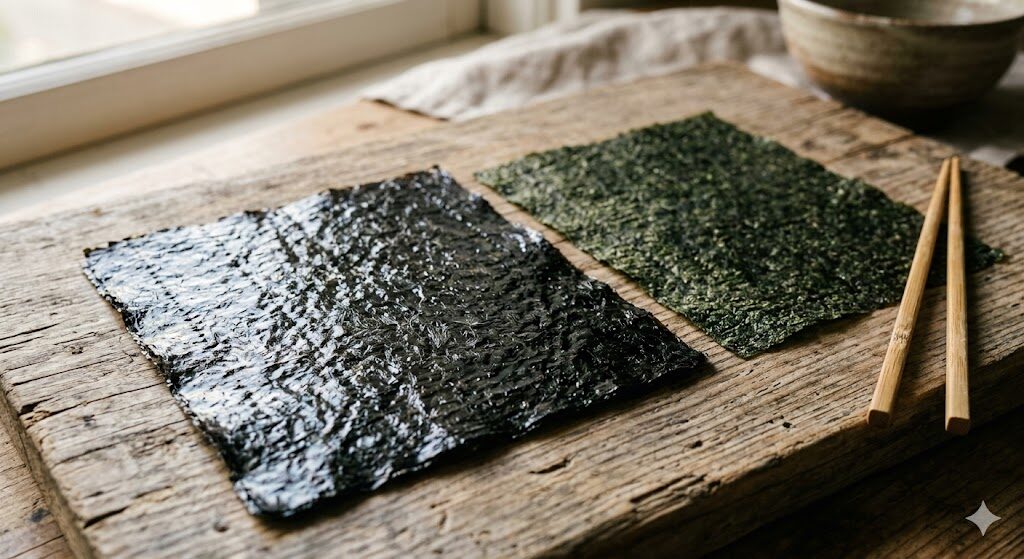
Thickness and density: Ariake nori sheets are notably thicker and more substantial than standard nori. When you hold a sheet to light, generic nori is often nearly transparent in spots; Ariake nori maintains consistent density throughout. Thickness affects how the nori holds during rolling and how it contributes flavor.
Color: Deep, uniform dark green-black with a glossy sheen. Generic nori often has color variation, brownish spots, and less glossiness. Color is a direct proxy for chlorophyll content and freshness.
Aroma: Ariake nori has a complex, multi-layered oceanic fragrance — a clean briny note layered with something almost sweet and mineral. Generic nori smells simply “like dried seaweed.”
Snap test: Quality nori snaps cleanly and crisply when torn. Ariake nori produces a clean break with a distinct sound. Generic nori bends more, tears unevenly, and lacks that satisfying crispness.
Flavor in use: In a well-made sushi roll, Ariake nori contributes distinct flavor rather than just neutral structure. The umami depth of premium nori is perceptible in the finished roll.
The Grading System Within Ariake Nori
Not all Ariake nori is equal — there's a grading system within the Ariake designation:
Early harvest (hatsu-nori): First harvest of the season, typically November–December. These thin, tender new-growth sheets have the most delicate flavor and are considered the premium tier. They're also the most expensive and available in the smallest quantities.
Mid-season: January–February harvest. This is the bulk of Ariake production — thick, glossy, excellent quality. What most premium nori products use.
Late season: March–April. Still quality but slightly less tender. Often used for cooking applications.
Grade numbers: Within each harvest period, sheets are sorted into grades (typically 1–10 or similar scales by individual producers/cooperatives). Gold label and silver label designations you see on packages correspond roughly to these grades.
Regular Nori: What You're Comparing Against
“Regular nori” for export markets often comes from multiple production areas — not always Ariake — and may blend harvests or quality grades. This doesn't make it bad, but it means less provenance transparency and typically lower quality ceilings.
Sources of non-Ariake Japanese nori:
- Ise Bay (Mie): Good quality, slightly more affordable than Ariake. Cleaner, more neutral flavor.
- Tokyo Bay / Chiba: Traditional growing area, reduced production now due to urbanization.
- Various other Kyushu coastal areas outside the Ariake Sea proper.
There's also significant production from Korea (used for Korean gim products) and, increasingly, China and other countries. These non-Japanese nori products are typically significantly cheaper but have different flavor profiles and generally lower quality for sushi applications.
Is Ariake Nori Worth the Premium? Honest Assessment
It depends on the application:
Worth it for:
- Sushi rolls where you want every component to contribute flavor
- Temaki (hand rolls) eaten immediately, where you want maximum crunch and aroma
- Any application where the nori is prominently featured and not masked by sauces
- Premium gifting — a package of Ariake nori is a legitimate gourmet gift for Japanese food enthusiasts
Less necessary for:
- Cutting into fine strips for garnish where flavor impact is minimal
- Cooking applications where the nori dissolves (some soups and porridges)
- Budget cooking where overall spend is a primary constraint
Shop our nori selection — we carry gold and silver label nori from Ariake and Ise growing regions.
Frequently Asked Questions
How can I tell if nori is genuinely from Ariake? Look for explicit “Ariake Sea” or “有明海” labeling with the specific prefecture noted (Saga, Fukuoka, Kumamoto, or Nagasaki). Generic “Japanese nori” without regional specificity may or may not be Ariake.
Does Ariake nori stay crisp longer? Yes — the greater thickness and density provide more moisture resistance. Ariake nori maintains crisp snap slightly longer after rolling than thinner generic nori.
Can I substitute regular nori in recipes that call for Ariake? Yes. The dish will work fine; the Ariake-specific flavor contribution will be reduced. For casual home cooking, standard quality nori is appropriate. For anything you'd present to guests or where the nori is a centerpiece, the upgrade is worthwhile.
What is the price range for Ariake nori? Expect $8–18 per 10-sheet pack for silver/gold grade Ariake nori through specialty importers. Compare to $3–6 for standard nori. Per-roll cost difference: roughly $0.50–1.00. Not prohibitive for home cooking.
Is Korean nori as good as Ariake nori for sushi? Different product, different use. Korean gim (often the familiar pre-seasoned snacking sheets) is typically thinner and oilier — excellent as a snack, but not the right choice for Japanese sushi rolls where structural integrity and specific flavor are important.