How to Remove Mold from a Wooden Cutting Board (And Keep It from Coming Back)
Finding mold on a wooden cutting board is alarming, but in most cases it's salvageable. The key is acting quickly, using the right treatment, and then addressing whatever storage or drying habit caused the mold in the first place. Here's exactly what to do.
First: Assess the Situation
Not all discoloration on a cutting board is mold. Differentiate before treating:
- Mold: Fuzzy, colored growth (green, black, white, or gray). Usually in grooves or edges that stay moist longer. May have a musty or earthy smell.
- Staining: Flat discoloration from foods (beets, turmeric, red cabbage, berries). No fuzzy texture, no smell.
- Dark grain lines: Natural variation in wood grain, not mold.
If it's staining or natural grain, no treatment is needed beyond normal cleaning. If it's genuinely fuzzy or has a musty odor, proceed with treatment.
What Causes Mold on Cutting Boards?
Mold on wood boards is almost always a moisture management problem:
- Board laid flat while wet — moisture trapped underneath
- Stored in a closed cabinet before fully dry
- Excessive moisture exposure (soaking in water, frequent use without adequate drying time)
- High ambient humidity in storage area
- Deep knife grooves that trap moisture and food particles
Treatment Method 1: White Vinegar Wash (For Surface Mold)
White vinegar is effective against most common mold species found on cutting boards. It's food-safe, doesn't bleach the wood, and is likely already in your kitchen.
- Mix undiluted white vinegar in a spray bottle or pour directly onto the board
- Let sit for 5-10 minutes
- Scrub with a stiff brush or rough sponge, working into any grooves
- Rinse thoroughly with cold water
- Pat dry with a towel, then stand on edge to air dry completely (4-6 hours minimum)
Check after drying. If the mold is gone and there's no remaining odor, you can return the board to use. If traces remain, proceed to Method 2.
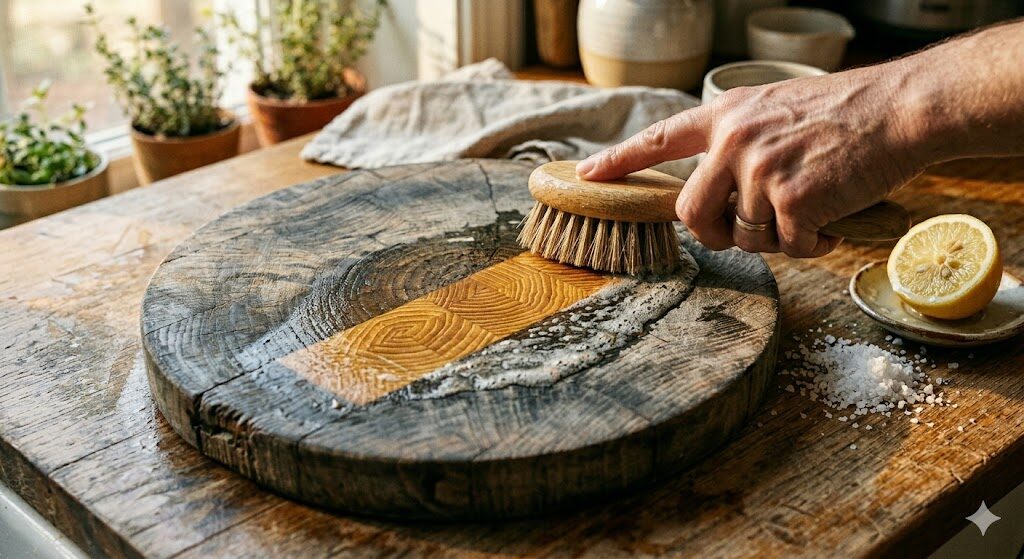
Treatment Method 2: Salt and Lemon Scrub (Mild to Moderate Mold)
Coarse salt acts as a mechanical abrasive while lemon provides acid to kill mold spores and neutralize odors.
- Generously cover the board surface with coarse kosher salt or sea salt
- Cut a lemon in half and use the cut face to scrub the salt into the board surface in firm circular motions
- Pay extra attention to grooves, edges, and any areas where mold was visible
- Let the salt-lemon mixture sit on the board for 5 minutes
- Rinse thoroughly with cold water
- Dry completely, standing on edge
Treatment Method 3: Hydrogen Peroxide (For More Stubborn Mold)
3% hydrogen peroxide (standard drugstore variety) is effective against mold without the harsh bleaching effect of chlorine bleach on wood.
- Apply 3% hydrogen peroxide directly to the moldy areas
- Let it fizz and sit for 10 minutes
- Scrub with a brush
- Rinse thoroughly
- Air dry completely
Hydrogen peroxide may lighten the wood slightly in treated areas. This is cosmetic only and fades with use.
Treatment Method 4: Sanding (For Deep Mold in Wood Grain)
If surface treatments don't fully eliminate mold or odor, the mold has penetrated deeper into the wood grain. Sanding is the definitive fix.
- Allow the board to dry completely (this is critical — sanding wet wood is ineffective and clogs sandpaper)
- Sand the affected areas with 80-100 grit sandpaper to remove the surface layer of wood
- Follow with 150-180 grit to smooth the surface
- Finish with 220 grit for a smooth surface
- Wipe all dust with a dry cloth
- Rinse lightly with water and dry standing on edge
After sanding, the board should look and smell like fresh wood. If you're working with a Japanese hinoki board, the characteristic cypress aroma will return after sanding. For Western hardwood boards, apply a light coat of food-grade mineral oil after sanding — hinoki boards should not be oiled.
Browse our hinoki cutting boards and Japanese cutting board collection.
When to Discard the Board
Some situations call for replacement rather than treatment:
- Mold has penetrated deeply throughout the board — visible on all sides and in the core grain
- The board has cracked or split, creating crevices that can't be cleaned
- Multiple treatments have been done and the musty smell persists after drying
- The board is warped severely and no longer lies flat
- The board is very thin from years of resurfacing — further sanding would leave it structurally compromised
Prevention: How to Avoid Mold Permanently
This is more important than treatment. All the cleaning in the world doesn't help if the storage habit hasn't changed.
The non-negotiable rules:
- Never lay a wet board flat. Always stand on edge immediately after rinsing. This is the single biggest factor.
- Dry both sides equally. If you rinse only the top surface and lay the board down, moisture collects underneath.
- Allow complete drying before storage. Don't put a board in a cabinet or drawer while still damp.
- Use a board rack or hook if space allows — vertical storage means constant air circulation on both sides.
- Clean knife grooves regularly. Run a brush along deep knife marks when washing — food trapped in grooves is the main mold food source.
Frequently Asked Questions
Is it safe to use a board that had mold after treating it?
Yes, after thorough treatment and complete drying. If the mold is visually gone and no musty odor remains after drying, the board is safe. Sanding is the most definitive treatment for complete peace of mind.
Can I use bleach on a wooden cutting board?
Use very diluted bleach only (1 tablespoon per gallon of water) and rinse very thoroughly. Bleach can discolor wood and weaken the grain over time. Hydrogen peroxide and vinegar are gentler and nearly as effective.
How long should a wooden board dry before storage?
At minimum 2-3 hours standing on edge in a ventilated area. In humid climates, longer is better. When in doubt, leave it out overnight.
Does hinoki wood resist mold better than maple?
Yes. Hinoki (Japanese cypress) contains hinokitiol and other compounds with documented antibacterial and antifungal properties. This means mold is less likely to develop on hinoki boards, but it's not immune — poor drying habits can produce mold on any wood.
Can I use the dishwasher to kill mold on a cutting board?
No. The dishwasher's high heat and prolonged water exposure will warp and crack the board, and it won't do a better job on mold than hand treatment. For wood boards specifically, dishwashers cause more damage than they prevent.