Full-Sheet vs Half-Sheet Nori: Which Should You Buy?
Nori sheet size might seem like a trivial decision, but it has practical implications depending on what you're making in your kitchen. Full sheets and half sheets are the two most common retail formats, and the right choice depends on how you cook with nori — not just how much storage space you have. Here's the practical breakdown.
Standard Nori Sheet Dimensions
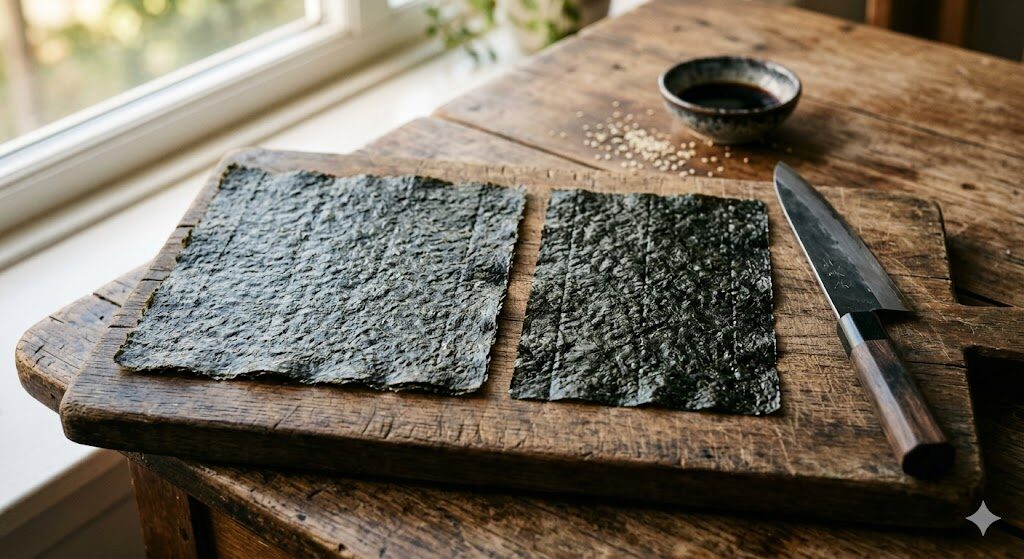
A full standard nori sheet measures approximately 7.5 inches x 8 inches (19cm x 21cm). This is the industry standard — sized specifically for maki sushi rolls, where the nori wraps completely around a standard bamboo mat roll.
Half sheets are simply full sheets cut across the width, resulting in two pieces of approximately 3.75 inches x 8 inches (9.5cm x 21cm). These are sold pre-cut as half sheets, or you can cut full sheets yourself.
When Full Sheets Are the Right Choice
Maki sushi rolls: Full sheets are the standard for maki. A full nori sheet wraps around a standard diameter maki roll with enough overlap to seal when the rice moisture binds the edge. Using a half sheet for maki requires either very thin rolls (hosomaki) or leaving the roll partially uncovered — neither is ideal for most applications.
Temaki (hand rolls): Hand rolls start with a full sheet or three-quarter sheet. The nori wraps around the filling in a cone shape, and you need the full surface area for both structure and enough nori to actually taste in every bite.
Nori-wrapped appetizers and garnishes: Wrapping pieces of fish, vegetables, or onigiri requires full sheets or cutting to size. Starting with full sheets gives you maximum flexibility.
Versatility and economy: Full sheets can always be cut in half or into strips. Buying full sheets means one product covers all applications. Half sheets can't be combined back into full sheets.
When Half Sheets Are Useful
Onigiri (rice balls): Traditional onigiri uses a half sheet (or slightly larger piece) to wrap the bottom and sides of the rice ball. The half sheet is exactly the right proportion — a full sheet creates awkward excess that either bunches up or needs to be cut anyway.
Hosomaki (thin rolls): Thin rolls with single fillings (kappamaki cucumber roll, tekkamaki tuna roll) use a half sheet. The narrower nori produces a smaller diameter roll with better rice-to-filling ratio for these applications.
Children's portions or small servings: If you regularly make smaller rolls or want single-serving wraps, pre-cut half sheets save the step of cutting yourself.
Convenience for less-frequent cooks: If you make onigiri weekly but full sushi rolls only occasionally, having half sheets on hand means less prep work for your most common use case.
The Practical Recommendation
For most home cooks: buy full sheets and cut when needed.
Reasons:
- Full sheets cover 100% of applications; half sheets cover roughly 60%
- Cutting a full sheet in half takes under 10 seconds with kitchen scissors
- Full sheets typically cost the same per gram as half sheets when comparing equivalent quality and pack size
- Storing full sheets flat keeps them in better condition than stacking many smaller pieces
The only scenario where buying pre-cut half sheets makes sense: you exclusively make onigiri and hosomaki and never full-sized maki rolls. If that describes you, pre-cut half sheets save minor prep time and store compactly.
How Many Sheets Per Pack: What to Buy
Nori is sold in several pack sizes:
- 10-sheet packs: For occasional home sushi making — perhaps monthly. Easier to use fresh before staleness sets in after opening.
- 25-sheet packs: For regular sushi or onigiri making — weekly or bi-weekly. Good balance of economy and freshness management.
- 50–100 sheet packs: For frequent use or households that go through nori quickly. Better per-sheet economics but requires diligent storage to maintain freshness after opening.
A practical rule: buy the pack size you'll use within 4–6 weeks of opening. Nori's freshness degrades quickly once exposed to air, regardless of pack size.
Cutting Full Sheets: Tips
When cutting full sheets to half sheets or strips:
- Use kitchen scissors: Cleaner and faster than a knife for nori. A single clean cut maintains the crisp edge.
- Cut immediately before use: Cut edges expose more surface area to air. If cutting in advance, seal the cut pieces tightly immediately.
- Avoid pressing down: Nori is delicate — press gently when holding to cut. Crumpled nori tears rather than cutting cleanly.
Nori Sheet Formats Beyond Full and Half
Other nori formats available:
- Nori strips (kizami nori): Pre-cut thin strips for garnishing noodles, rice bowls, and soup. Convenient for this specific application.
- Square nori for gunkan maki: Some specialty nori products come pre-cut for specific sushi types. Rarely worth the premium for home use — cut your own.
- Nori flakes (ao-nori): Different species of seaweed (Enteromorpha), green in color, used primarily as a condiment on okonomiyaki and takoyaki — not the same as sushi nori sheets.
Browse our nori sheet selection — full sheets in gold and silver grade, 10-sheet and 50-sheet packs.
Frequently Asked Questions
Does it matter which side of the nori faces out in maki rolls? Yes — nori has a smooth, glossy side and a rough, matte side. Traditional technique places the rough side against the rice (better adhesion) and the smooth side facing out. For inside-out rolls (rice on outside), this is inverted.
Can I use half sheets to make full-size maki? Not effectively. You can overlap two half sheets on the mat, but they won't bond at the seam and the roll will be structurally weaker. Use full sheets for full-size rolls.
Are there thick and thin varieties within full sheets? Yes — this corresponds to grade. Gold-label nori sheets are noticeably thicker and denser than silver or green label. Thickness affects structural integrity and flavor contribution in finished rolls.
How do I store cut pieces of nori? Immediately seal in an airtight bag or container, press out all air, and store at room temperature. Use within 1–2 weeks for best crunch.
Does cutting nori ahead of time affect quality? Slightly — cut edges are more exposed to moisture. For best results, cut immediately before assembly. For onigiri you'll eat within an hour, pre-cutting is fine.