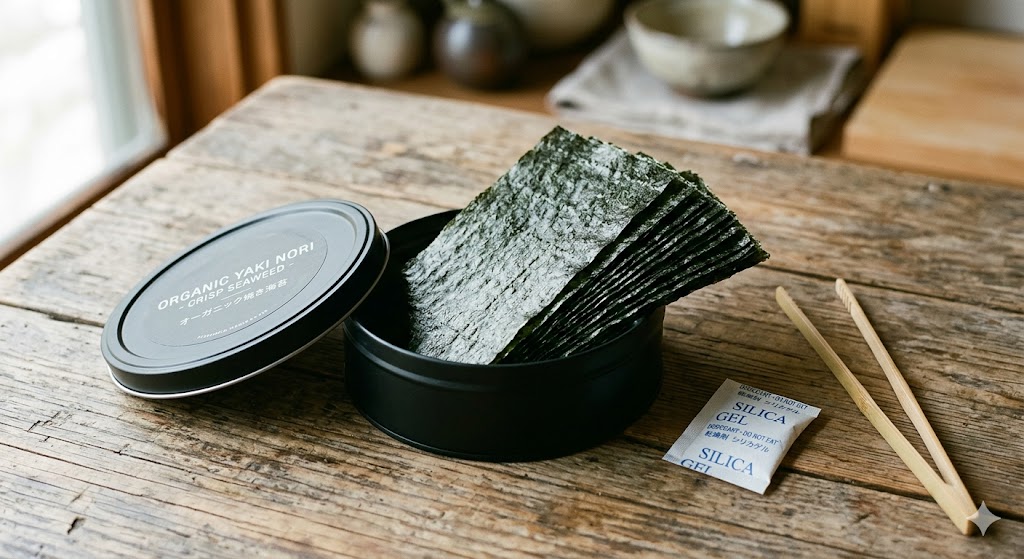
How to Store Nori: Keep It Crispy and Fresh
You open a fresh pack of nori, roll a couple of hand rolls, and leave the rest. Three days later you pull it out and it's leathery, chewy, and smells stale. Sound familiar? It's one of the most common kitchen frustrations for anyone who cooks Japanese food at home. Nori's arch enemy is humidity, and most storage mistakes are some form of letting moisture in. Here's exactly how to prevent it — and how to revive nori that's already gone soft.
Why Nori Goes Soft: The Science
Nori is dried seaweed, which means it was specifically processed to remove moisture. That drying process is what creates the characteristic crisp snap and concentrated umami flavor. Problem: seaweed is hygroscopic — it actively pulls moisture from the surrounding air. In a humid kitchen, an open pack of nori can go from perfectly crisp to chewy within a few hours.
The moisture doesn't just change the texture. It also begins breaking down the flavor compounds that make quality nori taste like the sea in a good way. Soft nori tastes flat compared to crispy nori — the aromatic compounds that volatilize in your mouth when the nori snaps are no longer there to deliver.
This is why professional sushi chefs are almost obsessive about nori timing — they'll often keep nori sealed until the last possible moment before rolling.
The Right Way to Store Opened Nori
The goal is to eliminate air contact as much as possible:
Step 1: Reseal immediately after use. Don't leave the bag open on the counter while you're prepping. Pull out what you need, then close the bag before you start cooking.
Step 2: Remove excess air. Press all the air out of the bag before sealing. If the bag doesn't reseal well, transfer the sheets to a zip-lock bag and press out air before closing. Some cooks keep a dedicated airtight container (like a rectangular Tupperware large enough to fit full sheets flat) specifically for nori.
Step 3: Add a desiccant. Drop a small silica gel packet into the container or bag. These are often included with high-quality nori packaging — save them and reuse them. The silica absorbs ambient moisture and keeps the nori environment dry. Food-grade silica packets are inexpensive and reusable (dry them in a low oven for 30 minutes to reactivate).
Step 4: Store at room temperature. This surprises people, but the refrigerator is actually a bad choice for nori in most cases. Refrigerators contain substantial moisture, and the temperature cycles as you open and close the door cause condensation. Unless you live somewhere with very high ambient humidity (and your room-temperature storage truly isn't working), keep nori in a cool, dark pantry or cupboard.
What About Freezer Storage?
The freezer does work for long-term nori storage, with one critical rule: the package must be completely airtight and the nori must come fully to room temperature before opening. If you open a cold package of nori, condensation immediately forms on the cold sheets, wetting them before you've even started.
Process for freezer storage:
- Seal nori in a vacuum-sealed bag or very well-pressed zip-lock
- Freeze
- When needed, remove from freezer and let the sealed package come to room temperature completely (30–60 minutes)
- Open and use
Frozen nori maintains quality for up to 12 months. Only worth doing if you bulk-buy quality nori and won't use it for months.
How to Revive Soft Nori
If your nori has already gone soft, all is not lost. The moisture is the problem — remove it and you restore the crunch:
Gas stove method: Hold the nori sheet flat (with tongs or your fingers at the edges) about 6 inches above a low gas flame. Move it in slow passes for 5–10 seconds total. Don't hold it still or it will burn. The heat evaporates the moisture rapidly and you'll feel the sheet stiffen and hear it crinkle as it crisps up.
Dry pan method: Place a dry skillet over medium heat. Wave the nori sheet an inch or two above the surface for 5–8 seconds, moving constantly. Same principle — rapid moisture evaporation without scorching.
Oven method: For multiple sheets, preheat oven to 200°F (93°C). Lay sheets flat on a baking rack for 2–3 minutes. Watch carefully — nori goes from crispy to burned quickly.
Revived nori won't be quite as good as freshly opened nori, but it's dramatically better than chewy nori and perfectly suitable for cooking.
Storage by Nori Type
Not all nori has the same storage needs:
Plain yaki nori (toasted, for sushi): Most moisture-sensitive. Everything above applies. Store carefully, use within 1–2 weeks of opening.
Seasoned ajitsuke nori (pre-sauced, for snacking): The oil coating provides some protection against moisture absorption, and the softness is somewhat acceptable in this format. Still store airtight, but less fussy than plain nori.
Nori flakes or furikake blends: Already processed to a more stable form. Standard airtight container storage works fine for 3–6 months.
Buying Nori in the Right Quantity
The best storage strategy is also a buying strategy: buy nori in quantities you'll actually use within 2–4 weeks. The 100-sheet wholesale packs are economical but create a storage challenge. For most home cooks, a 10-sheet or 25-sheet pack purchased monthly is more practical than a giant pack bought twice a year.
Browse our nori selection — we carry 10-sheet and 50-sheet packs in gold and silver grades from Ariake and Ise growing regions.
Frequently Asked Questions
Can I store nori in the refrigerator? Generally no — refrigerators contain too much moisture. Exception: if your kitchen is extremely humid (tropical climate) and you have no air-conditioned storage, a tightly sealed container in the fridge is better than nothing. Let it come to room temp before opening.
How long does nori last once opened? With proper storage (airtight with desiccant), 2–4 weeks at peak quality. It doesn't go unsafe after that, just less flavorful and crispier to revive.
My nori smells off — is it bad? Stale nori smells flat or papery. Bad nori (though rare) smells genuinely unpleasant or rancid. If the smell is just “not as vibrant as fresh,” it's stale. If it smells actively wrong, discard it.
Does nori need to be refrigerated before opening? No. Sealed, unopened nori is shelf-stable in a cool, dark location for 6–12 months.
Why does my nori always break when I try to revive it? You're heating it too aggressively. Use lower heat and shorter passes — you want to drive off moisture, not scorch the nori. Crispy nori that snaps cleanly is the goal; burnt nori with holes is too far.