Japanese Tea Ceremony: A Complete Guide to Chado and Chanoyu
The Japanese tea ceremony — called chanoyu (茶の湯, “hot water for tea”) or chado (茶道, “the way of tea”) — is one of the most refined cultural practices in the world. It is not simply the act of drinking matcha. It is a complete philosophy, a living art form that weaves together architecture, garden design, ceramics, calligraphy, flower arrangement, and a precise choreography of movement into a single, unified moment of presence. For a deeper look, see our guide to kukicha — Japan's low-caffeine twig tea. Browse our collection including this noren curtain.
To attend a tea ceremony is to step outside ordinary time. The 16th-century master Sen no Rikyu called this state ichigo ichie (一期一会) — “one time, one meeting.” Every gathering is unrepeatable. The season, the guests, the scroll on the wall, the bowl in your hands — they will never combine this way again. That understanding is why every gesture in the ceremony, down to how a cloth is folded, carries real weight.
This guide covers everything you need to understand the ceremony deeply: its history and philosophy, the tea room and its symbolism, the tools and how they work, the step-by-step ritual, how to behave as a guest, and how to begin practicing at home. We'll also look at what makes spring tea ceremonies special — because March and April bring hanami (cherry blossom viewing) gatherings that are among the most beautiful expressions of the tradition.
A Brief History: From Status Symbol to Spiritual Practice
Tea arrived in Japan from China in the 8th century, brought by Buddhist monks who used it to stay alert during long meditation sessions. For centuries, it remained a luxury confined to monasteries and the aristocracy. By the 14th and 15th centuries, the Ashikaga shogunate had transformed tea gatherings into elaborate status displays — an excuse to showcase collections of rare Chinese porcelain, silk scrolls, and lacquerware. These were parties for the powerful, with beauty measured in expense.
The revolution came from an unlikely place: a merchant's son from Sakai named Murata Juko (1423–1502), who began insisting on wabi — the beauty of simplicity, rusticity, and impermanence. His successor Takeno Jo-o developed this further, and then came Sen no Rikyu.
Sen no Rikyu: The Master Who Redefined Beauty
Sen no Rikyu (1522–1591) is the defining figure of the Japanese tea ceremony. As tea master to the warlord Oda Nobunaga and later Toyotomi Hideyoshi, he had enormous cultural influence — and he used it to argue for the opposite of extravagance.
Rikyu championed wabi-cha: tea ceremony in the spirit of wabi. He designed tea rooms as small as 2 tatami mats. He replaced Chinese porcelain with rough Korean and Japanese bowls. He used bamboo where gold had been. He insisted the garden path should be swept but not too perfectly. The point was that over-perfection betrays effort — and effort destroys the atmosphere of naturalness that true beauty requires.
Rikyu's relationship with Hideyoshi ended in tragedy. In 1591, for reasons still debated by historians — possibly a conflict over authority, or an insult perceived in a sculpture — Hideyoshi ordered Rikyu to perform ritual suicide. He obeyed. His influence, however, proved impossible to kill. His three grandsons established the three great schools of tea that persist today: Urasenke, Omotesenke, and Mushanokoji Senke.
The Four Principles: Wa, Kei, Sei, Jaku
Rikyu articulated four principles that form the philosophical foundation of all tea ceremony practice. They are not decorative slogans — they describe actual states that the ceremony is designed to produce.
- Wa (和, Harmony) — The relationship between host, guest, tools, and environment. Not just politeness: a genuine stripping away of ego that allows a shared human experience to emerge. The tea room's design enforces this: everyone enters through the same small door, everyone sits at the same level.
- Kei (敬, Respect) — Mutual regard for all participants and all objects. Expressed through mindfulness — the recognition that this person, this bowl, this moment deserves full attention. Samurai left their swords outside. Status was checked at the nijiriguchi.
- Sei (清, Purity) — Both physical and mental. The ritual cleaning of each utensil is not merely hygienic; it is a visible enactment of clearing the mind. The host has been preparing and cleaning for hours before guests arrive.
- Jaku (寂, Tranquility) — The serene state that arises only when the other three principles are genuinely present. It cannot be forced. It cannot be performed. It arrives when the room, the tools, and the people are truly in alignment — and it is often described as tinged with a beautiful sadness, the awareness that the moment is already passing.
Wabi-Sabi: The Aesthetic at the Heart of Tea
Wabi-sabi (侘寂) is often translated as “the beauty of imperfection” — but that translation undersells it. Wabi originally referred to the loneliness and poverty of a hermit in the mountains. Sabi referred to the beauty of aged, weathered things. Together they describe an aesthetic that finds depth and authenticity in what is incomplete, irregular, and transient.
In the tea ceremony, wabi-sabi is everywhere. The chawan (tea bowl) may be irregular in shape, uneven in glaze, repaired with gold where it once cracked — a practice called kintsugi. A kintsugi bowl is considered more beautiful for its history, not despite it. The flower in the tokonoma alcove may be a single wild stem rather than a formal arrangement. The wooden pillars of the tea room are not painted or lacquered; they show their grain and their age.
This is a radical proposition: that the expensive, the symmetrical, and the perfect are not, in fact, beautiful — because they cannot change, cannot be damaged, cannot become anything more than what they already are. Wabi-sabi objects carry time in them. That is what gives them life.
The Tea Space: Architecture as Ritual
The physical environment of the tea ceremony is not backdrop — it is an active participant. Every element of the tea house and garden is designed to guide the guest from their ordinary state of mind into the calm receptivity that the ceremony requires.
| Element | Japanese | Description and Significance |
|---|---|---|
| Roji | 露地 | The “dewy ground” garden path from the gate to the tea house. Designed for slow, meditative walking. Stepping stones are placed irregularly so you look down — arriving already quieted. |
| Tsukubai | 蹲踞 | A stone water basin where guests wash their hands and mouth before entering — a physical act of purification, parallel to entering a Shinto shrine. |
| Nijiriguchi | 躙口 | The “crawling entrance” — a door only about 60cm square. Everyone must kneel to enter. Samurai left swords outside. Status becomes irrelevant inside. |
| Tatami | 畳 | Rush-covered straw mats. A traditional small tea room (koma) is 4.5 mats. Measurements in traditional architecture are still based on tatami proportions. |
| Tokonoma | 床の間 | The decorative alcove containing a hanging scroll (kakejiku) and a single flower arrangement (chabana). Sets the philosophical and seasonal theme for the gathering. |
| Mizuya | 水屋 | The preparation area, hidden from guests. The host prepares and cleans everything here before and after the ceremony. |
The seasonal element of the tokonoma deserves special attention. The kakejiku (hanging scroll) typically features Zen calligraphy — often a single phrase that sets the philosophical theme. In spring, a host might hang a scroll reading hana wa yama ni ari (“flowers belong in the mountains”) — a reminder not to cling. In winter, perhaps kan tan (“cold and simple”). The choice is not arbitrary; it is a message from host to guest.
The Tools: A Complete Equipment Glossary
The tools of the tea ceremony — collectively called dogu (道具) — are selected and arranged with the same care a musician gives to their instrument. Each has a specific function, but each is also chosen to reflect the season, the occasion, and the spirit of tools used in the ceremony.
| Japanese Name | English | Purpose and Notes |
|---|---|---|
| Chawan (茶碗) | Tea bowl | The central object. In summer, shallow and wide to cool tea; in winter, deep and narrow to retain heat. Irregular shape is a virtue, not a defect. |
| Chasen (茶筅) | Tea whisk | Carved from a single piece of bamboo into 80–120 fine tines. Used to whisk matcha into a frothy suspension. Different styles for usucha vs. koicha. Requires gentle care. |
| Chashaku (茶杓) | Tea scoop | A slender bamboo or ivory scoop for measuring matcha. Often individually named by master craftsmen. Simple but deeply significant. |
| Natsume (棗) | Thin tea caddy | A lacquered wooden container used to hold matcha powder during usucha (thin tea). Named for its resemblance to the jujube fruit. |
| Chaire (茶入) | Thick tea caddy | A small ceramic container for koicha (thick tea). Often stored in a silk drawstring pouch called a shifuku. Among the most prized objects in a host's collection. |
| Kama (釜) | Iron kettle | The heartbeat of the ceremony. Traditionally cast iron. The sound of water in the kama — a specific resonance called matsukaze (“wind in the pines”) — is considered the ceremony's music. |
| Furo / Ro (風炉/炉) | Brazier / Hearth | The heat source. Furo (portable brazier) used May through October; ro (sunken floor hearth) used November through April. Switching seasons is a ceremony in itself. |
| Hishaku (柄杓) | Bamboo ladle | Used to transfer hot water from the kama to the chawan, and cold water from the mizusashi to the kama. |
| Mizusashi (水指) | Fresh water jar | A covered ceramic or lacquered container holding cold water. Its lid is handled with particular care during the ceremony. |
| Fukusa (帛紗) | Silk cloth | A square of silk used to ritually purify the natsume and chashaku. The way it is folded and used is one of the most studied movements in tea practice. |
| Chakin (茶巾) | Linen wiping cloth | A small rectangle of white hemp or linen used to wipe the chawan after rinsing. Folded precisely; never wrinkled. |
| Kensui (建水) | Waste water bowl | Receives the rinse water used to clean the chawan. Deliberately humble in appearance — it holds what is discarded. |
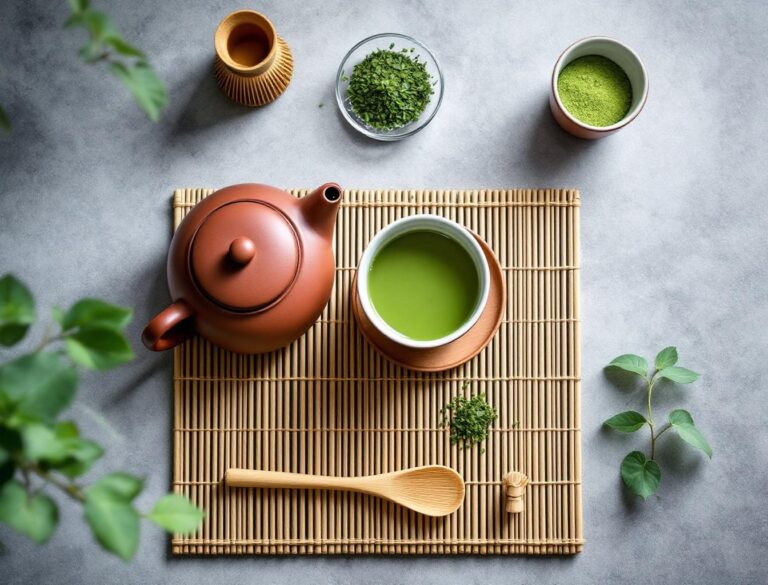
If you are building a home practice, the minimum essential set is: a chawan, a chasen, a chashaku, a natsume, and quality ceremonial-grade matcha. These five items are enough to perform the core ritual with integrity.
Usucha vs. Koicha: The Two Faces of Matcha
Most people who have tried matcha have had usucha — thin tea. But a formal tea ceremony includes both preparations, and they are very different experiences.
| Usucha (薄茶) — Thin Tea | Koicha (濃茶) — Thick Tea | |
|---|---|---|
| Matcha amount | ~1.5–2g (roughly 1 chashaku) | ~4–6g (roughly 3 chashaku) |
| Water | ~70–80ml at ~80°C | ~40ml at ~80°C |
| Texture | Light, frothy, individual portions | Thick, smooth, syrup-like; shared bowl |
| Preparation | Whisked quickly with chasen in zigzag motion | Kneaded in slow circular motion — never whisked aggressively |
| Matcha grade | High-quality ceremonial grade | The finest single-cultivar, shade-grown matcha available |
| Bowl sharing | Each guest receives their own bowl | One bowl is passed among all guests — each takes three sips |
| Formality | More casual; served later in a formal ceremony | The formal, ceremonial preparation; served first in a full chaji |
| Sweets | Higashi (dry sweets) | Omogashi / Namagashi (moist sweets, usually seasonal) |
Koicha matcha must be exceptional — the flavor is concentrated, and any bitterness or poor processing becomes impossible to hide. When choosing matcha for home practice, the grade that works for usucha is a starting point; for anything approaching koicha, you want the finest single-cultivar, shade-grown matcha you can source.
The Ceremony Step by Step
A full formal tea gathering (chaji) takes approximately four hours and includes a meal, a break in the garden, and both koicha and usucha. What most people attend — and what is described here — is a shorter gathering called chakai, focused on usucha. Here is how it unfolds:
Before Guests Arrive
The host has been preparing for hours — sometimes days. The tea room has been cleaned and aired. Fresh flowers have been selected and arranged in the tokonoma. The scroll has been chosen for its seasonal and philosophical resonance. The kama has been filled with water and the fire lit. Water left in the kama overnight is called yuzamashi (cooled water); some schools insist on fresh water from a well each morning.
1. The Roji Walk
Guests gather at the gate and are invited in. They walk the roji garden path slowly. If there are stepping stones, they step on them deliberately. They pause at the tsukubai basin to wash hands and rinse the mouth — both physical and symbolic purification. The garden is designed so that by the time guests reach the nijiriguchi, the world outside feels distant.
2. Entering and Viewing the Tokonoma
Guests remove shoes and enter on their knees through the nijiriguchi. Inside, they bow to the tokonoma — to the scroll and the flowers — before taking their seats on the tatami. This gesture acknowledges the host's aesthetic choices. Guests sit in seiza (formal kneeling) or, if that is difficult, with crossed legs.
3. The Host Enters with Utensils
The host enters carrying the tools in a specific order, each placed in an established position. The kama is already heating water. The arrangement of objects follows a logic that ensures everything needed is within reach and nothing interrupts the flow of movement. Silence is maintained — or conversation is quiet and unhurried.
4. Ritual Purification of Tools
The host uses the fukusa (silk cloth) to ritually wipe the natsume and chashaku. This is not really about cleanliness — everything was cleaned beforehand. It is a visible, intentional act of preparation, a way of saying: I am giving these objects my full attention before I use them to serve you.
5. Wagashi Sweets Are Served
Before the matcha is prepared, guests receive wagashi — traditional Japanese sweets. The reason is practical: sweets prime the palate, coating it with gentle sweetness that allows the savory, grassy, umami-rich flavor of matcha to register fully without being dominated by bitterness. The guest uses the kaishi (personal folded paper) to receive the sweet, and eats before the bowl arrives.
6. Preparing and Whisking the Tea
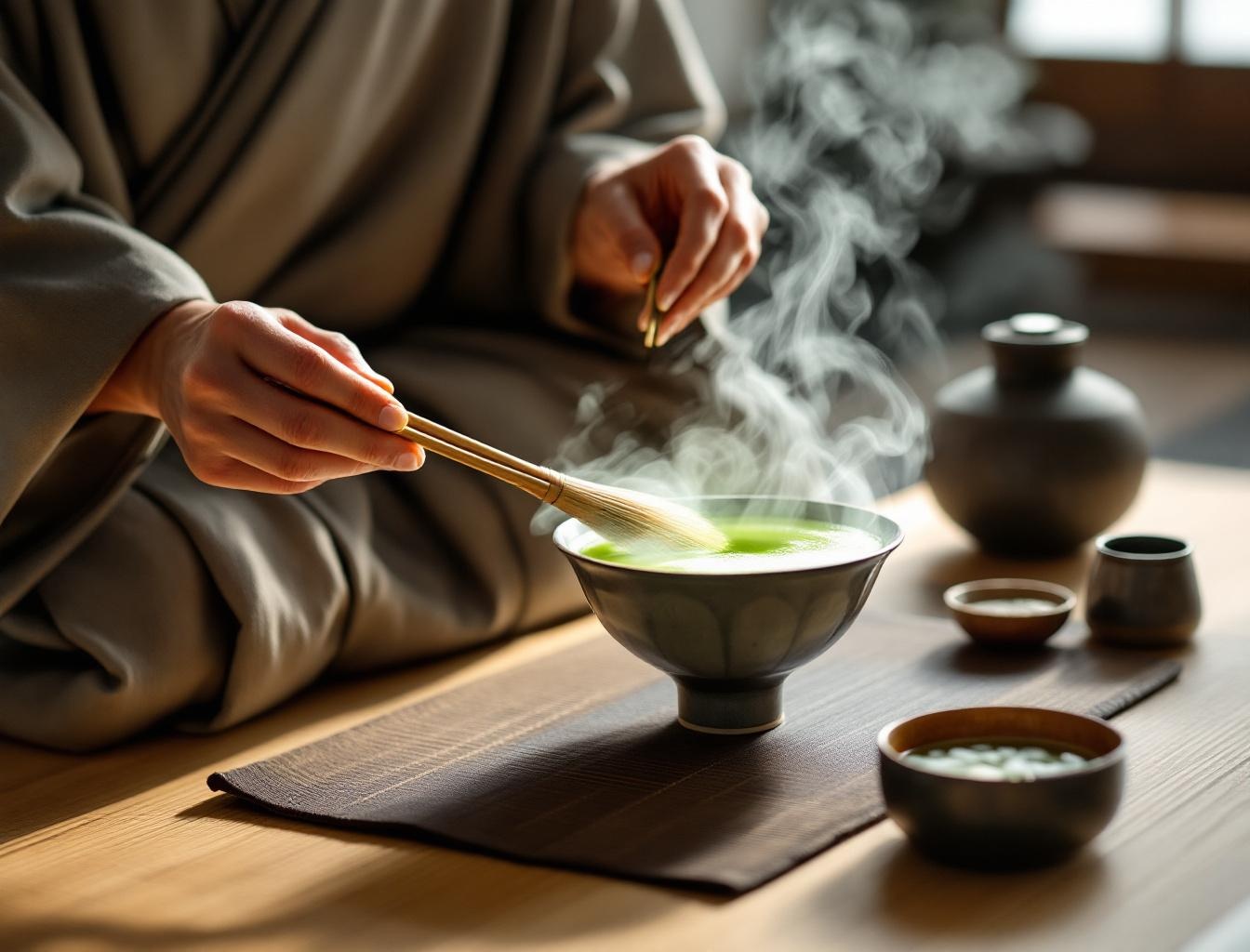
The host warms the chawan with hot water, then empties it into the kensui. They wipe the bowl dry with the chakin. Matcha is scooped from the natsume with the chashaku — one to two scoops — and added to the bowl. Hot water is ladled in with the hishaku. The chasen is used to whisk in a rapid “W” or zigzag pattern until the tea becomes uniformly frothy. The bowl is then oriented so its front faces the guest.
7. Receiving and Drinking
The guest picks up the bowl with the right hand, places it on the left palm, and bows. They then rotate the bowl clockwise two times — about 180° — so that they are not drinking from the “front” (the decorated face). This is an act of respect: the guest does not press their mouth against the bowl's most valued surface. They drink in about three sips, then wipe the rim with the kaishi paper, rotate the bowl back counterclockwise, and place it to admire before returning it to the host.
8. Admiring the Utensils
After the tea, guests may ask to examine the chawan, chashaku, and natsume. This examination is part of the ceremony — the host has chosen these objects for a reason, and the guest's engagement with them honors that choice. Questions about the objects' origin, the potter's name, or the calligrapher's lineage are welcome and expected.
9. Closing
The host collects and cleans each utensil in view of the guests, then carries them out. Guests bow when the host removes the kama. The ceremony ends with a quiet exchange — gratitude expressed and received. Then guests re-enter the roji to leave, often in as much silence as they arrived.
Guest Etiquette: How to Behave at a Tea Ceremony
If you are attending a tea ceremony — whether a formal gathering in Japan or a demonstration at a cultural center — these are the key things to know:
- Wear socks — you will remove shoes at the entrance. Bare feet on tatami is not appropriate.
- Avoid strong perfume — the subtle fragrance of the tea room (incense, fresh tatami, the wood of the building) is part of the experience. Strong scents disrupt it.
- Remove jewelry — rings and bracelets can scratch the chawan, which may be hundreds of years old.
- Carry kaishi paper — folded under your obi (belt) or in a pocket. Your host will often provide it.
- Eat the wagashi before the tea arrives — not after. The sequence matters.
- Rotate the bowl — pick up with right hand, place on left palm, rotate clockwise twice before drinking.
- Drink quietly in about three sips — the final sip may produce a small sound (susu), which signals you have finished and is considered acceptable.
- Ask questions about the utensils — this is welcomed and shows genuine interest.
- Sit in seiza if possible — if not, inform your host. Many hosts will offer a zaisu (low chair) for guests who cannot kneel.
Seasonal Tea: How the Ceremony Changes Through the Year
The tea ceremony is among the most seasonally sensitive arts in Japan. The host does not simply acknowledge the season — they embed it in every detail of the gathering. The traditional Japanese calendar recognizes 24 micro-seasons (nijushi sekki), and experienced tea masters calibrate their gatherings to them.
Spring (March–May): The Hanami Season
March and April are among the most beautiful times for tea gatherings in Japan. The ro (sunken hearth) is still in use through April, providing warmth as temperatures fluctuate. Hanami tea ceremonies — held outdoors or near cherry trees in full bloom — are a beloved tradition. The wagashi in spring are often sakura mochi or flower-shaped namagashi in pale pinks and whites. The chabana might be a single plum blossom or a stem of forsythia.
The transition from ro to furo happens in May — called the robiraki and then furo hajime — and is treated as a ceremonial event in its own right. Students of tea mark this season change the way musicians mark a key change.
Summer (June–September): The Furo Season
The portable brazier replaces the floor hearth. Summer bowls are wide and shallow, allowing the tea to cool quickly. Ceremonies may begin at dawn (akatsuki no chaji) to avoid the heat. Ice is sometimes incorporated. The aesthetic leans heavily into blue-greens, water themes, and a sense of coolness.
Autumn (October): Ro Opening
The opening of the ro in November is the most important ceremony of the tea calendar — the equivalent of New Year in a tea practitioner's year. Fresh matcha from the new harvest is opened (kuchikiri no chaji). Old tools are retired; new ones are introduced. This gathering is deeply anticipated and attended with particular reverence.
Winter (November–April): The Deep Season
Winter tea gatherings have an introspective quality. The ro creates a point of warmth in a cold room. The yobanashi no chaji — a night gathering held by candlelight — is particular to winter, evoking the long, dark nights of the old calendar. Winter sweets tend toward deeper flavors: sweet potato, azuki bean, chestnut.
Where to Experience a Tea Ceremony
If you are traveling to Japan, tea ceremony experiences are widely available — ranging from five-minute tourist demonstrations to full afternoon gatherings with a practicing master.
- Kyoto — The center of tea culture. Urasenke and Omotesenke headquarters are here. Establishments like En and Camellia Tea Experience offer quality demonstrations. Daitoku-ji temple complex has multiple sub-temples with historic tea rooms.
- Tokyo — The Hamarikyu Gardens (a former shogunal estate) has an authentic tea house. Happo-en garden in Minato ward offers regular ceremonies.
- Nara — Isuien Garden has a beautiful tea room setting with views of the garden.
- Cultural centers abroad — Many Japanese cultural centers and museums host periodic tea demonstrations; the Japanese Tea Society of Australia, the Urasenke North America chapters, and similar organizations offer lessons.
If you want a genuine experience rather than a tourist performance, look for gatherings hosted by local tea schools (Urasenke, Omotesenke, or Mushanokoji Senke). These organizations have chapters worldwide and often welcome visitors to observation gatherings.
Practicing at Home: What You Actually Need
You do not need a tea house, a garden, or years of formal training to begin a home practice. The core of chado is available to anyone who approaches it seriously. Here is a realistic minimum:
Essential Equipment
- Chawan — A ceramic bowl, ideally Japanese-made, with some character to it. It need not be antique. A bowl you find beautiful and return to is worth more than an expensive one that intimidates you.
- Chasen — A genuine bamboo whisk. Do not substitute a milk frother. The chasen‘s tines are specifically shaped to incorporate air without bruising the matcha. Inspect your chasen before each use; if tines are broken, retire it. A chasen kusenaoshi (whisk holder) extends its life significantly.
- Chashaku — The bamboo scoop. One-two scoops per portion is standard; develop your eye for the right amount.
- Ceremonial-grade matcha — Quality matters enormously here. Good matcha is vibrant green, sweet-savory, and never harsh. It is grown in shade for the final three to four weeks before harvest (which concentrates chlorophyll and L-theanine). Single-cultivar matcha — Okumidori, Samidori, or Yabukita — offers the most distinct flavor character.
- A small container for matcha — A natsume or even a sealed ceramic jar. Matcha oxidizes rapidly; always store it in an airtight container in the refrigerator or freezer.
A Simple Home Practice
Before you begin, clean the space. Set your phone aside. This is the sei (purity) principle applied to everyday life — remove distractions before you begin.
- Warm the chawan with hot water. Pour the water out.
- Sift 1–2 chashaku scoops of matcha into the bowl. Sifting removes clumps and improves texture.
- Add 70–80ml of water at about 75–80°C (not boiling — boiling water damages the delicate amino acids that create umami).
- Whisk in a rapid “W” or “M” pattern — not circular — until the surface is uniformly frothy.
- Sit with the bowl. Rotate it. Drink in three considered sips.
The formal movements of the full ceremony can be learned over years of study. The spirit of it — attention, presence, one moment fully inhabited — is available now.
The Three Schools of Tea
Sen no Rikyu's three grandsons established three schools (sansenke) that represent the main living lineages of tea ceremony today:
- Urasenke — The largest and most internationally active school. Known for slightly more accessible teaching methods and the largest network of overseas chapters. Uses a foamy, well-whisked usucha style.
- Omotesenke — Considered slightly more austere and traditional. Usucha in Omotesenke style is less frothy — the surface of the tea is quieter. Learn more in our guide on the history of Japanese tea ceremonies. Often described as more “inward.”
- Mushanokoji Senke — The smallest of the three. Known for a simplified, elegant approach that some consider closest to Rikyu's original teachings.
Each school has its own specific procedures, tool positions, and aesthetic preferences. If you study formally, you will follow one school's curriculum. If you practice at home without a teacher, you draw from all of them.
Frequently Asked Questions
How long does a Japanese tea ceremony last?
A full formal gathering (chaji) takes three to four hours and includes a meal, a break in the roji garden, and both thick and thin tea. A shorter ceremonial gathering (chakai) takes one to two hours. Tourist demonstrations at cultural centers or historic sites typically last 30 to 45 minutes and focus on the usucha (thin tea) preparation. A home usucha practice — just the core preparation and drinking — takes about 10 to 15 minutes.
What do you eat at a tea ceremony?
Wagashi — traditional Japanese sweets — are served before the matcha. For a formal ceremony with koicha, the sweets are omogashi or namagashi: moist, fresh, typically seasonal confections made from rice flour, azuki bean paste, or sweet potato. With usucha, lighter higashi (dry sweets) are more common — pressed sugar or baked sweets. At a full chaji, a multi-course light meal (kaiseki) is served first.
Can foreigners participate in a tea ceremony?
Absolutely — the tea ceremony has been shared with international guests for over a century. Urasenke has actively promoted the ceremony abroad since the 1950s. No prior knowledge is required for most experience gatherings. Your host or guide will explain the key gestures (rotating the bowl, when to bow) before you begin. The only requirements are genuine respect and a willingness to be present.
Why do guests rotate the tea bowl before drinking?
The bowl is turned so that the guest does not drink from its “front” — the most beautiful or decorated face. This is an act of humility and respect: you do not press your lips against the bowl's finest surface. The rotation is typically two clockwise turns (about 180°), and the bowl is rotated back counterclockwise after drinking.
What is the difference between chanoyu and chado?
Chanoyu (茶の湯) means “hot water for tea” and refers to the practice of the ceremony itself — the physical ritual. Chado (茶道) means “the way of tea” and encompasses the broader philosophical, artistic, and spiritual path that a practitioner undertakes. In practice, both terms are used interchangeably to refer to the overall tradition, but chado implies the lifetime study dimension more strongly.
Do I need to know Japanese to attend a tea ceremony?
No. Most experience gatherings aimed at visitors include English-language explanation, either from the host or a guide. Learning a few key words — itadakimasu (I receive this gratefully), otemae chodai itashimasu (I humbly receive your preparation) — is a gesture of appreciation that hosts notice and appreciate. Your genuine attention matters far more than fluency.
What is ichigo ichie?
Ichigo ichie (一期一会) means “one time, one meeting.” It is the understanding that every tea gathering is a singular, unrepeatable event. These exact people, this precise season, this specific bowl, this moment — they will never combine this way again in a lifetime. The concept encourages both host and guest to bring their full attention to the gathering, because there is no second chance to be fully present for this particular one.
How is tea ceremony different from just drinking matcha?
The matcha is the vehicle, not the destination. Tea ceremony is a practiced discipline of attention — the choreography of the host's movements, the design of the space, the seasonal objects in the tokonoma, the wagashi, the silence, the bowl's weight in your hands. All of it converges to create a particular state of awareness that ordinary matcha preparation does not approach. The tea is the same; the frame around it transforms the experience entirely.
What is kintsugi, and how does it relate to tea ceremony?
Kintsugi (金継ぎ, “golden joinery”) is the Japanese practice of repairing broken ceramics with lacquer mixed with gold, silver, or platinum powder. Rather than hiding damage, kintsugi makes the repair the most visible feature of the object. In the context of tea ceremony, a kintsugi bowl is considered more beautiful — not despite its history of breaking, but because of it. The cracks represent lived experience. This is wabi-sabi made tangible: the acceptance and even celebration of impermanence and imperfection.
How much does it cost to attend a tea ceremony in Japan?
Experience gatherings for visitors range from free (some temple demonstrations) to ¥5,000–¥15,000 (approximately $35–$100) for formal demonstrations with matcha and wagashi included. Full formal chaji hosted by a tea master may be by invitation only. Many museums and cultural centers offer affordable group demonstrations that are excellent introductions. Kimono rental for the experience is usually offered separately at an additional cost.
Can I learn tea ceremony if I don't live in Japan?
Yes. Urasenke, Omotesenke, and Mushanokoji Senke all have international chapters and licensed teachers in North America, Europe, Australia, and beyond. The International Chado Culture Foundation maintains a directory of certified instructors worldwide. Local Japanese cultural associations and universities with Japanese studies programs often host periodic tea gatherings as well. A home practice — which requires only a chawan, chasen, chashaku, and quality matcha — can begin immediately while you seek a teacher.
Ready to begin your home practice? Our shop carries ceremonial-grade matcha, hand-thrown chawan bowls, and handcrafted chasen whisks sourced directly from Japanese artisans. Browse the matcha collection and tea ceremony tools to find the right starting point for your practice.