The Complete Guide to Ginkgo Cutting Boards: Why Japanese Chefs Choose Icho
Walk into a professional kitchen in Tokyo — a sushi-ya in Ginza, a kappo restaurant in Kyoto, a kaiseki dining room in Osaka — and look at the cutting board on the counter. It won't be hinoki. It won't be maple or bamboo or plastic. It will almost certainly be ginkgo.
Ginkgo wood (イチョウ / icho) is the cutting board material that Japanese professional chefs have used for generations. Yet in English, there is almost no information about it. The SERP is product pages and thin affiliate posts. No comprehensive guide exists. No explanation of why the professionals choose this wood over every other option available to them.
That's the gap this article fills. If you cook with Japanese knives and care about what happens at the point where blade meets board, ginkgo is the material you should understand — even if you've never heard of it before now.
What Is a Ginkgo Cutting Board? (イチョウのまな板)
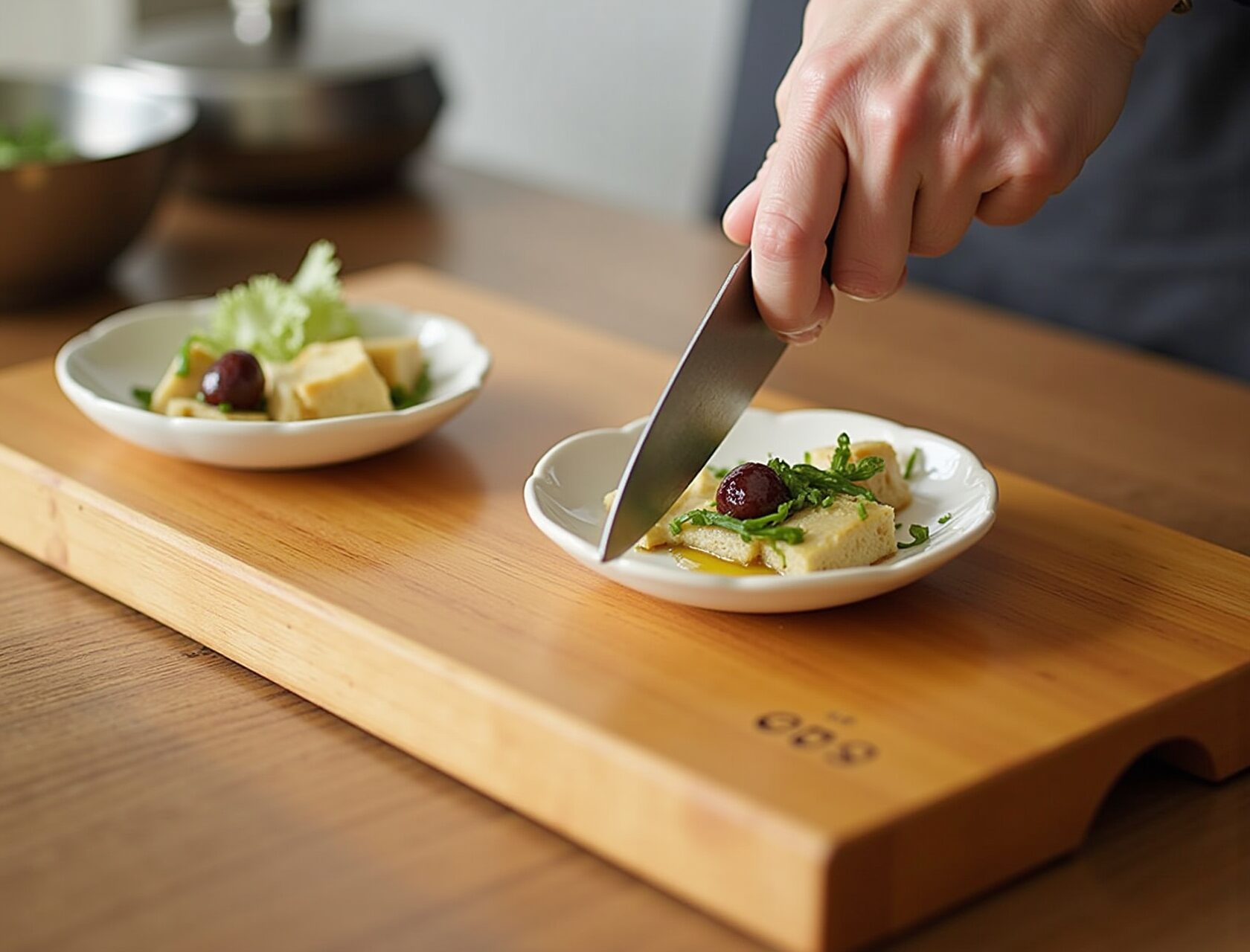
A ginkgo cutting board — called icho no manaita (イチョウのまな板) in Japanese — is a cutting board made from the trunk wood of the ginkgo tree (Ginkgo biloba). It's the standard working surface in professional Japanese kitchens, valued above all other woods for a single quality that Japanese chefs consider the most important criterion in any cutting board: haatari (刃当たり), or blade contact feel.
If you've only encountered ginkgo trees as the ones lining city streets with their fan-shaped leaves — or smelled the notoriously unpleasant fruit that female trees drop every autumn — you'd be forgiven for not connecting this tree to fine kitchen tools. But the trunk wood of Ginkgo biloba has a combination of properties that no other commonly available wood replicates: it's soft enough to protect delicate knife edges, firm enough to provide stable cutting resistance, fast-drying, odor-neutral, and dimensionally stable. It also has a remarkable capacity for self-repair.
The word 板前 (itamae), which is the standard Japanese term for a professional chef, literally translates to “in front of the board.” The cutting board isn't just a tool in Japanese culinary culture — it's the defining object of the profession. And the board most itamae stand in front of is ginkgo.
The Living Fossil: Ginkgo's 270-Million-Year Story
The ginkgo tree has the longest fossil record of any living tree species on Earth. Fossilized ginkgo leaves dating back 270 million years — before the dinosaurs — are virtually identical to the leaves on the tree outside your window. Every other member of the division Ginkgophyta went extinct. Only Ginkgo biloba survived. Biologists call it a “living fossil,” and it's the sole surviving species of its entire botanical division.
The tree arrived in Japan approximately 1,000 years ago, carried by Buddhist monks traveling from China. It established itself quickly in temple grounds across the country, and the Japanese relationship with ginkgo became deeply intertwined with both spiritual practice and daily life.
Sacred Tree, Sacred Fire Resistance
In Shinto tradition, exceptionally old or large ginkgo trees are designated as 神木 (shinboku) — sacred trees believed to house divine spirits. Shimenawa ropes are wrapped around their trunks, and small shrines are often built at their base. You'll find ancient ginkgo trees at major shrines across Japan, many of them hundreds of years old.
Ginkgo's fire resistance is not folklore — it's documented history. The Great Kanto Earthquake of 1923 triggered massive fires across Tokyo. Contemporary accounts record that ginkgo trees survived the conflagration in disproportionate numbers compared to other species, their high water content and thick bark providing a natural firebreak. More remarkably, six ginkgo trees survived the atomic bombing of Hiroshima in 1945. They still stand today, within 1-2 kilometers of the hypocenter, scarred but alive — living monuments to the tree's extraordinary resilience.
Tokyo adopted the ginkgo leaf as its official symbol in 1989. If you've seen the city's emblem — a stylized yellow fan shape — that's the ginkgo leaf.
The Wedding Board Tradition
In traditional Japanese households, it was common for a mother to give her daughter a ginkgo cutting board as a wedding gift. The board was considered essential equipment for running a kitchen — a “right arm” for the new wife's culinary life. A quality ginkgo board, properly maintained and periodically resurfaced, would last through decades of daily cooking. The gift was practical, symbolic, and deeply personal.
This tradition has faded in modern Japan as kitchen habits change, but it reflects how seriously Japanese culture treats the relationship between a cook and their board. The cutting board wasn't disposable. It was heirloom-quality equipment, intended to age alongside the person using it.
Why Professional Japanese Chefs Choose Ginkgo
Japanese chefs evaluate cutting boards on criteria that differ fundamentally from how most Western cooks think about them. Understanding these criteria explains why ginkgo dominates professional Japanese kitchens.
Haatari: The Quality That Has No English Translation
刃当たり (haatari) literally means “blade contact” — the sensation the knife produces when it meets the board's surface. It's the single most important criterion for cutting boards in Japanese culinary culture, and the concept has no English equivalent.
Western cutting board discussions focus on hardness, durability, and food safety. Japanese discussions start with haatari.
Ginkgo has what Japanese chefs describe as the best haatari of any common cutting board wood. The blade sinks in just enough to provide a stable cutting surface without dulling the edge. It's soft enough to absorb impact, firm enough to spring back. Chefs describe the sensation as the knife “landing” on the board rather than “striking” it. The sound is different too — a soft, rhythmic tup tup tup that experienced cooks find deeply satisfying, compared to the sharper tak tak tak of harder woods.
This matters practically, not just aesthetically. Japanese knives are sharpened to extremely acute angles — 10-15 degrees per side versus 20-25 degrees for Western knives. That acute geometry makes them sharper and better at precise work, but also more vulnerable to micro-chipping on hard surfaces. A ginkgo board absorbs the cutting impact that would otherwise travel back into the delicate edge geometry, meaningfully extending the time between sharpenings.
Self-Healing Surface (復元力 / Fukugenryoku)
Ginkgo wood has a property that Japanese woodworkers call 復元力 (fukugenryoku) — restorative power. When the blade cuts into the wood, it compresses the fibers rather than severing them cleanly. After cutting, when the board is rinsed with water, those compressed fibers swell back toward their original position, partially closing the cut mark.
This isn't magic, and it doesn't make knife marks disappear entirely. But it means a ginkgo board maintains a smoother working surface significantly longer than harder woods that scar permanently. The fibers are pliable without being weak — they compress under blade pressure and then recover. Over weeks and months of daily use, a ginkgo board accumulates fewer visible scars than a board of equivalent hardness made from a different species.
The mechanism is related to ginkgo's uniform grain structure. Unlike most softwoods, which have alternating bands of soft earlywood and hard latewood, ginkgo's annual rings are relatively uniform in density. There are no hard layers for the blade to catch against and no soft layers that collapse permanently. The entire cutting surface responds to the blade consistently.
Fastest Drying of Any Traditional Board Wood (水はけ / Mizuhake)
水はけ (mizuhake) — water drainage — is a critical practical criterion for any wooden cutting board. A board that stays wet invites mold, staining, and bacterial growth. Ginkgo contains natural oils that repel water absorption, giving it the fastest drying time of any traditional Japanese cutting board wood.
After washing, a ginkgo board air-dries noticeably faster than hinoki, hiba, or paulownia. This makes daily maintenance easier and reduces the risk of the two most common wood board problems: mold (カビ / kabi) and black staining (黒ずみ / kurozumi).
Odor Neutrality (無臭性)
This is a point where ginkgo and hinoki differ sharply, and where professional chefs tend to favor ginkgo for certain work.
Hinoki has a strong, pleasant cypress fragrance — warm, clean, forest-like. Many people love it, and it's genuinely beautiful as a sensory experience. But in a professional kitchen, where a chef might cut delicate sashimi-grade fish, that aroma becomes a liability. Even a faint transfer of wood scent to a piece of otoro or shima-aji is a problem.
Ginkgo wood is effectively odor-neutral. It contains flavonoids — primarily quercetin and kaempferol — that actively prevent food smells from penetrating the wood grain. You can cut raw fish, garlic, ginger, and onions on a ginkgo board, wash it, and the next item you cut carries no residual scent from the previous one. For multi-course professional work where the same board handles different ingredients in sequence, this matters enormously.
(Yes, the ginkgo tree's fruit is notoriously foul-smelling. The cutting boards are made from trunk wood, which has no connection to that odor. The compounds responsible for the fruit's smell — butyric acid and related fatty acids — are entirely absent from the heartwood.)
Natural Antimicrobial Properties
Ginkgo wood contains several bioactive compounds with documented antimicrobial activity: ginkgolic acid, flavonoids (quercetin, kaempferol), and shikimic acid. These compounds provide a natural defense against surface bacterial colonization between washes.
This is not a claim that ginkgo boards are self-sanitizing — no cutting board is, and proper washing after every use remains non-negotiable. But the presence of these compounds means a well-maintained ginkgo board resists bacterial buildup more actively than an untreated hardwood board with no bioactive compounds.
For context: hinoki's antimicrobial compound, hinokitiol (β-thujaplicin), is more potent and better studied than ginkgo's compounds. This is one area where hinoki has a genuine edge. But ginkgo's antimicrobial properties are real and meaningful, even if less pronounced.
The Science Behind Ginkgo Wood
Ginkgo occupies a genuinely unusual place in botany. It is neither a hardwood nor a softwood in the conventional sense. Hardwoods are angiosperms (flowering plants); softwoods are conifers. Ginkgo is a gymnosperm — a seed-producing plant — but it's not a conifer. It belongs to its own division, Ginkgophyta, and is the only living species within it. In the entire plant kingdom, there is nothing else quite like it.
This unusual classification translates to physical properties that don't fit neatly into the hardwood/softwood framework.
| Property | Ginkgo (Ginkgo biloba) | Notes |
|---|---|---|
| Janka hardness | 560-750 lbf | Softer than hinoki (~800-1,000 lbf), much softer than maple (~1,450 lbf). This is a feature for blade protection. |
| Specific gravity | 0.43-0.46 | Medium-light. Heavy enough for stability, light enough to handle comfortably. |
| Grain structure | Uniform annual rings | No hard/soft density variation between earlywood and latewood. Contributes to even blade feel and self-healing. |
| Active compounds | Ginkgolic acid, quercetin, kaempferol, shikimic acid | Antimicrobial and odor-resistant. Less potent than hinokitiol but effective. |
| Dimensional stability | High — minimal warping | Uniform ring structure means even moisture absorption and release. |
| Drying speed | Fastest of traditional Japanese board woods | Natural oils resist water absorption. |
| Odor | Effectively neutral | Flavonoids prevent food smell transfer. |
| Classification | Gymnosperm (neither hardwood nor softwood) | Sole surviving species of division Ginkgophyta. |
The Janka hardness number deserves attention. At 560-750 lbf, ginkgo is significantly softer than the woods commonly used for Western cutting boards: hard maple sits around 1,450 lbf, black walnut around 1,010 lbf. This softness is exactly the point. A board that yields under the blade is a board that protects the blade. For Japanese knives hardened to HRC 60+ — harder, sharper, and more brittle than their German counterparts — that yielding matters for edge longevity.
Ginkgo vs Hinoki: How to Choose
This is the comparison most people searching for Japanese cutting boards need. Both are excellent. Neither is universally “better.” The right choice depends on what you prioritize.
| Feature | Ginkgo (イチョウ) | Hinoki (檜) |
|---|---|---|
| Blade protection (haatari) | Superior — the professional benchmark | Very good — softer than most Western woods |
| Janka hardness | 560-750 lbf | ~800-1,000 lbf |
| Self-healing (fukugenryoku) | Excellent — fibers swell and close cuts | Good but less pronounced |
| Drying speed | Fastest of traditional woods | Good — natural oils help |
| Antimicrobial | Moderate (ginkgolic acid, flavonoids) | Strong (hinokitiol / β-thujaplicin) |
| Aroma | Neutral — no scent transfer to food | Strong cypress fragrance — pleasant but can transfer |
| Odor resistance | Excellent — flavonoids prevent absorption | Moderate — can absorb strong food odors over time |
| Dimensional stability | Excellent — uniform grain, minimal warping | Very good — especially quarter-sawn (masame) |
| Weight | Medium — stable on counter, manageable to move | Medium to medium-heavy |
| Price range | $40-315 depending on maker and size | $10-530+ — wider range due to more brands |
| Availability outside Japan | Very limited | Widely available through importers and Amazon |
| Best for | Knife preservation, fish/sashimi work, scent-sensitive prep | All-around daily use, humid environments, those who love the scent |
When to Choose Ginkgo
Choose ginkgo if your primary concern is protecting expensive Japanese knives. If you own Masamoto, Suisin, Aritsugu, or any knife you've invested real money in, the difference in blade feel between ginkgo and harder woods compounds over months and years of daily use. Ginkgo is also the clear choice if you work with raw fish or other delicate ingredients where scent neutrality matters.
When to Choose Hinoki
Choose hinoki if you want the strongest natural antimicrobial protection (hinokitiol is the more potent compound), if you love the cypress fragrance as part of your cooking experience, or if you're in a humid climate where mold resistance is especially important. Hinoki is also significantly easier to find outside Japan.
For a deep dive on hinoki, see our complete guide to hinoki cutting boards.
The “Mottainai” Perspective
There's a saying among Japanese woodworkers that using hinoki for cutting boards is mottainai (もったいない) — wasteful. Hinoki is the wood of Ise Jingu, Japan's most sacred shrine. It's the material of temple architecture, traditional bathhouses, and the finest joinery. Using it as a surface to be cut into strikes some craftspeople as an extravagant misuse of a wood that deserves more reverence.
Ginkgo, by contrast, is the purpose-built kitchen choice. It doesn't have hinoki's architectural prestige, and it doesn't need it. It was selected for cutting boards specifically because its properties — softness, resilience, drying speed, odor neutrality — make it better suited to that particular job than any other available wood. It's the specialist, not the generalist.
The Three Traditional Japanese Cutting Board Woods
For completeness, the three woods traditionally regarded as the best for Japanese cutting boards are:
- Ginkgo (イチョウ) — the all-purpose professional standard. Best overall balance of blade protection, drying speed, odor resistance, and dimensional stability.
- Willow (柳 / yanagi) — the absolute best for blade protection. Even softer than ginkgo, with exceptional haatari. But willow boards are rare and expensive, and the wood is less durable. Willow is the connoisseur's choice, not the practical daily-use choice.
- Hinoki (檜) — the best antibacterial protection. Strongest natural antimicrobial compound (hinokitiol), pleasant aroma, excellent water resistance. The sushi bar favorite for its scent pairing with vinegared rice.
Ginkgo sits at the center of this triangle — not the softest, not the most antibacterial, not the most aromatic, but the best overall combination for daily professional use.
Top Japanese Ginkgo Cutting Board Makers
The quality gap between a mass-produced ginkgo board and one from a dedicated workshop is significant. These are the makers whose boards show up in professional Japanese kitchens.
Futaba Shoten (双葉商店) — Fukui Prefecture
Futaba Shoten is Japan's only workshop that specializes exclusively in ginkgo cutting boards. Established in 1946, they've spent nearly 80 years refining a single product. Their boards are what you'll find in high-end sushi restaurants and kaiseki kitchens across Japan.
What sets Futaba apart is their wood selection and drying process. They source aged ginkgo logs and air-dry the lumber for years before shaping it — a slow process that produces wood with superior dimensional stability and haatari. Every board is finished by hand. They also offer a free resurfacing service (削り直し / kezurinaoshi) for the life of the board, which is virtually unheard of and reflects extraordinary confidence in the product.
Price range: Approximately $80-200+ depending on size and grade.
Where to buy: Rakuten, Japanese specialty kitchenware shops, direct from maker.
Morinaga Zaimokuten (森永材木店) — Nagasaki Prefecture
Morinaga Zaimokuten has been producing ginkgo cutting boards for over 75 years, with a particular distinction: they source ginkgo wood from shrine trees. When sacred ginkgo trees at shrines and temples are damaged by storms or felled for safety reasons, Morinaga acquires the timber — wood that can be 100+ years old.
Their drying process is exceptionally patient: up to 8 years of natural air drying before the wood is shaped into boards. This extended drying period produces boards with remarkable stability and a density that reflects the slow growth of old-growth trees. The result is a board that feels different from one made with younger, faster-dried wood — denser, more resonant, with a subtle depth to the haatari.
Price range: Premium — typically $100-250+ depending on size and wood provenance.
Where to buy: Japanese specialty retailers, occasional listings on Rakuten.
Woodpecker (ウッドペッカー) — Gifu Prefecture
Woodpecker has done something remarkable: they've made ginkgo cutting boards popular with younger Japanese consumers who might otherwise buy plastic. Their signature round cutting board (まるいまな板) became an Instagram and design-magazine staple, bringing ginkgo boards into the lifestyle aesthetic conversation.
This isn't just about aesthetics. Woodpecker's boards are genuinely well-made, and their success has expanded ginkgo's presence in Japanese home kitchens. They're stocked in over 150 retail stores across Japan, making them the most accessible premium ginkgo board brand in the country.
Price range: Approximately $50-120.
Where to buy: Rakuten, official website, lifestyle shops across Japan.
Yamacoh (ヤマコー) — Gifu Prefecture
Yamacoh offers the broadest size range of any ginkgo board maker — six standard sizes from compact apartment boards to full professional dimensions. Their pricing makes ginkgo accessible without sacrificing quality: their entry-level boards start around $40, making them the most affordable route to a genuine Japanese ginkgo cutting board.
For a buyer's first ginkgo board, Yamacoh represents solid value. The boards are well-made, properly dried, and available in sizes that work for both Japanese-style and Western-style kitchen layouts.
Price range: $40-105.
Where to buy: Amazon Japan, Rakuten, Japanese kitchenware retailers.
How to Care for Your Ginkgo Cutting Board
Japanese wooden cutting board care differs from the Western approach in several important ways. Some of the advice below directly contradicts what you'll read in Western board-care guides. The Japanese approach is based on decades of professional kitchen experience with these specific woods, and it works.
Before First Use
Wet both sides of the board thoroughly with water. This initial soaking allows the wood fibers to expand evenly and helps prevent the board from absorbing stains and odors during its first use. Let the board air-dry standing upright before its first cutting session.
Note: Unlike many Western cutting board guides, Japanese tradition does not recommend oiling ginkgo boards with mineral oil before first use. The wood's natural oils provide sufficient protection, and adding external oil can seal the pores in a way that traps moisture and bacteria. More on this in the FAQ below.
Before Each Use: The Water Barrier
This step is the single most commonly omitted piece of Japanese cutting board care, and it makes a meaningful difference.
Before you start cutting, run both sides of the board under water and shake off the excess. The board should be damp, not dripping. This does two things: it creates a moisture barrier on the wood surface that prevents food juices, pigments, and oils from penetrating into the grain, and it pre-swells the wood fibers slightly so that blade cuts close more cleanly.
Think of it like wetting a sponge before using it — the pre-saturated surface doesn't absorb new liquids as readily. Japanese cooks do this every single time, and it's one reason their boards maintain a cleaner appearance over years of use.
After Each Use
- Scrub with a tawashi brush (たわし), along the grain direction. A tawashi is a natural-fiber scrub brush made from palm fibers — stiff enough to remove food particles from the grain without damaging the wood surface. Scrub in the direction of the grain, not against it. This is the standard cleaning tool for Japanese wooden boards, and it works better than sponges for this purpose.
- Rinse with water — no detergent. Japanese professional practice avoids dish soap on wooden boards. Soap strips the natural oils and antimicrobial compounds from the wood over time. Water and the tawashi are sufficient for daily cleaning. If you've worked with particularly odorous ingredients (raw fish, garlic), a scrub with coarse salt before the water rinse is effective.
- Wash both sides. Even if you only cut on one side, wash both. This ensures even moisture absorption and release, which prevents warping.
- Stand vertically to dry, in a shaded, well-ventilated area. This is the single most important care rule. Never lay a wet wooden board flat. The bottom surface can't dry while sitting on the counter, which creates uneven moisture — the primary cause of warping. Stand the board on its edge so air circulates over both faces equally. Keep it out of direct sunlight, which can cause rapid, uneven drying and cracking.
Never:
- Put it in the dishwasher. The heat and aggressive water cycle will crack, warp, and destroy any wooden board.
- Leave it soaking in water. Brief wetting before use is essential; prolonged submersion is destructive.
- Use bleach or chemical sanitizers. These degrade the wood fibers and strip the natural antimicrobial compounds that give ginkgo its protective properties.
- Dry it in direct sunlight for extended periods. Brief sunlight (15-30 minutes) can help UV-sanitize the surface, but prolonged sun exposure causes cracking.
Resurfacing: 削り直し (Kezurinaoshi) — How Your Board Lasts a Lifetime
This is the concept that transforms a ginkgo cutting board from a kitchen tool into a lifetime investment, and it's almost completely unknown in English-language cutting board content.
削り直し (kezurinaoshi) literally means “to plane again.” After years of daily use, when a board has accumulated deep knife marks, staining, or minor warping, it can be sent to a craftsman who planes the surface down with a hand plane (鉋 / kanna), exposing fresh, clean wood beneath. The board comes back looking and performing as though it were new — fresh grain, renewed natural oils, restored haatari.
A board that starts at 3 cm thick can typically be resurfaced 2-3 times over its life, each resurfacing removing about 2-3 mm of wood. That translates to a 15-25 year useful life for a board that might have cost $100-150. Many premium makers — including Futaba Shoten — offer resurfacing as a service, sometimes free for boards they produced.
This aligns with a broader Japanese philosophy of 物を大切にする (mono wo taisetsu ni suru) — taking care of things. The Western approach to cutting boards is largely disposable: use it until it's grooved and stained, then replace it. The Japanese approach is restorative: maintain it, resurface it, extend its life for decades. It's more sustainable, more economical in the long run, and it produces a board that actually improves with proper care.
What to Look for When Buying a Ginkgo Cutting Board
Quality Indicators — What to Seek
- Single piece (一枚板 / ichimai ita): Cut from a single plank of wood. This is the premium construction method and what professional kitchens use. Single-piece boards are more stable, won't delaminate, and provide the most consistent haatari across the entire cutting surface.
- Minimum thickness of 2.5-3 cm: Thinner boards warp more easily and can't be resurfaced as many times. For a primary daily-use board, 3 cm or thicker is ideal. Professional boards are often 3-4 cm.
- Heartwood (芯材 / shinzai): The inner wood of the trunk is denser, more dimensionally stable, and contains higher concentrations of the natural oils and antimicrobial compounds. Heartwood boards are premium for good reason.
- Naturally dried (天然乾燥 / tennen kansou): Air-dried lumber, dried over years rather than kiln-dried in days, produces wood with superior stability and working properties. This is one of the most significant quality differentiators and one of the hardest to verify from a product listing.
- Made in Japan: The expertise in selecting, drying, and finishing ginkgo specifically for cutting boards is concentrated in Japanese workshops. The domestic supply chain — from log selection to final finishing — reflects generations of accumulated knowledge about this particular application.
Red Flags — What to Avoid
- Laminated or glued construction: Boards made from multiple pieces glued together are cheaper, but the seams can harbor bacteria and may eventually delaminate with repeated wetting and drying cycles. If you're buying ginkgo specifically for its properties, a glued board doesn't deliver the full benefit.
- Very thin boards (under 2 cm): These warp easily, can't be resurfaced, and don't provide the same depth of haatari. They're false economy — a thicker board that lasts 15 years is a better investment than a thin board you replace every 2-3 years.
- Chemical finishes, lacquer, or polyurethane coating: A ginkgo board should be raw, unfinished wood. Any surface coating blocks the antimicrobial compounds from working, prevents the self-healing fiber action, and will eventually chip into food.
- Unspecified origin or species: “Wood cutting board” or “natural wood board” without specifying species tells you nothing. Ginkgo boards from reputable makers identify the wood species and often the wood's origin.
Price Ranges
| Tier | Price Range (USD) | What You Get |
|---|---|---|
| Entry | $40-60 | Small to medium size, solid construction, good for a first ginkgo board. Yamacoh range. |
| Mid-range | $60-100 | Larger sizes, quality construction, brands like Woodpecker. A serious home cook's board. |
| Premium | $100-200 | Single-plank, naturally dried, from specialist makers like Futaba Shoten. Professional-grade. |
| Specialist / Large | $200-315+ | Extra-large professional sizes, aged heartwood, extended natural drying. Full-size sushi bar boards. |
Compared to Western end-grain hardwood boards from makers like Boos or Larchwood — which routinely sell for $150-400+ — a mid-range ginkgo board represents strong value, especially given the resurfacing option that extends its usable life well beyond what most Western boards offer.
Frequently Asked Questions
Is ginkgo wood actually good for cutting boards?
Yes — ginkgo is considered the best all-purpose cutting board wood by Japanese professional chefs. Its combination of blade protection (superior haatari), self-healing surface, fast drying, odor neutrality, and dimensional stability makes it the preferred material in professional Japanese kitchens. The Janka hardness of 560-750 lbf is soft enough to protect delicate Japanese knife edges without being so soft that it falls apart.
What is the difference between ginkgo and hinoki cutting boards?
Ginkgo provides better blade protection (lower Janka hardness), faster drying, and superior odor resistance — making it preferred by professional chefs, especially for fish work. Hinoki provides stronger antibacterial properties (hinokitiol), a pleasant cypress aroma, and is easier to find outside Japan. Ginkgo is the professional's workhorse; hinoki is the aromatic all-rounder. Many serious Japanese cooks own both. See our hinoki cutting board guide for a full comparison.
How long does a ginkgo cutting board last?
With proper care — upright drying, pre-use wetting, tawashi cleaning, no dishwasher — and periodic resurfacing (kezurinaoshi), a quality ginkgo board lasts 15-25 years. A board that starts at 3 cm thick can be resurfaced 2-3 times, each time restoring a fresh working surface. Some Japanese families use the same board for decades.
Do ginkgo cutting boards smell bad?
No. While ginkgo fruit is notoriously foul-smelling, the trunk wood used for cutting boards is effectively odor-neutral. The compounds responsible for the fruit's smell (butyric acid) are entirely absent from the heartwood. In fact, ginkgo's odor neutrality is one of its biggest advantages — flavonoids in the wood actively prevent food smells from transferring, making it ideal for sashimi and other delicate preparations.
Should I oil my ginkgo cutting board?
Japanese tradition says no. Unlike the Western practice of oiling boards with mineral oil, Japanese wooden cutting boards are generally left unfinished. The wood's natural oils provide sufficient protection, and the board needs to “breathe” — absorbing and releasing moisture through its pores. External oil can seal these pores, trapping moisture and potentially encouraging bacterial growth beneath the sealed surface. Instead of oiling, Japanese practice relies on the pre-use water barrier, proper washing, and upright drying to maintain the board.
Can I use a ginkgo cutting board for meat?
You can, but ginkgo's primary strengths — odor neutrality, delicate haatari, self-healing — are best showcased with fish, vegetables, and precision knife work. For heavy meat butchery or bone-in cutting, a thicker board or dedicated second board is more practical. For slicing cooked meats or delicate raw preparations like sashimi, ginkgo excels. As with any cutting board material, maintaining separate boards for raw proteins and ready-to-eat foods is standard food safety practice.
Where can I buy a ginkgo cutting board outside Japan?
This is the challenge. Ginkgo cutting boards are significantly harder to find outside Japan than hinoki boards. Your best options: Japanese kitchenware importers, specialty knife shops (Korin in New York, Bernal Cutlery in San Francisco occasionally stock them), and direct ordering from Japanese e-commerce platforms like Rakuten or Amazon Japan (search: 銀杏 まな板 一枚板). The limited availability outside Japan is one reason ginkgo remains relatively unknown in the West despite its professional reputation.
What does “icho” mean? Is it the same as ginkgo?
Yes. イチョウ (icho or ichou) is the Japanese word for the ginkgo tree (Ginkgo biloba). The kanji 銀杏 literally means “silver apricot,” a reference to the tree's nut-like seeds. When you see “icho cutting board” or “icho manaita” (イチョウのまな板), it refers to a ginkgo cutting board. The terms are interchangeable.
How do I remove stains from a ginkgo cutting board?
For surface stains: scrub with coarse salt (粗塩 / arajio) using a tawashi brush, then rinse. For more stubborn discoloration: make a paste of baking soda and water, apply it to the stained area, let it sit for 10-15 minutes, then scrub and rinse. For deep stains that won't respond to surface treatment, resurfacing (kezurinaoshi) removes the stained layer entirely. Prevention is the best strategy — always wet the board before use to create the moisture barrier that keeps stains from penetrating in the first place.
Is a ginkgo cutting board worth the price?
If you cook with Japanese knives regularly, yes. A $100 ginkgo board that lasts 15-20 years with resurfacing costs roughly $5-7 per year. It protects knife edges that may have cost $200-500+, reducing sharpening frequency and extending the knives' working life. It also makes the physical experience of cutting noticeably more pleasant — the haatari, the sound, the way food releases cleanly from the neutral surface. For a serious home cook or anyone investing in quality Japanese kitchen tools, the board is the foundation that makes everything else work better.
For more on Japanese cutting board woods and how to choose between them, see our complete guide to hinoki cutting boards.