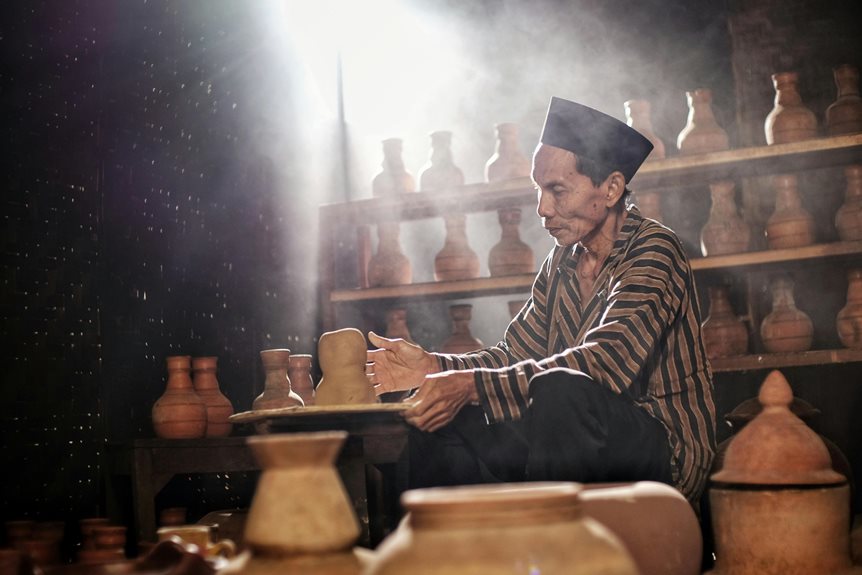
Kutani Pottery
Kutani pottery is one of Japan's most visually commanding ceramic traditions — characterized by bold overglaze enamels, intricate painted motifs, and a 370-year history that spans feudal court patronage, Meiji-era global exports, and a thriving contemporary art scene. Whether you're browsing your first piece at a Japanese market or building a serious collection, understanding what to look for makes all the difference between a piece you'll treasure and one you'll regret. Our guide to reading and identifying Kutani ware marks goes into much more depth on this topic.
This guide covers the essentials: the major styles at a glance, how Kutani pottery is made, the modern artists pushing it in new directions, how to choose and authenticate pieces, and — for those who use fine ceramics the way they were intended — a detailed look at Kutani teaware for the Japanese tea table. For a deep dive into history and production, see our comprehensive Kutani Ware guide.
What Makes Kutani Pottery Distinctive
Kutani ware originates from Ishikawa Prefecture in Japan's Chubu region — the area around the cities of Kaga, Komatsu, Nomi, and Kanazawa. The tradition is conventionally dated to around 1655, when Goto Saijiro is credited with establishing the first kiln under the patronage of the Daishoji domain lord, Maeda Toshiharu — though scholarly debate continues about whether Ko-Kutani wares were produced at the Kutani site itself or produced in the Arita region of Kyushu and later associated with Kutani.
What sets Kutani apart from other Japanese ceramics is its radical emphasis on surface decoration over form. Most celebrated Japanese pottery traditions — Bizen, Hagi, Shigaraki — prize clay texture, natural glaze effects, and the accidental beauty of kiln atmosphere. Kutani inverts this. The vessel is essentially a canvas, and the overglaze painting (uwae-tsuke) is the art.
The defining palette is Kutani Gosai (the Five Colors): deep green, yellow, purple, dark blue, and red. These mineral pigments are applied on top of an already-fired glaze and fused in the final enamel firing at 750°C–900°C, producing jewel-like colors with a distinctive glassy depth. Gold is applied separately in a third firing at around 400°C.
How Kutani Pottery Is Made
Understanding the production process explains why authentic Kutani costs what it does — and why the surface decoration is both its greatest strength and most vulnerable feature.
From Stone to Porcelain
Kutani porcelain begins with Hanasaka tōseki, a feldspathic pottery stone quarried near Komatsu in Ishikawa Prefecture. The stone is crushed, refined, and blended with local kaolin clays to produce a fine-grained paste with high silica content. This raw material fires white and translucent — the ideal canvas for Kutani‘s intense painted decoration.
Pieces are shaped by wheel-throwing, slip-casting, or hand-building depending on the form. Plates and large serving dishes are typically press-molded for consistency; tea cups and vases are often wheel-thrown. After shaping, pieces are air-dried slowly to prevent cracking, then bisque-fired at around 900°C to harden the clay body without vitrifying it.
Glazing and the First High-Fire
The bisqued piece is dipped or brushed with a transparent feldspathic glaze, then fired again at approximately 1300°C — high enough to fully vitrify the porcelain and create the glass-clear surface that Kutani‘s overglaze enamels require. After this first high-fire, the piece is hard, non-porous, and ready for decoration.
Overglaze Enamel Painting (Uwae-tsuke)
This is the stage that defines Kutani as an art form. Skilled painters apply mineral-based overglaze enamels directly onto the fired glaze surface using fine brushes. The five traditional colors require different techniques: green and purple can be applied in broad, confident strokes; the signature fine red linework (aka-e) demands extraordinary brush control — the finest Iidaya-style lines can be under 0.3mm wide.
The piece is then fired a third and final time at 750°C–900°C — hot enough to fuse the enamel into the glaze surface, but not so hot that the colors volatilize or run. This lower temperature is why overglaze enamels are more vulnerable to abrasion than underglaze decoration: they sit in the top layer of glaze rather than beneath it.
Gold Application
Gold decoration — whether the lavish all-over kinran-de brocade style or refined accent lines — is applied last and fired at the lowest temperature, around 400°C. Gold requires the gentlest heat of all, which is why it's most susceptible to wear and dishwasher damage. On high-quality pieces, gold application and burnishing is done by a specialist separate from the painter. On Living National Treasure works like Yoshida Minori's Yūri-kinsai, the gold is placed beneath the transparent topglaze rather than on top — a technically demanding reversal that produces the technique's characteristic soft, deep luster.
Kutani Styles: A Quick Reference
Kutani's 370-year history produced multiple distinct aesthetic schools. Each has its own color palette, motif vocabulary, and artistic logic — knowing them helps you identify what you're looking at and understand the significance of Kutani marks.
| Style | Era | Colors / Look | Signature Feature |
|---|---|---|---|
| Ko-Kutani | Edo (1655–c.1710) | All five colors, bold and dark | Large-scale pictorial compositions; rare and highly valued |
| Yoshidaya | Edo revival (early 19th c.) | Green, yellow, purple, blue — no red | Deep, dense surface coverage; Ko-Kutani revival spirit |
| Mokubei | Edo revival | Red ground with polychrome figures | Chinese literati painting themes; sophisticated literary feel |
| Iidaya (Aka-e Saibyō) | Edo revival | Red and gold | Extraordinarily fine red linework; virtuosic brushwork |
| Eiraku (Kinran-de) | Edo revival | Red ground, all-over gold | Maximum luxury; brocade-like surface richness |
| Shōza | Meiji (late 19th c.) | All colors including Western pigments | Grand synthesis; the “Japan Kutani” exported worldwide |
| Yūri-kinsai | Modern (Living NT) | Subtle shimmer, gold leaf between glaze layers | Gold leaf fired beneath the glaze; ethereal depth |
| Saiyū | Modern (Living NT) | Color gradation glazes, no figures | Aurora-like color fields; glaze as the subject |
Modern Kutani Artists Worth Knowing
The contemporary Kutani scene is more vibrant than most Western collectors realize. A new generation of artists trained in classical technique is pushing the form into genuinely new territory — abstract color fields, collaborations with global brands, and hybrid approaches that blend East Asian and Western aesthetics.
Living National Treasures
Tokuda Yasokichi III (1933–2009) was designated a Holder of Important Intangible Cultural Properties by the Japanese government for his Saiyū technique. Rather than painting figurative motifs, Tokuda layered colored glazes across broad surface areas to create breathtaking gradations — sweeping fields of color that evoke the aurora borealis or a Japanese sunset over the sea. His approach was a fundamental philosophical departure: in Saiyū, color itself becomes the subject matter. His work commands significant collector attention at auction.
Yoshida Minori (1932–) received the same Living National Treasure designation for Yūri-kinsai — a technique of applying intricately cut gold or silver leaf to the vessel before the final transparent glaze is applied. When fired, the metal glows from beneath the glassy surface with a soft, deep luster entirely unlike the surface-applied gold of Kinran-de. It's a more restrained luxury — sophisticated rather than opulent.
Contemporary Studios and Artists
Kitade Tojiro and Fujio represent a compelling father-son lineage that introduced Middle Eastern motifs and carved decorations into Kutani vocabulary — evidence that the tradition has always been open to outside influence, dating back to the Chinese porcelain techniques that sparked the whole movement in the 17th century.
Seikou Kiln, founded in 1935 as a third-generation family operation in Terai-machi, Ishikawa, pioneered the use of screen printing with traditional hand finishing — making quality Kutani ware accessible at lower price points without abandoning artisanal craft. Their signature Aote style features the deep, dramatic green overglaze of the Yoshidaya tradition, applied with modern consistency. They've won recognition from Japan's Tourism Agency for their souvenirs and ship internationally.
Harekutani takes a more contemporary approach — colorful, pattern-driven designs that feel at home on a modern dining table while remaining unmistakably Kutani in technique. Their pieces are a good entry point for collectors who find traditional motifs too formal for everyday use.
Pop culture collaborations have become a serious part of modern Kutani‘s identity: Snoopy, Doraemon, Gundam, Moomin, and Miffy motifs painted using traditional five-color enamel technique on authentic Kutani porcelain bodies. These aren't novelties — they're legitimate Kutani pieces that happen to carry 20th-century iconography. They're also considerably more accessible price-wise and a smart gateway for new collectors.
Kutani Pottery for the Japanese Tea Table
Kutani ware was always functional before it became collectible. The original Ko-Kutani kilns in the 17th century produced tea ceremony bowls and sake vessels for the Maeda clan's court — and the tradition of making beautiful ceramics for actual use has never disappeared. For anyone who drinks Japanese tea seriously, Kutani pieces offer a combination of artistic depth and tactile quality that few other Japanese ceramics match.
Yunomi (Everyday Tea Cups)
The yunomi — a tall, cylindrical tea cup without a handle — is the most accessible and widely available Kutani teaware form. Unlike the handled mugs of Western tradition, yunomi are designed to be held with both hands, warming your palms as you drink. Kutani yunomi are typically made from thin-walled porcelain that heats quickly and retains warmth without being too heavy to hold comfortably.
For everyday sencha or hojicha, look for yunomi in the 180–220ml range. The overglaze enamel decoration makes each cup visually striking — a small luxury that transforms a daily tea ritual. Modern studios like Seikou Kiln produce yunomi designed for actual daily use: the enamels are fired to withstand gentle handling, and the forms are practical as well as beautiful. Expect to pay ¥3,000–¥15,000 ($20–$100) for studio-quality yunomi from active Ishikawa kilns.
A note on pairing: Kutani‘s bold colors work beautifully with the golden-amber liquor of roasted hojicha and the pale gold of sencha. The visual contrast between the vivid ceramic and the tea color is part of the aesthetic experience — one reason Kutani cups appear throughout Japanese tea culture from everyday to formal settings.
Chawan (Tea Bowls) for Matcha
Kutani chawan — wide, open bowls for preparing and drinking matcha — are more unusual than yunomi but historically significant. Traditional tea ceremony aesthetics (Wabi-sabi) often favor rougher, less decorated wares like Raku or Hagi for chawan, which can make Kutani‘s bold decoration seem at odds with the ceremony's spirit of restraint.
That tension is worth embracing rather than avoiding. Kutani chawan exist precisely at this intersection — formal beauty meeting functional use. The Eiraku and Yoshidaya styles in particular produce chawan where the decoration is so dense it becomes almost abstract when the bowl is filled with bright green matcha. This is not casual drinking ware; a fine Kutani chawan is a statement piece for special occasions.
For practical matcha use, look for chawan with a stable, wide foot ring (essential for whisking with a chasen), a lip diameter of at least 12cm, and smooth internal glazing without ridges that would catch the whisk tines. Check that the internal glaze is free from cracking (kannyu) that could harbor bacteria in daily use.
Sake Sets and Small Teapots
Kutani sake sets — a tokkuri (flask) with matching ochoko (cups) — are among the most gifted and collected teaware forms. The small scale demands exceptional painting precision, which is why sake sets often showcase a studio's finest brushwork. They also photograph beautifully, which explains their prominence in gift markets both in Japan and internationally.
Small Kutani teapots (kyusu) exist but are less common than their Tokoname or Kyoto counterparts — Kutani‘s identity is more strongly tied to serving vessels and drinking cups than to brewing. When you do encounter a Kutani kyusu, examine the spout attachment and lid fit carefully; these functional elements reveal build quality more honestly than the decorated surface. For a primary brewing vessel, see our guide to Tokoname teapots for comparison — the two traditions each excel in different areas.
Seasonal and Ceremonial Sets
Japanese ceramic culture places strong emphasis on seasonality — using wares that reflect the current season is part of what makes a tea gathering feel considered rather than generic. Kutani studios produce seasonal sets: cherry blossom motifs for spring, autumn foliage for fall, pine and plum for winter. For tea hosts who change their teaware with the seasons, building a set of Kutani cups for each season creates a coherent aesthetic through the year without requiring a single “perfect” piece.
Buying Guide: How to Choose Kutani Pottery
Kutani spans one of the widest price ranges of any Japanese ceramic tradition — from ¥2,000 souvenir cups to ¥3 million museum-quality antiques. Knowing where you're shopping on that spectrum before you start prevents buyer's remorse.
Price Tiers and What to Expect
| Budget | What You Get | Best For |
|---|---|---|
| Under $100 | Modern studio pieces, some transfer-print decoration; Seikou Kiln range, souvenir quality | First-time buyers, daily use, gifts |
| $100–$500 | Signed studio pieces with hand painting; small vases, teacups, sake sets | Starting a collection, quality gifting |
| $500–$3,000 | Meiji-period pieces, named kiln works, finer contemporary art pieces | Serious collectors, investment pieces |
| $3,000–$25,000+ | Ko-Kutani-era pieces, Living National Treasure works, important signed antiques | Advanced collectors, auction markets |
New vs. Antique: Which Is Right for You?
New pieces from established studios offer known provenance, consistent condition, and direct relationships with makers. You can buy from the kiln itself, which is the cleanest transaction. Seikou Kiln, Harekutani, and other contemporary studios sell internationally through their own sites and curated retailers.
Antique Kutani — particularly Meiji-period exports and anything Ko-Kutani — requires more homework. Condition matters enormously (hairline cracks, restored chips, and worn gold all affect value significantly), and provenance documentation becomes essential above the $1,000 mark. Japanese auction houses like Mitsukoshi and Shinwa, and Western specialists like Bonhams' Japanese ceramics department, are your most reliable sources for high-end pieces.
What to Ask Before Buying
- Is this piece hand-painted or transfer-printed? (Both are legitimate; transfer-print is less valuable)
- What period is it from, and can the seller document that?
- Is there a maker's mark, and does the seller know who made it?
- Has it been repaired or restored? (Kintsugi or invisible repair both affect value)
- For antiques: is there an appraisal certificate from a Japanese ceramics specialist?
Where to Buy
- Direct from Ishikawa kilns: Seikou Kiln, Kutani-ware.jp, and similar producers ship internationally
- Japanese department stores: Isetan, Mitsukoshi, and Takashimaya maintain curated ceramic floors with authenticated pieces
- Specialty importers: Western dealers who source directly from Japan, often with better curation than generic “Japanese goods” shops
- Auction houses: For serious antique collecting; Bonhams, Christie's, and Japanese houses like Shinwa run dedicated ceramics sales
- Antique markets in Kanazawa: If you're traveling, the Kanazawa area market scene (including the Higashi Chaya district) is the best hunting ground for genuine regional pieces
How to Authenticate Kutani Pottery
Genuine Kutani ware has specific, learnable characteristics. Most low-quality imitations fail multiple tests simultaneously — a real piece will pass all of them. For a dedicated guide to reading marks and signatures specifically, see our Kutani Ware Marks guide.
Check the Base: Marks and Signatures
Flip the piece and examine the foot ring and base. Authentic marks are hand-painted, engraved, or embossed — never just printed on a sticker. Common authentic marks include:
- “Kutani” (九谷) in kanji — the geographic indicator
- “Kaga” (加賀) — the historical domain name, common on older pieces
- “Daishoji” (大聖寺) — another historic production center reference
- Artist's personal seal or signature — present on higher-quality studio pieces
Printed marks are not inherently fake — they're common on contemporary production pieces and souvenir grade — but they do indicate a lower tier of production. What is a red flag: marks that appear hand-painted but have the telltale uniformity of a stamp, or signatures that don't match any documented Kutani artist.
Era-Specific Visual Markers
Edo period (Ko-Kutani, c.1655–1710): Bold, dynamic compositions often covering the entire surface; irregular brushwork with genuine personality; subject matter often Chinese-influenced (dragons, phoenixes, scholars in landscape). True Ko-Kutani is extremely rare and commands museum prices. Most pieces labeled “Ko-Kutani style” are revival-era interpretations, which is completely legitimate — just different in value.
Meiji period (1868–1912): More refined, export-oriented Shōza style is typical. Look for Western floral motifs alongside Japanese themes, bright aniline-style colors alongside traditional Gosai, and the multi-panel “madori” compositional structure. Meiji pieces are the sweet spot for collectors: historically significant, genuinely antique, still relatively accessible.
Taisho and Showa (1912–1989): More restrained designs, some incorporating Art Deco geometry; quality varies widely as mass production expanded. Marks from this period often include “Japan” or “Made in Japan” in English on export pieces, which actually helps date them precisely.
Physical Examination Tests
Weight and sound: Authentic Kutani porcelain feels substantial — not heavy like earthenware, but with a satisfying density. Tap it gently: genuine high-fired porcelain tends to produce a clearer, more sustained ring than earthenware. A dull thud can indicate earthenware or lower-fired clay — treat this as a general indicator, not a definitive diagnostic test on its own.
Translucency: Hold a thin piece (like a teacup) up to a bright light. Fine Kutani porcelain shows a degree of translucency through thin walls. This won't apply to thick decorative pieces but is a useful test for tableware.
Enamel quality: Under magnification or even close visual inspection, genuine overglaze enamels have depth and slight texture — the pigment was applied thickly, around 0.5–1mm, and you can often feel a very slight relief where colors were layered. Transfer-print decoration lies perfectly flat with no texture variation.
Painting quality: Look at the finest details — the lines of figures, the veining of flowers, the border patterns. In authentic hand-painted Kutani, fine lines have variation in weight and energy that comes from a moving brush. Machine-applied or transfer-print lines are perfectly uniform in width throughout.
Red Flags for Questionable Pieces
- Colors that look faded or washed out rather than deep and jewel-like
- Perfect uniformity in painted lines — suggests transfer or screen printing where hand painting is claimed
- Marks that are printed rather than applied; marks in ink that can be rubbed off
- Signature that doesn't match documentation or seems inconsistent with the style period
- Price dramatically below market rate for the claimed period (genuine Ko-Kutani pieces don't show up for $80)
- No maker information and no provenance documentation on anything claimed to be antique
Kutani vs. Other Japanese Porcelain
Collectors — especially those newer to Japanese ceramics — often encounter Kutani alongside other well-known Japanese porcelain traditions and wonder how they compare. The distinctions matter both aesthetically and practically when buying.
| Tradition | Region | Key Characteristic | Decoration Style | Price Range |
|---|---|---|---|---|
| Kutani | Ishikawa (Chubu) | Bold overglaze enamels; the vessel as canvas | Dense painting, five traditional colors, gold | $20–$25,000+ |
| Imari / Arita | Saga (Kyushu) | First Japanese porcelain tradition; heavy VOC export history | Underglaze blue + overglaze red/gold; more European-influenced | $30–$50,000+ |
| Kakiemon | Saga (Kyushu) | Milky white porcelain ground; asymmetric, spare composition | Soft polychrome on vast white space; highly restrained | $200–$100,000+ |
| Nabeshima | Saga (Kyushu) | Originally produced exclusively for the Nabeshima clan; extreme quality control | Underglaze blue with overglaze polychrome; distinctive comb-foot base | $500–$200,000+ |
| Hasami | Nagasaki (Kyushu) | Practical, mass-produced porcelain; widely used in daily life | Simple underglaze blue or minimal decoration; clean modernist aesthetic | $10–$300 |
| Kyoto (Kyo-yaki) | Kyoto | Refined, tea-ceremony-oriented; multiple clay bodies and techniques | Overglaze enamels similar to Kutani but more painterly, less dense | $50–$50,000+ |
The most common confusion is Kutani vs. Imari. Both use overglaze enamels and gold; both were produced for export from the Edo period onward. The key visual difference: Imari pieces typically have a white porcelain ground with underglaze cobalt blue as a structural element in the composition — the blue and red/gold work together. Kutani avoids underglaze blue almost entirely in its classical forms; the composition is built entirely in overglaze colors on a white or cream ground.
The confusion deepens because “Imari” was historically used as a generic export term — Kutani pieces were sometimes shipped from Imari port and labeled accordingly. When in doubt, regional marks (九谷 for Kutani; 有田 or 伊万里 for Arita/Imari) and style analysis are more reliable than port records.
Caring for Your Kutani Collection
Kutani‘s overglaze enamels are the most vulnerable part of the piece. The pigments sit on top of the primary glaze, fired at a lower temperature — this gives them their distinctive jewel-like appearance but also makes them more susceptible to abrasion than underglaze decoration.
- Hand wash only — dishwashers will eventually erode overglaze enamel and gold. Use warm water and mild soap; rinse thoroughly
- No abrasives — steel wool, scrubbing pads, and abrasive cleansers scratch and dull the enamel surface
- No microwave — pieces with gold or silver decoration will arc; high heat cycling also stresses the glaze
- Avoid sudden temperature changes — don't pour boiling liquid into a cold cup or refrigerate a hot piece
- Storage: line shelves with felt or cloth; avoid stacking directly (the foot ring of one piece will scratch the enamel of another)
- For new tableware pieces: season by soaking in rice water for 1–2 hours before first use — this fills microscopic pores and helps prevent staining
- Display rotation: if pieces are in direct light, rotate them periodically to ensure even aging
Frequently Asked Questions
What's the difference between Kutani pottery and Kutani porcelain?
Technically, Kutani ware includes both ceramics (tōki, a broader category covering earthenware and stoneware) and true porcelain (jiki, stone-based). In practice, the vast majority of Kutani ware is porcelain — specifically made from Hanasaka tōseki (pottery stone) quarried in Komatsu, Ishikawa. True pottery-body Kutani exists but is uncommon. When people say “Kutani pottery,” they almost always mean the porcelain tradition. The term refers to the decorative style, not the clay body.
How does Kutani differ from Imari or Arita porcelain?
Kutani originates in Ishikawa Prefecture (Chubu region); Imari and Arita come from Saga Prefecture in Kyushu — two completely separate ceramic traditions. The visual distinction: Imari typically uses underglaze cobalt blue as a structural element alongside red and gold overglaze; Kutani uses overglaze enamels almost exclusively, with denser, more surface-covering composition. Both were exported heavily during the Meiji era, and pieces were sometimes mislabeled at the port of shipment — when in doubt, check the base marks (九谷 = Kutani) and compare the style against the characteristics described above.
Is Ko-Kutani the most valuable Kutani?
Ko-Kutani (pieces from the original 1655–c.1710 kiln period) are the rarest and most historically significant, but “most valuable” depends on what you're buying. A signed piece by Living National Treasure Tokuda Yasokichi III or Yoshida Minori can command higher prices than a generic Ko-Kutani-style revival piece. For pure investment, documented Ko-Kutani provenance matters most; for artistic quality, many Meiji and contemporary pieces rival anything from the Edo period.
How do I know if my Kutani piece is hand-painted or transfer-printed?
Look at the finest lines under magnification. Hand-painted lines show variation in weight — they're slightly thicker where the brush slowed, thinner where it moved quickly. Transfer-printed or screen-printed lines are perfectly uniform throughout. You can also feel the surface: genuine overglaze enamel has slight texture relief where pigment was built up; transfer decoration is perfectly flat. Price is also a rough signal — transfer-printed pieces are priced for everyday use, not collectors.
Is Kutani teaware safe for hot liquids?
Yes — Kutani porcelain is high-fired and fully vitrified, making it non-porous and safe for hot tea, soup, or sake. The caveats: avoid pouring boiling liquid into a cold cup (thermal shock can stress the glaze), don't use gold-decorated pieces in the microwave, and hand-wash rather than dishwash to preserve the enamel long-term. The porcelain body itself is robust; it's the decorative layer that requires care. Modern studio pieces made for daily use (Seikou Kiln, Harekutani) are specifically designed with functional durability in mind.
Can I use Kutani tableware for everyday meals?
Yes, with some care. Traditional Kutani was designed as functional tableware — tea sets, sake cups, serving dishes — not just display objects. Modern studio pieces (Seikou Kiln, Harekutani, etc.) are specifically made for regular use. The main caution: hand wash only, avoid abrasives, and don't use gold-decorated pieces in the microwave. Antique or museum-quality pieces are better kept for special occasions where you can control handling.
What's the right way to interpret the mark “Japan Kutani” on a piece?
“Japan Kutani” in English is typically found on export pieces from the Meiji period (1868–1912) onward, particularly post-1891 when the US McKinley Tariff Act required country-of-origin marking on imports. It's a legitimate marking that actually helps date a piece. Meiji export Kutani is widely collected and genuinely valuable — don't mistake the English-language mark for an indicator of low quality or inauthenticity. Pieces marked only “Japan” (without “Kutani”) may be Kutani or other Japanese ceramics — check the style against the visual characteristics above.
Are the Doraemon and Gundam Kutani pieces “real” Kutani?
Yes. The pop culture collaboration pieces produced by established Kutani studios — Doraemon, Gundam, Moomin, Miffy, Snoopy — are made using authentic Kutani porcelain bodies and overglaze enamel techniques by skilled artisans in Ishikawa Prefecture. They're “real” Kutani in every technical sense. Their value is different from traditional motif pieces (they're primarily for enthusiasts rather than traditional collectors), but they're excellent entry points that make the craft accessible to a broader audience. Japanese ceramic culture has a long history of depicting pop iconography on fine ceramics — it's not a departure from tradition so much as a continuation of it.
What's the best piece to start with as a first-time buyer?
A Kutani tea cup (yunomi) from a reputable contemporary studio is the ideal starting point. Prices typically run ¥3,000–¥15,000 ($20–$100 USD) for a quality piece. At that size and price, you experience the authentic overglaze enamel technique and can assess the painting quality without significant financial risk. Sake cup sets are another good option. Avoid large decorative vases as a first purchase — they're harder to authenticate, condition matters more, and the price range is wider with more opportunity for error.
Where can I see significant Kutani collections in person?
In Japan, the Ishikawa Prefectural Museum of Art in Kanazawa and the Kutani Kosen Kiln Museum in Nomi City hold important collections. The Kosen Kiln museum in particular has a working kiln you can tour. Internationally, the Victoria & Albert Museum in London, the Metropolitan Museum of Art in New York, and the Museum of Fine Arts Boston all have Kutani ware in their Asian ceramics collections — though not always on permanent display. Checking before you visit is worth it.
{
“@context”: “https://schema.org”,
“@type”: “FAQPage”,
“mainEntity”: [
{
“@type”: “Question”,
“name”: “What's the difference between Kutani pottery and Kutani porcelain?”,
“acceptedAnswer”: {
“@type”: “Answer”,
“text”: “Technically, Kutani ware includes both ceramics (tōki, a broader category covering earthenware and stoneware) and porcelain (jiki, stone-based). In practice, the vast majority of Kutani ware is porcelain — made from Hanasaka tōseki (pottery stone) quarried in Komatsu, Ishikawa. When people say ‘Kutani pottery,' they almost always mean the porcelain tradition. The term refers to the decorative style, not the clay body.”
}
},
{
“@type”: “Question”,
“name”: “How does Kutani differ from Imari or Arita porcelain?”,
“acceptedAnswer”: {
“@type”: “Answer”,
“text”: “Kutani originates in Ishikawa Prefecture (Chubu region); Imari and Arita come from Saga Prefecture in Kyushu — two separate ceramic traditions. Imari typically uses underglaze cobalt blue as a structural element alongside red and gold overglaze; Kutani uses overglaze enamels almost exclusively with denser, more surface-covering composition. Check base marks (九谷 = Kutani) when in doubt.”
}
},
{
“@type”: “Question”,
“name”: “Is Ko-Kutani the most valuable Kutani?”,
“acceptedAnswer”: {
“@type”: “Answer”,
“text”: “Ko-Kutani (pieces from the original 1655–c.1710 kiln period) are the rarest and most historically significant, but ‘most valuable' depends on what you're buying. A signed piece by Living National Treasure Tokuda Yasokichi III or Yoshida Minori can command higher prices than a generic Ko-Kutani-style revival piece. For pure investment, documented Ko-Kutani provenance matters most.”
}
},
{
“@type”: “Question”,
“name”: “How do I know if my Kutani piece is hand-painted or transfer-printed?”,
“acceptedAnswer”: {
“@type”: “Answer”,
“text”: “Look at the finest lines under magnification. Hand-painted lines show variation in weight — slightly thicker where the brush slowed, thinner where it moved quickly. Transfer-printed lines are perfectly uniform throughout. You can also feel the surface: genuine overglaze enamel has slight texture relief where pigment was built up; transfer decoration is perfectly flat.”
}
},
{
“@type”: “Question”,
“name”: “Is Kutani teaware safe for hot liquids?”,
“acceptedAnswer”: {
“@type”: “Answer”,
“text”: “Yes — Kutani porcelain is high-fired and fully vitrified, making it non-porous and safe for hot tea, soup, or sake. Avoid pouring boiling liquid into a cold cup (thermal shock), don't use gold-decorated pieces in the microwave, and hand-wash rather than dishwash to preserve the enamel long-term. Modern studio pieces made for daily use are specifically designed with functional durability in mind.”
}
},
{
“@type”: “Question”,
“name”: “Can I use Kutani tableware for everyday meals?”,
“acceptedAnswer”: {
“@type”: “Answer”,
“text”: “Yes, with some care. Traditional Kutani was designed as functional tableware — tea sets, sake cups, serving dishes — not just display objects. Modern studio pieces are made for regular use. The main cautions: hand wash only, avoid abrasives, and don't use gold-decorated pieces in the microwave. Antique or museum-quality pieces are better kept for special occasions.”
}
},
{
“@type”: “Question”,
“name”: “What's the right way to interpret the mark ‘Japan Kutani‘ on a piece?”,
“acceptedAnswer”: {
“@type”: “Answer”,
“text”: “‘Japan Kutani‘ in English is found on export pieces from the Meiji period (1868–1912) onward, particularly post-1891 when the US McKinley Tariff Act required country-of-origin marking. It's a legitimate marking that helps date a piece. Meiji export Kutani is widely collected and genuinely valuable — the English-language mark does not indicate low quality or inauthenticity.”
}
},
{
“@type”: “Question”,
“name”: “Are the Doraemon and Gundam Kutani pieces ‘real' Kutani?”,
“acceptedAnswer”: {
“@type”: “Answer”,
“text”: “Yes. Pop culture collaboration pieces — Doraemon, Gundam, Moomin, Miffy, Snoopy — are made using authentic Kutani porcelain bodies and overglaze enamel techniques by skilled artisans in Ishikawa Prefecture. They're ‘real' Kutani in every technical sense, and excellent entry points that make the craft accessible to a broader audience.”
}
},
{
“@type”: “Question”,
“name”: “What's the best piece to start with as a first-time buyer?”,
“acceptedAnswer”: {
“@type”: “Answer”,
“text”: “A Kutani tea cup (yunomi) from a reputable contemporary studio is the ideal starting point. Prices typically run ¥3,000–¥15,000 ($20–$100 USD). At that size and price, you experience the authentic overglaze enamel technique and can assess painting quality without significant financial risk. Sake cup sets are another good option.”
}
},
{
“@type”: “Question”,
“name”: “Where can I see significant Kutani collections in person?”,
“acceptedAnswer”: {
“@type”: “Answer”,
“text”: “In Japan: the Ishikawa Prefectural Museum of Art in Kanazawa and the Kutani Kosen Kiln Museum in Nomi City (which has a working kiln you can tour). Internationally: the Victoria & Albert Museum in London, the Metropolitan Museum of Art in New York, and the Museum of Fine Arts Boston all hold Kutani ware in their Asian ceramics collections.”
}
}
]
}