Genmaicha Chiffon Cake: Roasted Rice Tea Oil-Infused Japanese Sponge
Genmaicha Chiffon Cake: Roasted Rice Tea Oil-Infused Japanese Sponge
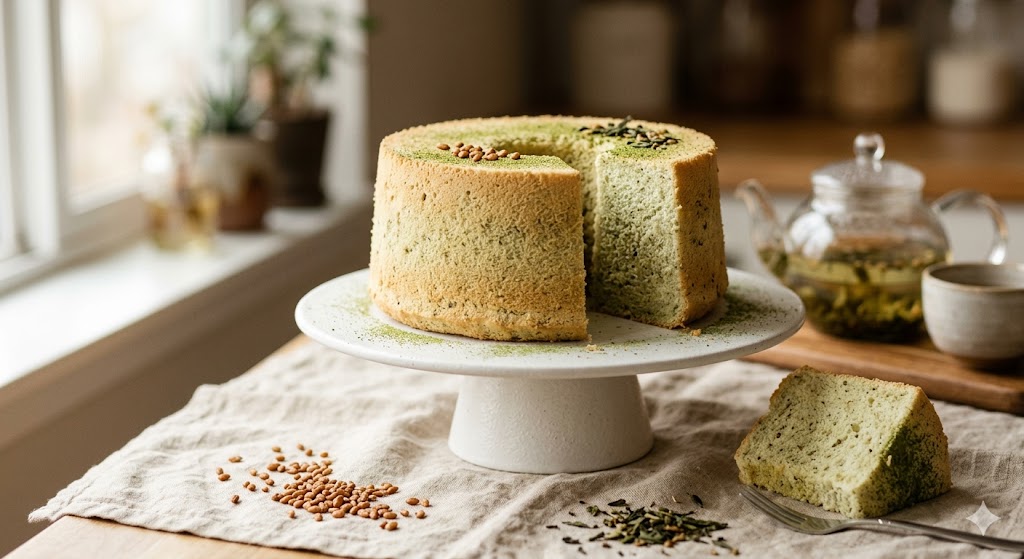
Genmaicha 玄米茶 — Japan's beloved blend of green tea with roasted brown rice — has a naturally toasty, popcorn-like flavor that translates into baking far better than most teas. This chiffon cake infuses the oil in warm genmaicha before it enters the batter, extracting fat-soluble aromatic compounds from the roasted rice that water-based steeping simply cannot capture. The result is a sponge with perfume rather than just color.
Why this genmaicha chiffon cake recipe is different
Standard tea-flavored cakes add tea powder to the flour and steep tea in the milk or water component of the batter. These water-based extraction approaches capture the water-soluble compounds in tea — primarily catechins, caffeine, and some amino acids — but miss the fat-soluble fraction that contains genmaicha's most distinctive aromatic compounds. The roasted brown rice in genmaicha produces maltol, 2-acetyl-1-pyrroline (popcorn aroma compound), pyrazines (roasted, nutty notes), and various Maillard furanones through its roasting process. These compounds are predominantly fat-soluble, with an oil/water partition coefficient that strongly favors the lipid phase. Water steeping extracts only a fraction of them.
Oil infusion at 60–65°C changes this entirely. At this temperature, the aromatic oil-soluble compounds dissolve into the vegetable oil efficiently — the warm (but not hot) temperature increases diffusion rates from the tea particles into the oil without the degradation that occurs above 100°C. The infused oil then carries these compounds uniformly through the chiffon batter as it is beaten with the egg yolks, distributing the aromatic compounds throughout every crumb of the finished cake rather than just the surface.
The dual approach — infused oil plus a small amount of genmaicha powder — combines fat-soluble and water-soluble extractions for a complete flavor profile. The powder contributes the water-soluble catechins and amino acids (particularly theanine's umami-adjacent contribution) along with visual color from the green tea chlorophyll and brown rice pigments. The infused oil contributes the roasted, toasty aromatic backbone that is impossible to achieve with powder alone.
Key ingredients explained
Genmaicha 玄米茶: The tea component is an equal-weight blend of sencha or bancha green tea with roasted genmai (brown rice). The quality of the rice component is what varies most between brands — premium genmaicha uses hōjicha-style deeply roasted rice that has developed full Maillard complexity; budget genmaicha uses lightly toasted rice with a pale, popcorn-forward but shallower flavor. For baking, more deeply roasted genmaicha produces a cake with more complex, coffee-adjacent aromatic depth. Ippodo Tea's genmaicha and Harney & Sons' genmaicha are reliable quality standards available internationally.
Neutral vegetable oil (米油 kome abura rice bran oil or canola): The oil must have a neutral flavor to avoid competing with the genmaicha aromatics. Rice bran oil is the traditional choice for Japanese chiffon cakes — its very clean, neutral flavor and high smoke point make it ideal. Canola oil is a perfect substitute. Do not use olive oil (too distinctive), coconut oil (solid at room temperature, disrupts the liquid-fat requirement of chiffon), or sesame oil (too aromatic — will compete with the genmaicha roasted character).
Hakurikiko 薄力粉 (Japanese cake flour, 7–9% protein): Lower protein = less gluten = more tender, finer crumb in the finished cake. The gluten network in a chiffon cake works against the airy structure created by the meringue — minimizing gluten formation by using low-protein flour allows the meringue structure to dominate, producing the characteristic cloud-like texture. Do not substitute bread flour or all-purpose flour.
Egg whites (for meringue): Room-temperature egg whites whip to greater volume than cold whites — the proteins unfold more readily at room temperature, trapping more air per minute of whipping. Cold egg whites from the refrigerator can be used but take significantly longer to reach stiff peaks. The meringue should be stiff but not dry (overbeaten) — peaks should curl slightly at the tip when the whisk is lifted, not stand rigidly straight.
Expert tips & techniques
- Oil infusion temperature control: Use a thermometer to confirm the oil reaches 60–65°C before adding genmaicha. The oil should feel clearly warm to the back of the wrist but not hot — slightly warmer than comfortable hand temperature. Below 55°C, the extraction rate is too slow for a 10-minute steep; above 70°C, the most volatile aromatic compounds begin to evaporate.
- J-stroke meringue folding: Hold the spatula like a paddle — not pinched at the tip. Insert the spatula at the center of the batter, draw it down through the batter and along the bowl's bottom, curve it up the side, and fold it over the center. This J-shape motion cuts through the batter vertically and lifts the denser yolk batter over the lighter meringue in a single motion. After each J-stroke, rotate the bowl 45 degrees and repeat. Stop after 12–15 strokes or when no white streaks remain — whichever comes first.
- Do not grease the pan: A chiffon cake pan (tube pan) must never be greased. The batter needs to adhere to the pan walls as it rises, using the wall surface as a climbing scaffold. Greased walls produce a cake that slides down its own walls as it cools — the signature dome-collapse failure of improperly prepared chiffon pans.
- Invert immediately on removal from oven: As soon as the cake is removed from the oven, invert the pan onto a bottle neck (most tube pans have legs for this purpose) or hang it upside down over a tall bottle. The inversion prevents the delicate air structure from compressing under the cake's own weight while it is still hot and structurally fragile. Leave inverted until completely cool (minimum 1 hour).
- Release technique: Run a thin, flexible offset spatula or plastic spatula around the outer and inner edges of the cooled pan. The cake should release cleanly if the edges are fully loosened — do not try to push it out from the bottom before fully releasing the sides.
Variations (regional, dietary, occasion)
Hojicha version: Substitute genmaicha with hojicha powder and hojicha tea for the oil infusion. Hojicha's deeper roast produces a cake with a more caramelized, slightly darker flavor profile — closer to a roasted grain flavor than genmaicha's lighter popcorn note. Use the same oil infusion technique and powder ratio.
Matcha-genmaicha blend: Use a 50:50 blend of genmaicha and matcha powder for the cake powder component. The matcha's grassy, slightly bitter, vivid green character contrasts with genmaicha's roasted warmth, producing a complex layered tea flavor. The visual effect — deep green streaks against the golden genmaicha base color — is striking in cross-section.
Black sesame cream filling: Slice the cooled chiffon horizontally and fill with black sesame cream (neri-goma mixed with stabilized whipped cream). The nutty, slightly bitter black sesame amplifies the roasted character of the genmaicha sponge rather than contrasting with it, producing a unified nutty-roasted flavor experience.
Equipment you'll need
17–18 cm tube pan (chiffon cake pan): The tube pan's central tube is essential — it provides a hot center column that ensures the batter in the core of the cake sets at the same rate as the batter near the outer walls. A standard round pan without a tube produces undercooked centers in chiffon cakes of this size. A 17 cm pan is appropriate for the standard recipe; an 18 cm pan produces a slightly wider, shorter cake.
Stand mixer or hand mixer with whisk attachment: For the meringue, a stand mixer with the whisk attachment is ideal — it maintains consistent whipping speed without fatigue. A hand mixer works well with attention to maintaining constant speed. The meringue should reach stiff peaks in 4–6 minutes at medium-high speed from room-temperature whites.
Small heavy saucepan (for oil infusion): A 14–16 cm saucepan is the right size for infusing 90 ml of oil. The saucepan must be able to maintain temperature steadily at 60–65°C over 10 minutes on the lowest burner setting. If the heat is too high, move the saucepan off the burner and use residual heat.
Frequently asked questions
Why does my chiffon cake collapse after coming out of the oven?
The most common cause is under-baking — the internal structure has not fully set before removal from the oven. Chiffon cake is done when a toothpick comes out clean and the top springs back fully when lightly pressed. A second common cause is not inverting immediately after removal — the hot, fragile structure collapses under its own weight if left right-side-up to cool. Inverting is not optional.
Can I taste the genmaicha in the finished cake?
Distinctly. Genmaicha produces a flavor that is noticeably different from plain vanilla chiffon — a warm, toasty, slightly nutty character from the roasted rice combined with a subtle green tea bitterness from the powder. The roasted rice aromatics are the most prominent; the green tea element is a background note. The cake does not taste like drinking a cup of genmaicha — it is more subtle and integrated than that.
Can I use loose-leaf genmaicha for the oil infusion?
Yes — loose-leaf genmaicha is used for the oil infusion in this recipe. The leaves and roasted rice are steeped in warm oil and then strained out. For the powder addition to the batter, use specifically milled genmaicha powder (not ground loose-leaf, which produces a coarse, gritty texture). These are two separate products used in two separate roles.
How do I prevent the meringue from deflating during folding?
The primary causes of meringue deflation are over-folding, folding with a cutting motion rather than a J-stroke, and using warm yolk batter (warm batter melts the fat globule structure stabilizing the meringue). Ensure the yolk batter is at room temperature before folding (not warm from the recently infused oil), use the J-stroke technique, and stop folding at 12–15 strokes regardless of visual streak concern. A few remaining light streaks of meringue are acceptable; a completely deflated meringue from over-folding is not recoverable.
What cream or topping goes best with genmaicha chiffon?
Unsweetened lightly whipped cream with a very small amount of vanilla is the traditional Japanese pairing — the plain cream contrasts with the tea's complexity without competing. Stabilized whipped cream with a small amount of hojicha or genmaicha powder folded in produces a unified flavor experience. Alternatively, serve with a drizzle of thin caramel sauce, which amplifies the roasted grain character of the tea.
Storage & make-ahead
Genmaicha chiffon cake keeps at room temperature for 2 days wrapped in plastic — the oil-based batter formula maintains moisture significantly better than butter-based cakes, which dry out faster. Refrigerate for up to 4 days; allow to come to room temperature before serving (cold chiffon is denser and less aromatic). Freezes well — wrap individual slices in plastic and freeze for up to 1 month. Thaw at room temperature for 1 hour.
The oil infusion can be made up to 24 hours ahead and stored covered at room temperature — the infused aromatic compounds stabilize quickly in the oil at room temperature. Do not refrigerate the infused oil (the oil's viscosity increases dramatically in the cold and it does not pour cleanly into the batter). Strain the tea leaves before storing and use the next day.
Recipe card with full ingredients and step-by-step instructions appears below.