Pyrazines: The Secret Aroma Compounds in Roasted Japanese Tea
When you savor roasted Japanese tea, you're tasting pyrazines—aroma compounds formed during roasting via Maillard reactions between amino acids and sugars. Low to moderate temps (200–250°C) create earthy, roasted, umami notes; higher temps add smokiness. They balance sweetness and bitterness, defining the tea's bold yet nuanced profile. Unlike coffee's high-temp pyrazines, tea's subtle derivatives offer floral depth. Brew at 80°C with 1.5g/8oz water for 30 seconds to preserve their delicate aromas. Discover how tea masters fine-tune roasting and brewing to access these hidden flavors. For more, see our guide on heat-stable compounds. For more, see our guide on roasted vs. unroasted tea. For a closer look, explore our Japanese tea that tastes like coffee.
KEY TAKEAWAYS
- Pyrazines are nitrogen-rich aromatic compounds that form during roasting via Maillard reactions between amino acids and reducing sugars at 200–250°C.
- Temperature control is the master variable: lower roasting temps produce earthy, nutty notes while higher temps generate smokier, bolder profiles.
- Japanese tea pyrazines are lower molecular weight (methyl/ethyl derivatives) than coffee's, yielding floral and herbaceous complexity rather than uniform robustness.
- Roasted teas like Houjicha and Genmaicha are defined by precision pyrazine management—Houjicha through high-heat leaf roasting, Genmaicha through toasted rice integration.
- Brewing at 80°C for 30 seconds with 1.5g per 8oz maximises pyrazine extraction without degrading delicate volatile compounds.[Komes et al., 2010]
Last updated: April 2026
What Are Pyrazines and Why Do They Matter in Tea?
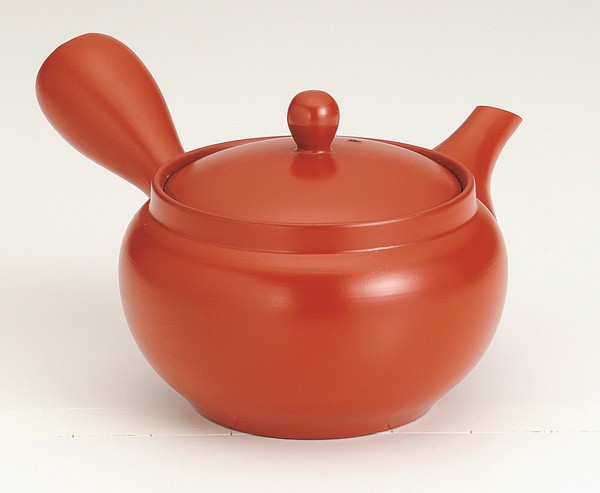
The visual below illustrates how pyrazine compounds emerge and concentrate during the high-heat roasting of Japanese green tea leaves.
Pyrazines are nitrogen-rich aromatic compounds formed during roasting that define the bold, earthy character of roasted Japanese tea. These molecules form when Maillard reactions bind amino acids and sugars under heat, amplifying smokiness, nuttiness, and umami on your palate. According to Hara (2001), roasting fundamentally alters tea chemistry by activating these volatile compounds, giving you precise control over intensity and depth.[Hara, 2001]
They're not just flavor enhancers—they're your secret weapon for crafting a tea experience that balances complexity and clarity. Mastering their role lets you command every sip, ensuring richness without overpowering bitterness.
Understanding pyrazines means accessing the science behind aroma dominance, letting you refine batches for consistent results. Their presence isn't random; it's a tool you wield to elevate your tea's character.
Claim that control now.
How Do Pyrazines Form During Japanese Tea Roasting?
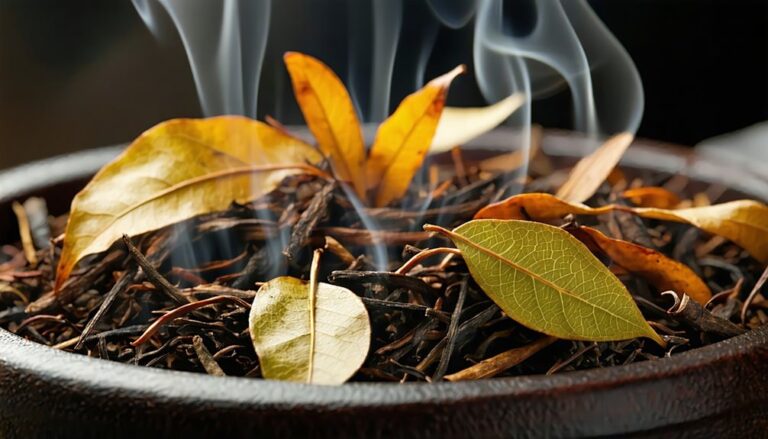
As shown in the following process image, precise heat and moisture management during roasting are the key variables that govern pyrazine formation.
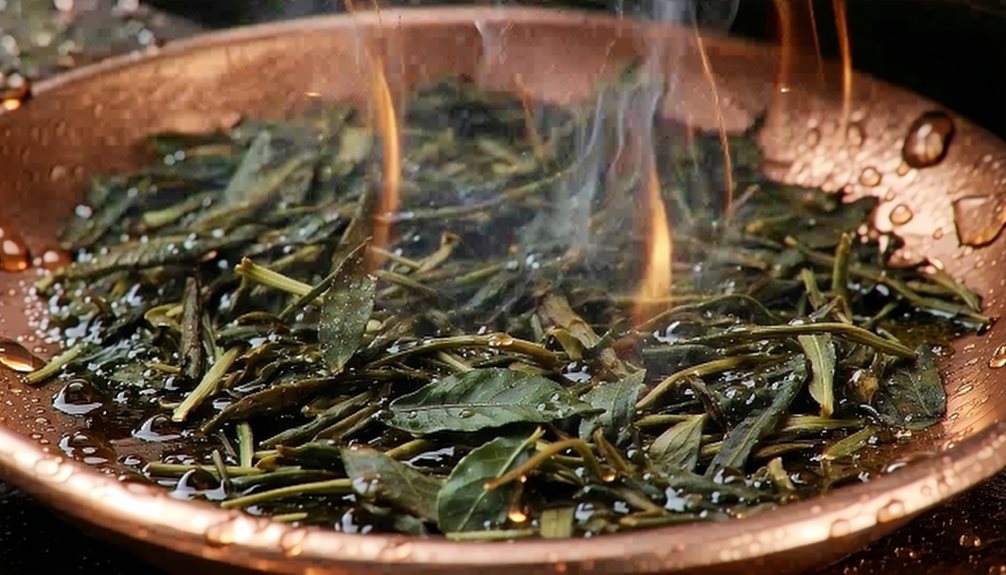
Pyrazines form through Maillard reactions—heat-driven chemical interactions between amino acids and reducing sugars—which intensify during roasting between 200–250°C. You command the bold, earthy scent of roasted Japanese tea by understanding this precise thermal process. Temperature and timing are your tools: lower heat (200–250°C) fosters gentle pyrazine development, while higher temps amplify smoky notes. Mastering moisture removal is key—excess water hinders reaction, so you carefully dry leaves first.
Roasting duration matters: too short, and pyrazines stay muted; too long, and volatile compounds degrade. By tweaking these variables, you control the aroma profile.
Each batch is a test of balance—heat intensity, green tea moisture, airflow. Precision here isn't optional; it's how you dominate the craft, ensuring every roast releases pyrazines' bold, savory power without overdoing it. Stay sharp. Stay authoritative.
What Is the Flavor Signature of Pyrazines in Tea?
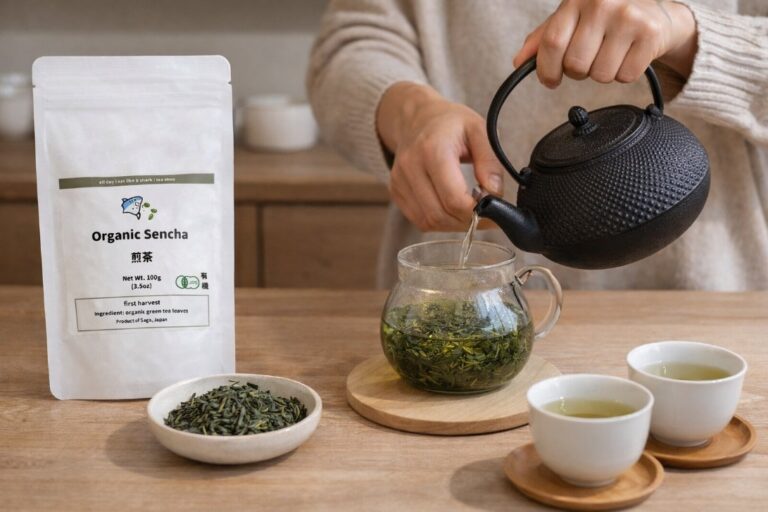
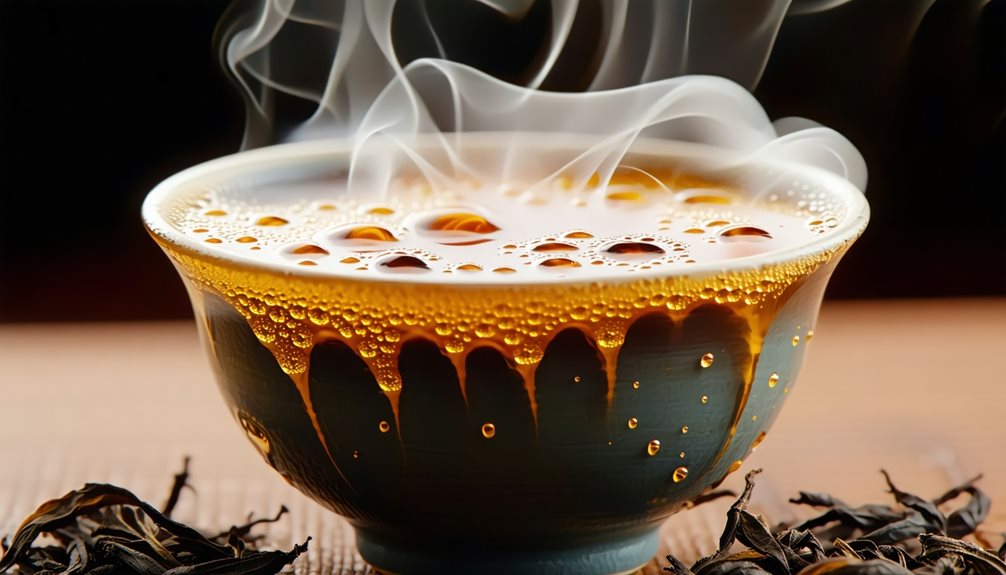
The brew pictured here demonstrates the deep amber color and bold, smoke-layered character distinctive of pyrazine-rich roasted Japanese tea.
Pyrazines create the signature smoky, nutty, umami-forward flavor profile that defines roasted Japanese teas. When you steep roasted Japanese tea, pyrazines dominate the sip—punchy umami, smoky nuts, and earthy depth collide, stripping away green tea's grassy freshness. These compounds aren't subtle; they assert authority on your palate, a hallmark of tea roasted just right. Research confirms that catechin content and volatile compound balance both shift significantly with processing method, and pyrazines are among the most sensory-impactful volatiles released under heat.[Cabrera et al., 2006]
You crave that complexity because you want to command every layer of flavor. Pyrazines anchor the brew, balancing sweetness with assertive bitterness, giving your cup unshakable character.
Their presence proves precision in roasting—too hot, and they vanish; too cool, and they hide. You *want* their boldness. It's a power move for those who refuse weak, forgettable tea.
Steeped correctly, they deliver the control you demand: full-bodied, smoky dominance that transforms each sip into a statement.
Are Pyrazines in Japanese Tea the Same as in Coffee?
Coffee and roasted Japanese tea both contain pyrazines, but their molecular profiles differ significantly, resulting in distinct aroma and flavor characteristics. Although coffee and roasted Japanese tea both rely on pyrazines for bold umami and smoky flavors, their specific compounds differ. Coffee's pyrazines, like 2,3-diethyl-5-methylpyrazine and 2,5-dimethylpyrazine, arise from high-temperature roasting.
Japanese tea features lower molecular weight pyrazines such as methyl and ethyl derivatives, stemming from both roasting and inherent amino acid content. These differences translate into distinct aroma profiles: coffee delivers earthy nuttiness, while tea offers floral, herbaceous undertones.
| Characteristic | Coffee Pyrazines | Japanese Tea Pyrazines |
|---|---|---|
| Key Compounds | 2,3-diethyl-5-methylpyrazine, 2,5-dimethylpyrazine (larger molecules) | Methyl and ethyl derivatives (lower molecular weight) |
| Roasting Temperature | High-temperature roasting (200°C+) | Controlled, low-to-moderate roasting (200–250°C) |
| Primary Aroma Profile | Earthy, nutty, robust, bold | Floral, herbaceous, subtle umami, layered |
| Flavor Depth | Full-bodied, uniform intensity | Complex, nuanced, with balance of sweetness and bitterness |
Knowing this helps you fine-tune flavor control. For example, if you crave coffee's robustness, you'll rely on its unique pyrazines. But if you seek subtler umami with a balance of smokiness, Japanese tea's compound mix gives you precision.
Understanding these nuances empowers your choices.
What Roasting Techniques Unlock Pyrazines in Tea?
Precise roasting techniques—using low, steady temperatures (200–300°F) and controlled durations—directly determine pyrazine levels and aroma profiles in Japanese tea. Roasting techniques determine the pyrazine profile in Japanese tea, setting it apart from coffee's high-heat approach. You manipulate heat and time to reveal pyrazines—those earthy, nutty notes.
Unlike coffee's uniform roasting, tea demands finesse. You control variables: low, steady temperatures (200–300°F) caramelize sugars without scorching; shorter durations preserve delicate aromas. Traditional methods, like pan-firing or infrared roasting, let you modulate intensity.
Each adjustment—whether adjusting airflow or batch size—alters pyrazine levels, directly shaping depth and balance. Precision guarantees the roasted aroma isn't overpowering but nuanced.
How Do Houjicha, Genmaicha, and Other Teas Showcase Pyrazines?
Houjicha and Genmaicha are roasted Japanese teas where pyrazine control defines their distinctive flavor character and cultural significance. Houjicha and Genmaicha showcase pyrazine-rich profiles honed by precision roasting, where low heat and careful timing transform green tea's vegetal tones into savory, toasty brews. You control the roast duration to amplify pyrazines, balancing earthy depth with fresh notes.
Houjicha (Best for: deep, toasted, nutty flavors with lower caffeine) — Houjicha's high-heat roasting process drives off a significant portion of caffeine through sublimation while locking in rich, nutty pyrazines, creating a warm, coffee-like experience.[Tea Chemistry, 2024] Genmaicha (Best for: balanced tea with popcorn-like toastiness and cultural authenticity) — Genmaicha's popped rice adds complexity, layering popcorn-like aroma over tea's umami. According to Heiss & Heiss (2007), genmaicha originated as a practical way to extend tea supplies while developing its own prized flavor profile through roasted rice integration.[Heiss & Heiss, 2007]
These techniques demand mastery—you adjust temperature shifts to avoid over-roasting, preserving subtle nuance.
Beyond these, roasted teas like Kaisei-cha or Gyokuro use similar methods, but shorter roasts retain brighter hints of seaweed or chestnut. By manipulating variables, you dictate pyrazine intensity, shaping the tea's character from earthy warmth to smoky sharpness.
Mastery here isn't just about taste—it's engineering aroma itself.
Can You Taste the Difference Pyrazines Make?
Yes—pyrazines are directly responsible for the bold, smoky, nutty flavor signature that distinguishes roasted Japanese teas from unroasted varieties. If you've ever sipped roasted Japanese tea, you've tasted pyrazines at work—though you mightn't realize how much they shape the flavor. These compounds create bold, earthy, nutty notes that define Houjicha or Genmaicha and set them apart from lighter brews.
When you drink, you're not just enjoying roasted grains or roasted beans; you're detecting pyrazines amplified by heat, adding depth and warmth. Without them, the tea loses its signature savor.
You can't ignore their influence: they're the reason your palate lingers on smoky, toasted undertones. Even subtle variations in roasting intensity alter their presence, letting you adjust flavor profiles to your taste.
Mastering their role gives you control—over your brew, your preferences, and your understanding of what sets roasted tea apart.
How Do Japanese Tea Masters Cultivate Pyrazines?
Japanese tea masters cultivate pyrazines by precisely controlling roasting temperature (200–300°F), duration, leaf moisture, and tea composition—techniques refined through centuries of tradition. Although you associate pyrazines with bold roasted flavors, their cultivation hinges on precise control of heat, time, and tea composition. Japanese tea masters monitor temperature gradients during roasting, balancing low-to-mid heat to maximize pyrazine retention without scorching.
They favor slower roasting cycles, preserving leaf moisture and allowing pyrazines to form through Maillard reactions. Tea composition matters, too: high-amino-acid leaves, like those in Gyokuro, react differently than oxidized varieties.
Masters adjust roast duration based on desired aroma profiles—shorter for floral undertones, longer for earthy depth. By fine-tuning these variables, they harness pyrazines to craft tea with controlled complexity, ensuring each batch hits your flavor targets.
Mastery lies in precision, not guesswork.
Why Are Pyrazines Key to Japanese Tea Culture?
Pyrazines embody the technical mastery and cultural values central to Japanese tea tradition—precision, respect for craft, and intentional flavor development. Tea masters' focus on pyrazines isn't just technical—it roots in tradition. You understand their role in shaping the earthy, nutty, and roasted notes prized in Japanese teas. By mastering these compounds, you control the sensory language of the craft, aligning with centuries-old practices that prioritize depth over novelty.
Precision in cultivating pyrazines reflects your respect for heritage and discipline. These aromas aren't accidental; they're deliberate markers of quality, signaling the tea's journey from shaded fields to fire-roasted leaves.
For you, leveraging pyrazines offers control not just over flavor, but over storytelling—each sip a nod to tradition, each note a proof of your craft. This is how you command the culture, not just consume it.
How Do You Brew Pyrazine-Forward Japanese Tea Perfectly?
Optimal brewing of pyrazine-forward tea requires precise water temperature (80°C / 175°F), leaf ratio (1.5g per 8oz), and steep time (30 seconds) to unlock delicate aromatic compounds. Once you've honed the craft of pyrazine-rich roasting, brewing becomes a delicate dance of precision and timing. Research on green tea extraction confirms that 70–80°C is the optimal temperature window to preserve volatile aromatic compounds without degradation.[Komes et al., 2010]
Start with water at 175°F (80°C)—too hot, and you'll strip pyrazines; too cool, and they'll fade.
Use 1.5g leaves per 8oz, measured precisely.
Pour water into a porcelain teapot, which preserves volatile compounds better.
Steep for 30 seconds maximum; pyrazines peak early.
Hit the sweet spot, and you'll unlock roasted earth, toasted nuts, and that unmistakable umami.
Avoid agitation: let leaves settle mid-steam, undisturbed.
Each brew is a test of your control—over heat, ratios, and rhythm.
Master this, and you command the aromas that define Japanese tea's soul.
Frequently Asked Questions
Are Pyrazines Present in Unroasted Japanese Tea Leaves?
Pyrazines are present in minimal quantities in unroasted Japanese tea leaves—roasting dramatically increases their concentration through Maillard reactions. You can control their intensity by adjusting roasting time and temperature to reveal or mute the bold aromas they create.
Can Different Japanese Tea Varieties Vary in Pyrazine Concentration?
Yes, Japanese tea varies in pyrazine concentration. You'll find higher levels in roasted varieties like Houjicha and Genmaicha due to heat treatment. Processing methods, not just cultivars, shape pyrazine profiles. Control your roast time and temp to customize aroma intensity.
How Do Humidity Levels During Roasting Affect Pyrazine Formation?
Humidity levels dramatically influence pyrazine formation. High humidity slows roasting, reducing pyrazines you crave; low humidity speeds reactions, boosting bold, earthy notes. Control temps and airflow to master these compounds and prevent moisture from hindering Maillard reactions.
Are There Non-Japanese Teas With Similar Pyrazine Profiles?
You'll find non-Japanese teas like Chinese stir-fired or Indian smoky black teas have similar pyrazine profiles through roasting and high-heat processing. You can control these by adjusting roast temps and times, so tweak processes to match desired nutty, roasted notes.
Can Pyrazines Degrade Over Time After Tea Is Roasted?
Yes, pyrazines fade like a whispered secret when exposed to light, heat, or oxygen. You control this: store roasted tea airtight, cooled, and dark to lock in those earthy aromas for months.