5-Minute Steep vs. 20-Minute Steep: How Infusion Time Affects Catechin Extraction
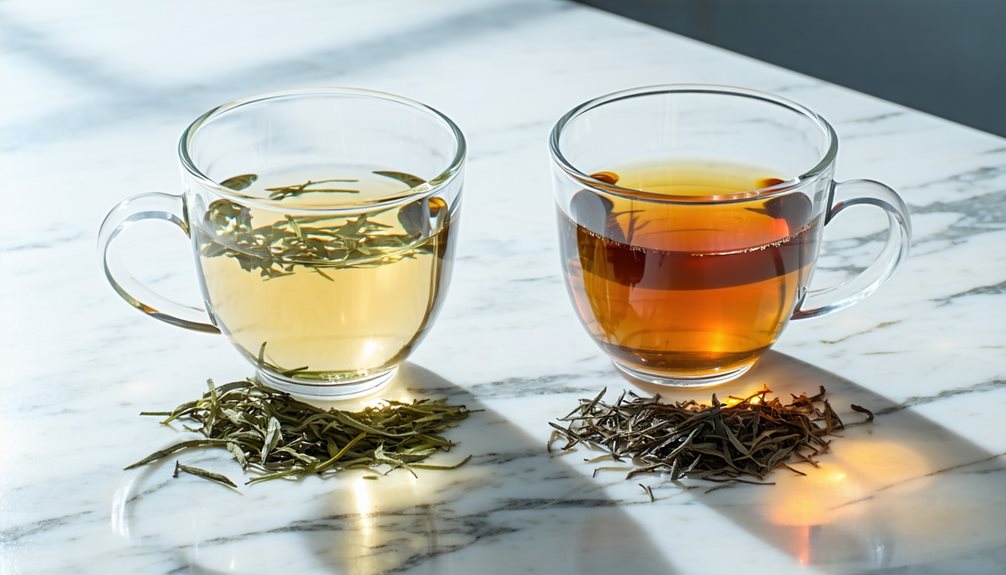
If you compare a 5-minute steep to a 20-minute steep, you’ll find the longer brew doubles catechin extraction, boosting EGCG levels considerably. But it also pulls out bitter tannins, marring flavor balance. Shorter steeps, especially around 6–8 minutes, capture ideal catechins without harshness. Controlling temperature—higher temps speed extraction—matters too. Want to brew tea that’s both potent and palatable? There’s more to discover ahead.
Understanding Catechins: How Steeping Time Impacts Extraction Efficiency
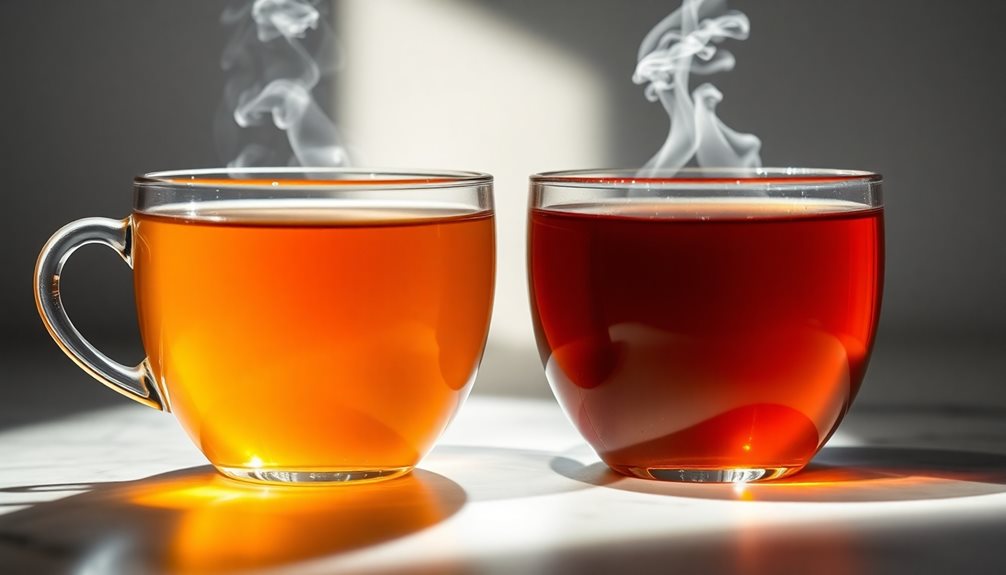
While steeping tea seems simple, the interplay between time, temperature, and catechin extraction is nuanced. You need precise control: longer steeps boost catechin levels, but beyond a point, diminishing returns set in.
Hot water (85–100°C) maximizes first-infusion catechins, while second infusions at 70°C extract higher amounts, offering a strategy to balance strength and efficiency.
Cold brewing? It underperforms for catechins, so if you want potency, heat matters. Interestingly, cold water extraction favors non-gallated catechins over their gallated counterparts non-gallated vs gallated, revealing a temperature-specific efficiency variation.
Multiple short infusions outperform one long steep at the same temp, so reuse your leaves to capture more over time.
Track your storage, too—leaving brewed tea at room temp (25°C) slashes catechin content within 36 hours, but refrigeration preserves it.
You’re not just steeping tea; you’re engineering extraction. Adjust time, temp, and reuse cycles to optimize your yield, then store results wisely to maintain control from cup to shelf.
5-Minute vs. 20-Minute Steeps: The Catechin Yield Difference
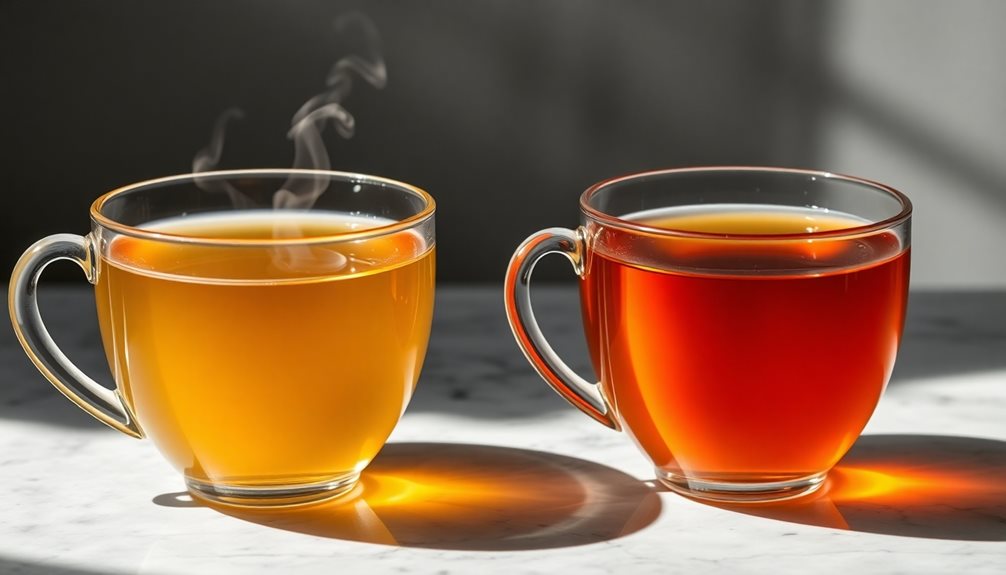
Because steeping time directly impacts catechin concentration, you might wonder what separates a quick 5-minute brew from a 20-minute extraction. The key lies in extraction progression: catechins, the slowest-leaching compounds, build steadily, with significant gains between 5–10 minutes before plateauing.
A 5-minute steep captures baseline levels, yielding foundational EGCG—around 605 mg total polyphenols/100g at 100°C—but a 20-minute steep nearly doubles that to over 1,500 mg, reaching near-max efficiency. Yet this yield curve isn’t linear. You’ll see accelerated extraction between 5–10 minutes, after which gains taper.
OVERSTEEPING introduces risks of bitterness and astringency, as prolonged infusion beyond 20 minutes can over-extract undesirable compounds alongside catechins. Pairing longer times with higher temps (95–100°C) turbocharges results, but lower temps (75–80°C) cap output. If you want precision, you control both variables: longer times boost yield, but you trade efficiency for time.
At 20 minutes, you’ve hit peak potential. For foundational potency without the wait, 5 minutes suffices; for maximum extraction, 20 gives you command over the full spectrum.
Brewing for Balance: Maximize Catechins Without Bitterness
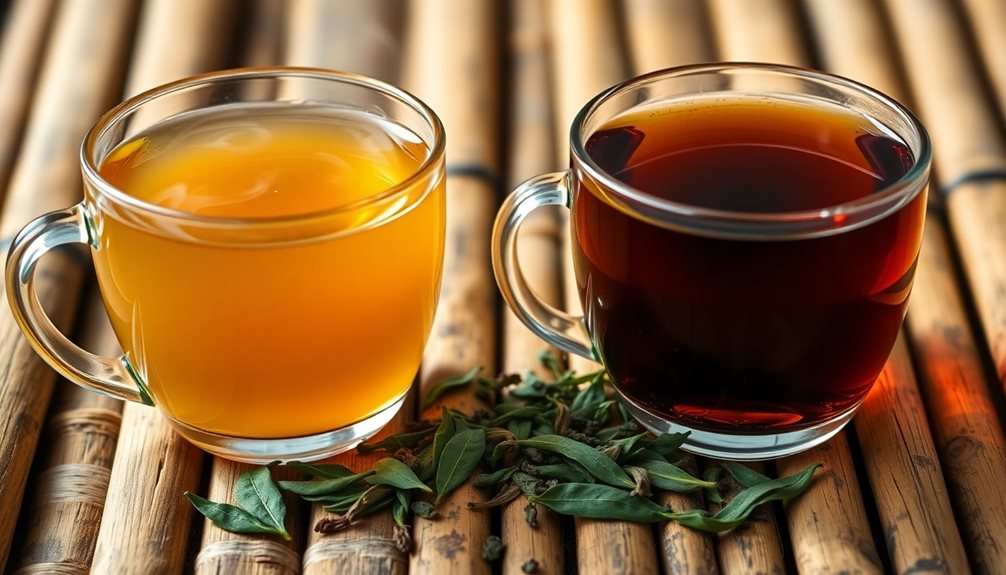
Balancing catechin extraction and bitterness starts with timing your brew to hit a sweet spot: you get maximum EGCG at 6–8 minutes, but go past 10, and astringency creeps in. Monitor the clock—after 5 minutes, you’ve likely extracted most caffeine and early polyphenols, but extending to 8 minutes boosts EGCG without harsh notes.
If you’re chasing balance, pull it at 7 minutes: your brew hits peak EGCG (around 5,000–6,000 mg/100g dry matter at 80–100°C) while sidestepping bitterness from over-extracted tannins. Studies show Green tea in bags maximize polyphenol extraction efficiency due to their fine particle size, which enhances surface area and solubility during brewing (knowledge 3).
For finer control? Use 1–2mm particle blends—they release more antioxidants, smoother flavor. Steep any longer, and you’ll chase diminishing returns; bitterness spikes as EGCG gains plateau.
Don’t let a 20-minute steep lure you—precision here means hitting that 6–8 minute window, then dumping the leaves. Your cup gets the full health boost, zero bitter sting.
Take charge: time your brew, and you master both flavor and function.
Prioritizing Temperature vs. Time for Catechin Extraction
When brewing tea, cranking up the heat matters more than stretching steep time—studies show higher temps extract catechins efficiently, while extra minutes barely boost yields. You’re better off prioritizing temperature control over fiddling with steep duration.
Data from trials on green, oolong, and black teas reveals that hits of 95–100°C (203–212°F) rapidly release maximum catechins—beyond what even 20-minute steeps at lower temps can match. Time beyond 3 minutes mainly affects bitterness, not extraction efficiency.
For premium teas, hotter water guarantees robust catechin pulls without astringency; lower-grade leaves demand cooler temps to avoid bitterness, but still favor precision over prolonged immersion.
If you want to optimize your brew, focus on mastering heat—higher temps in 5–10-minute windows deliver consistent, science-backed catechin yields, while time acts as a secondary tool for flavor balance.
Keep it simple: heat first, time second.
(Prolonged steeping (beyond recommended durations) risks excess tannins, which can lead to astringency and diminish the tea’s enjoyment despite higher antioxidant yields.)
How Tea Quality Influences Catechin Extraction and Flavor
The quality of tea leaves directly impacts both catechin content and flavor profile, with leaf particle size and growing conditions playing pivotal roles in extraction efficiency and sensory outcomes. Use high-quality, uniform leaves processed at ideal particle sizes (100-180 μm) to maximize catechin yields (33.5 mg/g) without compromising flavor.
Smaller particles can reduce extraction efficiency due to heat damage, but blending them with 5 mm fragments enhances EGC, EC, and ECGg levels while balancing bitterness and astringency via increased amino acids and theanine. Control your variables: select leaves grown in climates with favorable rainfall and thermal conditions to boost natural catechin concentrations.
Prioritize hot water extraction (25.98% yield) over alternatives for superior efficiency. By refining particle blends, managing environmental inputs, and aligning extraction methods with leaf quality, you’ll maximize both bioactive compound recovery and palatable outcomes.
Bitterness vs. Balance: How Steep Time Shapes Tea Flavor
Once you’ve optimized tea leaf quality, steeping duration becomes the key variable that shapes both catechin extraction and sensory balance.
Steep times under 3 minutes yield high catechins with minimal bitterness, ideal for a clean, crisp taste. But push to 3–5 minutes at 80–85°C, and you hit the sweet spot: peak EGCG extraction, rich color, aroma, and that satisfying balance of boldness and drinkability.
Scientific studies have identified 80°C as the optimal temperature for maximizing catechin yield, while 30-minute extraction times ensure comprehensive recovery, though in home brewing, shorter durations still allow significant beneficial compounds to manifest without overwhelming tannins.]
Go past 5 minutes, though, and you’ll risk extracting astringent tannins that overwhelm the sip. Even worse, prolonged steeping at high temps breaks down desirable EGCG into less beneficial forms, turning your brew bitter and flattening its health perks.
While longer steeps don’t boost catechin content past ~85 mg/100ml, they do amplify undesirable flavors. Control matters here: short, precise steeps at lower temps (70–80°C) preserve balance.
Longer times demand tighter temperature checks to avoid bitterness. Your choices in minutes and degrees directly map to either a harmonious cup or one that’s astringent and harsh.
Replicating Results at Home: Optimal Brewing Techniques
Want consistent, richly balanced tea at home? Start by calibrating water temps: use 212°F for black and herbal, 175–180°F for green/white, 195°F for oolong. A thermometer or kettle with presets ensures precision.
Time each steep strictly—use a timer to hit 1–2 mins for green, 3–5 for black, 5–10 for herbs. Rushing or lingering past these windows ruins balance.
Preheat your 16-oz cast iron teapot to stabilize temps, then add 1–2 tsp quality tea leaves per 6 oz water (adjust based on tea type). Cover during steeping to lock in heat.
Over-extraction? That’s bitterness; control it with exact timing. For multiple infusions, extend time or raise temp slightly on second steeps to evolve flavors—oolong, Pu-erh, and quality greens excel here.
This system lets you fine-tune flavors, every time.
Frequently Asked Questions
Does Pouring Water Over Tea vs. Immersion Affect Catechin Extraction?
You’ll find no data proving pouring vs. immersion affects catechin extraction. Focus on temperature, time, tea type, and agitation for control. Adjust these variables to optimize your brew’s catechin content.
How Does Water pH Influence Catechin Extraction Efficiency?
Lower pH boosts extraction efficiency by stabilizing catechins, preserving major forms (EC, EGCg), and reducing epimerization. You'll harness acidic water to shield bioactives, masterfully controlling pH to maximize yield and minimize degradation during steeping.
Can Stored Brewed Tea Retain Catechin Content Over Time?
Yes, stored brewed tea retains catechins if you refrigerate at 4°C with pH 4.0, but degradation accelerates after 6 months, so control storage conditions and time to minimize loss.
How Do Different Tea Leaf Cut Sizes Affect Extraction Rates?
You see, smaller tea cuts (120 μm) boost initial extraction but risk bitterness; blending with larger particles balances flavor. Opt for 120 μm with 5 mm bits for efficient, smooth extraction—control speed and taste. PEF-treat for faster results.
What Role Does Oxygen Exposure Play in Catechin Degradation During Steeping?
You might not know this, but oxygen steals your tea's antioxidants. Longer steeps, hotter water, finer cuts mean faster catechin loss. Take control—time, temp, leaf size matter. Oxidize less, extract more.