The Catechin-to-Amino Acid Ratio: A Key Marker of Tea Quality
High tea quality hinges on your catechin-to-amino acid ratio. Balanced ratios mean a silky, umami-rich brew with controlled bitterness; too many catechins? Astringent, flat flavors. Theanine boosts smoothness and masks bitterness, while nitrogen management in leaves shapes this balance. Harvest timing and processing matter, as does using fresh, mature leaves. Want to discover your tea’s true depth? Understanding these ratios reveals how flavor and health benefits align—and why some brews sing. You’ll see why this balance isn’t just a sip, but a science.
How Catechin-Amino Ratios Shape Your Tea Experience
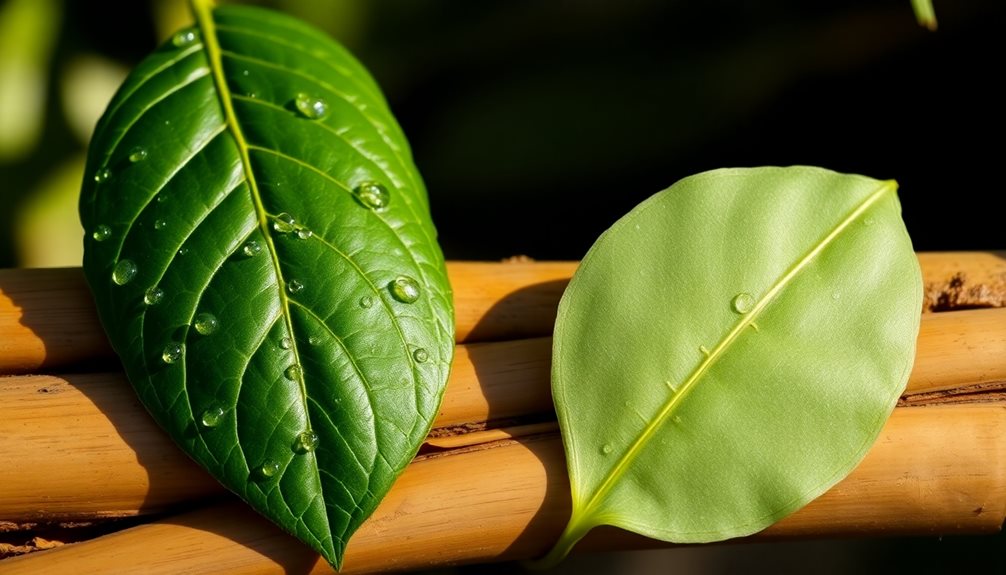
Since the phenol-to-amino acid ratio serves as a traditional quality marker in tea, it directly shapes your sensory experience by balancing bitterness, astringency, and umami. You’ll notice that high-grade teas—where amino acids outweigh catechins—deliver a silken, umami-rich mouthfeel, while imbalanced ratios result in harsher, astringent notes you likely want to avoid.
Theanine drives this equilibrium: its 0.989 correlation with quality ensures a smooth, invigorating profile, especially in spring harvests where amino acids peak and catechins dip. By prioritizing teas with higher theanine and lower galloylated catechins, you gain control over flavor intensity and perceived freshness.
Restrictive ratios (6.55–6.81) guarantee consistency across grades, letting you decode quality through taste. Remember, when amino acids inhibit bitter compounds, your cup becomes both mellow and vibrant—mastering this balance means crafting the exact tea experience you crave.
Catechins, Bitterness, and Antioxidant Power in Tea
Catechins do more than shape your tea’s taste—they also pack antioxidant punch and dictate bitterness levels based on their structure and concentration. You need to know EGCG and ECG are the power players: they dominate antioxidant activity and bitterness, especially in unfermented greens.
Fermentation slashes their levels, while high heat during roasting warps them into epimerized forms, reducing bioactivity. Opt for lower-fermentation teas to maximize these compounds.
Gallic acid, a byproduct of degradation, adds subtle astringency, so its presence signals processing precision. For the strongest antioxidant edge, target teas with elevated EGCG and ECG—like high-quality Chinese greens.
But beware: higher ester-catechin ratios amplify bitterness, which you can balance by adjusting brewing time and temp. Control your tea’s profile by choosing processing methods that preserve catechin integrity; this isn’t just about flavor—it’s about harnessing bioactive power through informed choice.
Let your brew reflect both health and harmony.
Theanine: The Amino Acid Behind Umami and Bitterness Balance
While catechins define tea’s bitterness and antioxidant power, they’re not the only players shaping your cup. Theanine, a unique amino acid found exclusively in *Camellia sinensis*, steers umami depth and bitterness balance. You’ll find it in two forms—L-theanine in fresh leaves, D-theanine from oversteeping or heating—but green tea holds the highest concentrations (6.56 mg/g), making it your go-to for crisp, savory notes and chestnut-like warmth.
It doesn’t just add flavor; it masks caffeine’s bitterness, smooths polyphenol astringency, and boosts sweetness perception—eliminating the need for additives. Theanine levels also signal quality: early spring harvests seasonal influence, tender buds, and premium varieties like albino yellow tea spike this marker.
For control, track theanine via amino acid analysis—its presence validates freshness, and freshness elevates value. Master brewing time and leaf selection, and you’ll command every sip’s complexity.
How Leaf Maturity Disrupts Catechin-Amino Ratios
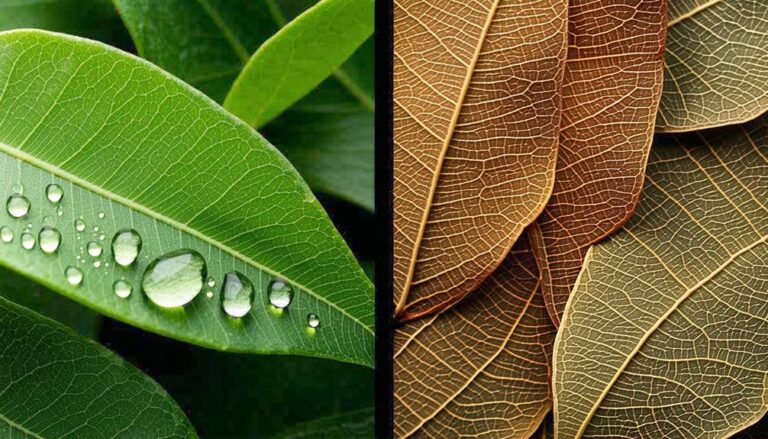
As leaf maturity progresses, the delicate balance between catechins and amino acids in tea plants hinges on nitrogen—a nutrient orchestrating their metabolic tug-of-war. You know nitrogen drives amino acid synthesis in roots, pushing carbon away from catechin pathways. That’s why mature leaves boost amino acids like theanine while suppressing polyphenols.
Yet, in some cultivars, catechin levels surge with maturity, defying uniform patterns. This variability means you must calibrate harvest timing based on varieties: early picks lock in catechins for boldness, but mature leaves prioritize amino acids for umami.
Root-to-shoot nitrogen flow steers these shifts. Too much nitrogen skews the C/N ratio, lowering catechins for glutamine and arginine. You need to optimize nitrogen balance—avoid extremes. Monitor C/N dynamics to control bitter-sweet profiles.
Blending different particle sizes, as demonstrated in studies on catechin extraction efficiency blend of various particle sizes, can further stabilize this balance by enhancing functional compound yields without compromising sensory acceptance.
Particle Size and Blending: Boosting Catechin Extraction
If you're grinding tea leaves to release their full catechin potential, particle size becomes your critical tool—strategic reductions to 100–180 μm maximize extraction without triggering oxidation losses. You’ll see catechin content jump from 26.0 mg/g in whole leaves to 33.5 mg/g at this range, while particles <50 μm degrade due to excess surface area–driven oxidation. Smaller than 50 μm? You’re risking lower bioavailability, not better it.
Balance matters: grind at 6000 rpm to preserve compounds, but avoid 18,000 rpm’s heat-triggered degradation. Use differential split methods—grinding and sieving—to isolate the 100–180 μm class, where EGCG and other key catechins peak. This isn’t guesswork—all five major catechins follow the same trend.
Measuring Tea Quality: Tools for Catechin-Amino Analysis
Understanding tea quality hinges on precise analytical tools to measure catechin and amino acid profiles—key determinants of bioavailability, antioxidant potency, and flavor impact. You’ll use HPLC systems, like the Shimadzu LC-16, to quantify eight catechin monomers. These systems separate ester (EGCG, ECG) and non-ester (C, EGC) variants, calculating totals for holistic profiling.
Capillary electrophoresis offers a complementary, efficient alternative. For enhanced sensitivity, UPLC-MS methods—such as Q-TOF/MS or Orbitrap-MS—distinguish structural isomers and track metabolite shifts during storage, like theanine or quercetin degradation.
Accredited labs apply HPLC to quantify 21 amino acids, including theanine (which dominates 50% in black tea), while isolating sweet vs. umami contributors. For example, albino yellow and green teas naturally contain the highest theanine levels, directly influencing their distinct umami profile and stress-reducing properties. You’ll also assess seasonal variations: spring teas hold higher total catechins (30.01 mg/g vs. summer’s 38.28 mg/g).
With EGCG as the star catechin, these tools empower precise quality control. By linking data to astringency, flavor, and antioxidant strength, you gain actionable insight to refine processing and guarantee consistency.
Do Catechin-Amino Ratios Differ in Organic vs. Conventional Teas?
When analyzing the quality of organic versus conventional teas, you’ll find that catechin-amino ratios reflect distinct cultivation impacts. Organic teas typically show 132.2 g/kg total catechins (vs. 115.7 g/kg), driven by higher EGCG, ECG, and EGC levels.
Yet free amino acids vary: some studies note lower concentrations in organic teas due to reduced soil nitrogen, while others report increases with nitrogen-rich fertilizers. This inconsistency highlights cultivation controls—inputs, soil management, and nutrient strategies directly shape ratios.
Organic teas also feature elevated minerals like potassium and calcium, boosting secondary metabolite accumulation but reducing sulfur and boron. Essential, conventional teas often display higher theanine and aspartic acid, while organic samples excel in proline and GABA. Crude fiber and extract differences further influence bioavailability.
These variations underscore the importance of advanced analytical methods (such as PCA and OPLS-DA) in accurately classifying tea authenticity with 93.9% accuracy.
What Ratio Metrics Reveal About Tea Quality
By examining the interplay between catechin and amino acid ratios, you immediately gain insight into tea’s flavor balance, fermentation progression, and varietal identity.
High catechin-to-low amino acid ratios signal dominant bitterness and astringency, typical of fermented black teas, while inverse ratios (high amino acids) define smooth, umami-rich white and green varieties. Monitoring these metrics controls for ideal taste equilibrium.
Fermentation stages are clear through declining catechin (10.96–95.67 mg/g) and amino acid levels (2.63–25.89 mg/g), with EGCG conversion tracking oxidation.
Varietal differentiation is precise: EGCG, theanine, and caffeine act as biomarkers, with white/green teas showcasing higher amino acid dominance. Genetic diversity among tea varieties influences these ratios—Japanese *sinensis* cultivars, for example, exhibit elevated theanine and reduced EGCG, underscoring their unique genetic heritage.
Genetic factors, like Japanese *sinensis*’s elevated theanine and lower EGCG, reinforce ratio-based classification.
Frequently Asked Questions
How Does Aging Affect the Catechin-Amino Acid Balance in Stored Tea?
Aging doesn’t mellow your tea into a harmonious drink—it’s a chemical power struggle. Catechins oxidize, theanine degrades, and flavoalkaloid alliances form, shifting your prized balance toward bitterness and mystery. Control? Keep it dark, cold, and sealed—or rethink your tea’s timeline.
(35 words)
What Brewing Temperatures Optimize This Ratio's Stability?
You'll optimize the ratio's stability by brewing at 160°F–175°F, balancing catechin and amino acid extraction to preserve structural integrity and sensory balance.
Do Specific Tea Types Differ in Catechin-To-Theanine Proportions?
Yes, they do—green tea’s higher catechin-to-theanine ratios dwarf black or oolong; fermentation trims theanine while caffeine climbs. You’re choosing flavor depth, antioxidant punch, and how those compounds play out—*control your brew’s edge*.
Can Home Infusion Techniques Modify Extraction Ratios Effectively?
Yes, you can tweak extraction ratios by adjusting water temp, steeping time, and leaf-to-water ratios. Lower temps preserve amino acids; longer steeps risk bitterness, so precision gives you control.
How Do Mineral Contents Influence Taste Without Altering Primary Ratios?
Minerals radically tweak your tea’s taste by hijacking extraction: they suppress polyphenol liberation, muffle bitterness, and cloud clarity, all while leaving core ratios intact. You *control* this by choosing water with ideal mineral balance to release desired flavors without altering chemical foundations.