Catechin Epimerization: Why Temperature Matters for Tea Quality
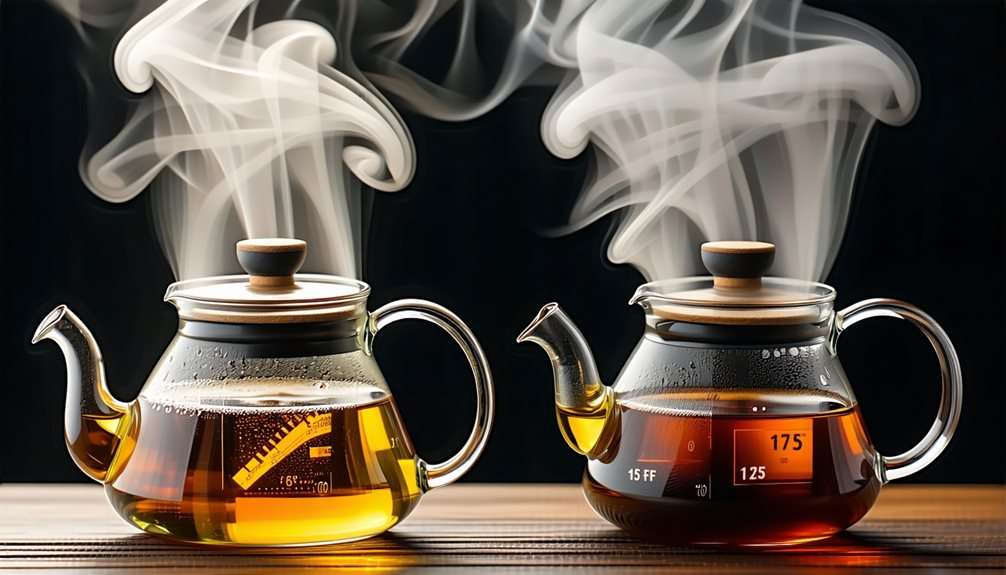
When brewing tea, you must control temperature to shape catechins' fate: 98°C accelerates epimerization, shifting bitterness and boosting bioavailability, while 85°C preserves EGCG for milder, umami-rich flavors and health perks. Boiling water risks tannic harshness, but cold brews maximize antioxidants. Every 10°C change alters extraction efficiency, amino acids, and flavor balance. Mastering this sweet spot guarantees ideal taste and wellness benefits—your key lies in the fine line between heat and ruin. Uncover the nuances next.
The Role of Catechins in Tea Flavor and Health
While you might associate catechins with their well-documented health perks—like fighting cancer or boosting heart health—their role in shaping tea’s flavor is equally vital and less explored. Catechins, especially EGCG, directly influence bitterness, astringency, and freshness, creating tea’s signature taste. Their health benefits stem from antioxidant activity, but you can’t separate their sensory impact: they anchor umami while balancing floral notes. Regulate their concentration, and you regulate the drink’s body and aftertaste. Yet, overextraction or underextraction distorts this balance, masking complexity. By mastering extraction, you harness catechins for both therapeutic value and refined flavor—no guesswork. Precision in brewing ensures you’re not just consuming antioxidants; you’re curating a sensory experience. The same compounds that protect your cells also sculpt the cup. Moreover, enhance endurance with tea catechins—specifically EGCG—can boost fat oxidation and reduce glycogen reliance during physical exertion, linking their metabolic effects to athletic performance.
The Catechin Tipping Points: 44°C vs. 98°C
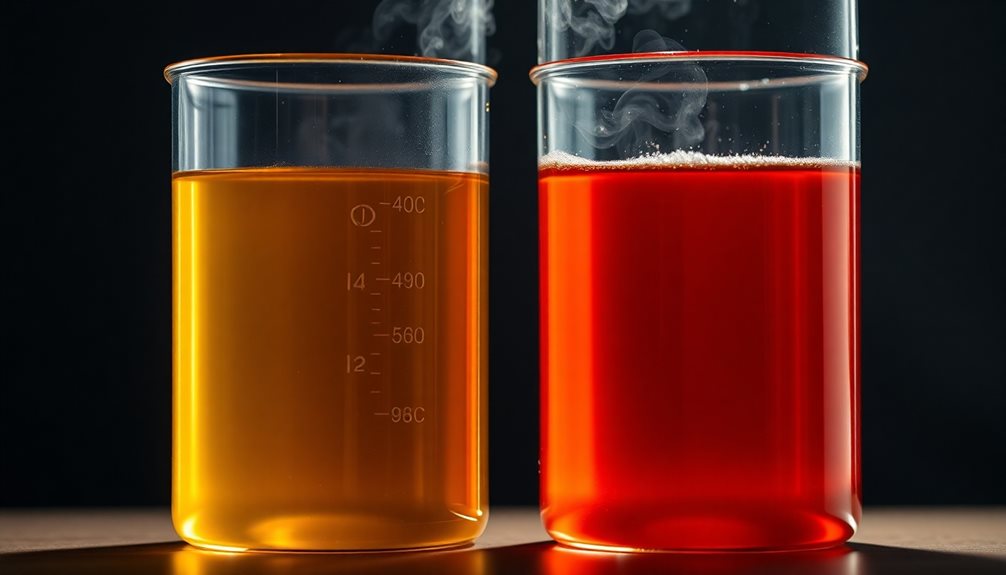
Precision in brewing sets the stage for revealing tea’s potential, but temperature choices take center stage when it comes to how catechins behave. Existing research highlights that epimerization accelerates above 90°C, particularly at 120°C or during typical brewing at 98°C. This means 98°C actively drives structural changes in catechins, altering flavor and bioavailability.
However, 44°C isn’t established as a threshold in studies—low enough to avoid epimerization but insufficient to release catechins fully. You must weigh whether to risk under-extraction at cooler temps or embrace the trade-offs of hotter brewing.
Notably, the epimerized GCG (from EGCG) retains similar DNA cleavage activity as the original compound,(https://example.com) highlighting its continued biological relevance despite structural changes. Though 44°C may preserve green tea’s delicate character, it doesn’t engage the epimerization process documented at higher temps. The data gap leaves 44°C as a theoretical boundary, not a proven tipping point.
For now, stick to the 98°C benchmark to guide your control over extraction and flavor. Research at these lower thresholds remains an unanswered question.
Maximizing Catechin Extraction While Preserving Integrity
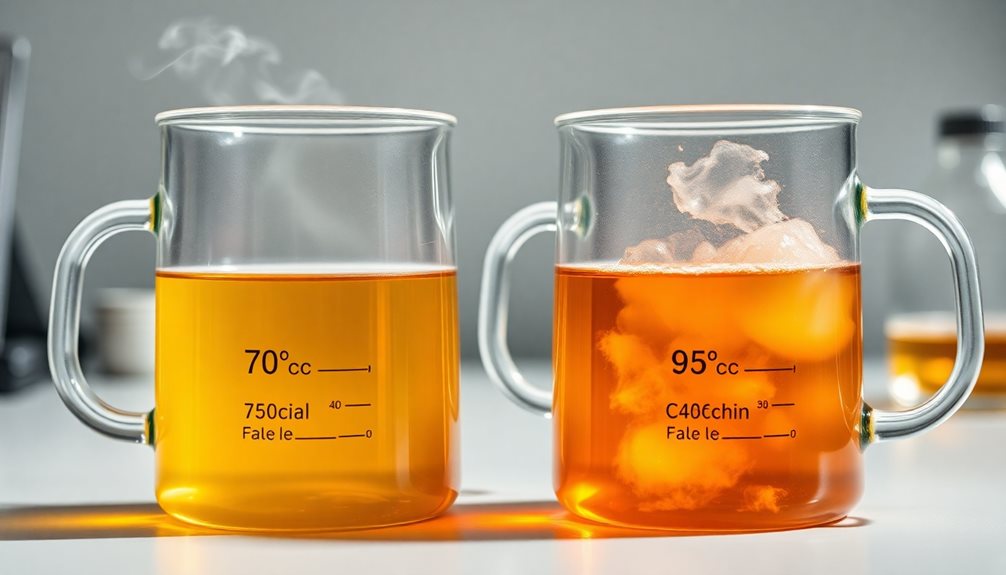
To balance high-yield catechin extraction with preservation of their sensitive structures, consider optimizing methods like hot water extraction (HWE), which delivers top efficiency at 80°C for 20 minutes using a 1:50 sample-to-solvent ratio. This method outperforms alternatives (e.g., UAE at 24.16%, EthE at 22.59%) due to its superior total catechin and antioxidant yields. This approach aligns with the study’s emphasis on leveraging green tea waste (GTW) as a sustainable resource for bioactive compounds, addressing food industry waste management challenges.
Avoid exceeding 80°C to prevent degradation of heat-sensitive compounds. Pair HWE with a chitosan/ascorbic acid solvent mix, harnessing chitosan’s adsorption and ascorbic acid’s antioxidative power to stabilize extracts.
Post-extraction, freeze-dry at 1 mbar for 72 hours to remove moisture without compromising integrity. Store samples at −20°C overnight to block enzymatic reactions.
How Heat Influences Taste and Aroma
When you apply heat during catechin processing, you’re not just influencing their chemical stability—you’re reshaping the sensory profile of teas and plant-based extracts. Controlling heat means commanding the balance between bitterness, astringency, and aroma complexity.
At lower temps, subtle catechin-derived notes like floral or fresh grass may persist; higher temps amplify earthy or roasted tones through thermal-induced polymerization. Yet, without data on volatile compound shifts during heating, precise predictions remain elusive.
Your ability to dictate heat duration and intensity directly impacts how these traits manifest. For instance, rapid high-heat treatments might lock in sharper, grassier notes, while slower, lower temps could mellow catechin interactions, enhancing sweetness.
Though studies on this subtopic are lacking, your hands-on control over thermal variables ensures tailored outcomes. Mastering heat isn’t just about chemistry—it’s about engineering the flavors and aromas your product demands.
Stay precise, stay proactive.
Key Compound Changes Between 60°C and 100°C
As you move past 44°C into the 60–100°C range, your tea infusions undergo a cascade of molecular shifts—epimerization peaks, caffeine extraction surges, and polyphenols reveal their true potential.
You’ll notice (–)-gallocatechin gallate converting to (–)-EGCG rapidly above 60°C, with rates spiking at 98°C. Caffeine extraction surges between 79.5°C and 94°C, amplifying bitterness and overriding astringency as concentrations cross 2 mmol/L.
Total catechins extracted outpace degradation during short-term brewing, but epimerization and degradation compete in all cases. Polyphenols—especially flavonol glycosides—multiply in concentration, boosting antioxidant activity and aroma as you hit 100°C, yet their variability alters flavor profiles.
You’re tightening control: every 10°C jump sharpens extraction efficiency but risks diminishing amino acids like L-theanine by 25%. Mastering this window means balancing epimerization dynamics with caffeine-driven bitterness before crossing into threshold chaos.
Taming Bitterness and Umami: The Sweet Spot for Your Tea Drink
Because higher temperatures amplify bitterness through rapid catechin and caffeine extraction, mastering the sweet spot for umami requires balancing heat with precision. You’ll achieve a rich, savory profile by brewing at 70°C (156°F), where L-theanine extraction peaks without bitter compounds dominating.
For high-grade Japanese greens like Gyokuro, 130–140°F (55–60°C) *releases* sweetness while minimizing caffeine’s sharp edge. Sencha thrives at 160–175°F (70–80°C), striking equilibrium between astringency and amino acid harmony. Using soft water soft water ensures optimal extraction of amino acids like theanine, enhancing the tea's natural sweetness and umami without introducing unwanted mineral flavors.
You control flavor intensity by adjusting temps: cold brew suppresses bitterness but mellows umami, while hot water risks overwhelming umami with astringency. Remember, each infusion shifts the balance—shorter steeps preserve umami; longer ones amplify bitterness.
With precise temperature control, you tailor your tea to highlight its inherent sweetness or guide its progression toward structured bitterness, ensuring every cup reflects your desired taste profile.
Why Bitterness Varies: The Role of Catechins and Heat
While temperature controls umami and bitterness balance, the chemical dance of catechins under heat reveals another layer: epimerization. When you heat tea leaves, catechins undergo structural shifts—specifically, epimerization—which alters their molecular form.
Though the direct sensory impact isn’t fully detailed in current data, these changes likely influence bitterness perception by modifying how catechins interact with taste receptors. Higher temps accelerate this process, potentially increasing the production of less bitter, epimerized forms versus their sharper, unmodified counterparts.
For controlled bitterness, you’re fundamentally balancing reaction speed and structural transformation: too much heat risks pushing catechins toward harsher profiles, while milder temps preserve subtler compounds. By adjusting heat exposure, you harness the underlying chemistry to shape the bitterness-umami equilibrium, even if the precise thresholds remain unquantified.
This gives you actionable insight to refine your brew.
Mastering Temperature for Premium Tea Flavor
Understanding the role of water temperature in tea extraction is the first step toward revealing premium flavor. Too hot, and you’ll over-extract tannins, creating a bitter, astringent brew. Too cold, and you’ll miss the tea’s depth, flattening its character.
Precision is your tool: black teas crave 95–100°C for bold richness; green teas demand 70–80°C to preserve delicate sweetness, preserving antioxidant catechins (which are vulnerable to breakdown at higher temps). White tea, fragile at 65–75°C, rewards gentle attention.
Use visual cues—shrimp eyes at 60°C (140°F) for delicate Japanese greens, streaming pearls at 90°C (194°F) for toasty oolongs. Lower temps boost umami (L-theanine) while preserving volatile oils; higher temps amplify bold aromas and polyphenols.
Under 5 minutes? Crab eyes (165–175°F) suit subtle vegetal notes. Beyond that? Fish eyes (175–185°F) for heartier leaves.
Brewing to Nourish: How Heat Enhances Tea's Health Benefits
By balancing heat with precision, you can transform tea from a simple drink into a vehicle for wellness. You maximize antioxidant extraction by hitting 80–100°C, where studies show white and green teas pull out the most EGCG and polyphenols. Don’t overdo it—boiling water (100°C) breaks down EGCG, cutting its potency.
For green tea, 85°C for 3–5 minutes strikes the sweet spot, preserving compounds while boosting bioavailability.
Control your time too. Steep 5–10 minutes: antioxidants hit a peak quickly, then plateau. White tea’s antioxidants rely more on time than temperature, while black tea needs short, hot infusions. Cold brewing (as low as 4°C) can yield higher antioxidant levels antioxidant levels while significantly reducing caffeine content, making it ideal for low-stimulant tea enjoyment.
Even cold steeping (2 hours) can rival hot methods, but heat accelerates compound transfer into your cup.
Adjust for your brew: Kenaf tea thrives at 80°C, green tea at 85°C. Avoid 75°C—its low heat underdelivers on polyphenols.
Frequently Asked Questions
Why Does 98°C Become the Dominant Temperature for Epimerization?
98°C isn’t the dominant temperature for epimerization; you’ll find higher rates above 85°C, where catechins degrade faster. Ideal extraction and quality peak at 85°C, balancing extraction speed with minimal breakdown—use lower temps to preserve EGCG and flavor.
How Does Caffeine Concentration Influence Bitterness Perception at Different Temps?
Hotter brews crank up bitterness by extracting more caffeine, activating TAS2R receptors. You’ll taste less at lower temps, but tweak it with additives, steep time, or leaf quantity. Master the heat—your cup’s yours to command!
What Drives Greener/Sweeter Aromas at 95°C Brewing Versus Lower Temperatures?
You get greener/sweeter aromas at 95°C because higher temps release volatile compounds faster, balancing preservation and breakdown to amplify tea’s fresh scent, while lower temps slow extraction, reducing aromatic intensity.
Why Is 44°C a Critical Point for Catechin Stability Over Degradation?
44°C is your tea’s stability switch: below it, catechins stay intact; above, they unravel. Lock in flavor and nutrients by mastering this cutoff—your brew’s fate hinges on it.
How Does L-Theanine Reduction Impact Umami When Brewing at Higher Temps?
High temps slash l-theanine by 25.20%, dimming umami’s sweet, mellow punch. You lose that calming edge—and flavor balance. Brew at 70–80°C to lock in umami without bitter over-extraction.